
Bitcoin's Institutional Adoption and Market Readiness: A Bullish Case for Strategic Entry Ahead of September 20, 2025
The Accumulation Narrative: Exchange Outflows as a Leading Indicator
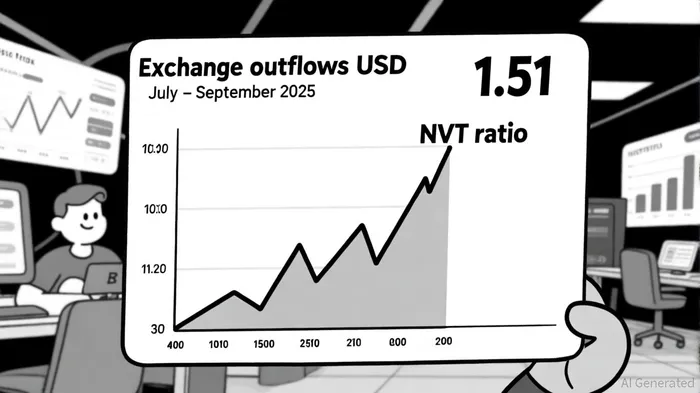
Bitcoin's on-chain activity in Q3 2025 has painted a compelling picture of institutional accumulation. According to a report by The Currency Analytics, exchange outflows surged by 347% on September 20, 2025, driven by large holders—commonly referred to as “whales”—moving BitcoinBTC-- off exchanges into long-term storage[1]. This behavior is historically associated with bullish sentiment, as it reduces liquidity on exchanges and signals a preference for holding rather than selling.
The surge in outflows aligns with broader institutional trends. For instance, U.S. spot Bitcoin ETFs recorded a net inflow of $23 million on September 9, with BlackRock's IBIT leading the charge with $169.3 million[5]. However, this inflow reversed briefly on September 18 due to the Federal Reserve's hawkish outlook, which triggered a $51.28 million outflow[4]. Despite these fluctuations, the underlying trend remains intact: institutions are accumulating Bitcoin, as evidenced by the record-high Gini coefficient of 0.4677, indicating growing wealth concentration among large holders[4].
NVT Resilience: A Validation of Network Valuation
Bitcoin's Network Value to Transactions (NVT) ratio has emerged as a critical metric for assessing valuation resilience. As of September 19, 2025, the NVT ratio stands at 1.51, a level often referred to as a “golden cross” in on-chain analysis[2]. This suggests that Bitcoin's market capitalization is supported by robust transaction activity rather than speculative fervor.
Data from XT.com highlights that the NVT ratio's current level is comparable to the 2017 bull cycle, when the metric signaled a maturing network with strong institutional backing[2]. Additionally, the MVRV Z-Score—a measure of realized versus market value—reinforces this narrative, indicating significant upside potential as more addresses trade at a profit[5]. These metrics collectively suggest that Bitcoin's valuation is underpinned by fundamentals, not just market sentiment.
Institutional Adoption: A Structural Shift
The institutional adoption of Bitcoin has accelerated in Q3 2025, driven by both regulatory clarity and macroeconomic tailwinds. The U.S. Securities and Exchange Commission's (SEC) approval of streamlined listing standards for crypto ETPs on September 17 has further lowered barriers for institutional entry[3]. This regulatory development, coupled with corporate treasury purchases and record inflows into spot ETFs earlier in the quarter, underscores a structural shift toward Bitcoin as a strategic asset class[3].
Moreover, on-chain data reveals that the number of large wallets holding 10,000+ BTC has reached record levels[4]. This concentration of holdings among institutions—rather than retail investors—signals a long-term investment thesis, as large players prioritize security and capital preservation over short-term trading.
Strategic Entry and Risk Mitigation
While the bullish case is strong, investors must remain cognizantCTSH-- of macroeconomic risks. The Fed's hawkish stance and geopolitical tensions could trigger short-term volatility, as seen in the September 18 ETF outflow[4]. However, the derivatives market's elevated open interest—over $220 billion in crypto futures—suggests that leveraged positions may amplify price swings, creating opportunities for strategic entry[4].
For investors, the confluence of exchange outflows, NVT resilience, and institutional adoption metrics presents a compelling case to position for a potential rally on September 20, 2025. Historical patterns indicate that September can be a weak period for Bitcoin, but October often sees a resurgence in bullish momentum[5]. Given the current on-chain fundamentals, a strategic entry ahead of this date could capitalize on reduced liquidity and institutional buying pressure.
Conclusion
Bitcoin's Q3 2025 performance has been defined by a unique alignment of on-chain strength and institutional demand. Exchange outflows, NVT resilience, and regulatory tailwinds collectively reinforce a narrative of accumulation and long-term value creation. While macroeconomic headwinds persist, the underlying fundamentals suggest that Bitcoin is entering a phase where on-chain metrics and institutional adoption will drive price action. For investors, the period leading up to September 20, 2025, offers a critical window to assess risk-reward dynamics and position for a potential breakout.





Comentarios
Aún no hay comentarios