
Bitcoin's Institutional Adoption and Investment Implications: Strategic Allocation in a Macroeconomic Tightening Environment
Bitcoin's journey from a niche digital experiment to a mainstream institutional asset has been nothing short of revolutionary. Over the past few years, the asset has transitioned from speculative curiosity to a strategic allocation tool for institutional investors. This shift is particularly pronounced in a macroeconomic environment marked by tightening monetary policy and a strengthening U.S. dollar. As central banks grapple with inflationary pressures and liquidity constraints, Bitcoin's unique properties-scarcity, decentralization, and low correlation to traditional assets-are reshaping how institutions approach portfolio construction.
Macroeconomic Headwinds and Bitcoin's Resilience
The Federal Reserve's tightening cycles, which began in earnest in 2022, have historically posed challenges for risk assets. BitcoinBTC--, however, has shown surprising resilience. During the 2022 tightening cycle, its price declined, but the asset's structural demand from institutions has since offset macroeconomic headwinds. For instance, the launch of U.S.-listed spot Bitcoin ETFs in 2025-backed by major players like BlackRockBLK--, Fidelity, and Ark-created a "buy-side imbalance," with ETF inflows absorbing 5–12 times more Bitcoin daily than the network's production. This demand has persisted despite macroeconomic uncertainties, including a strong U.S. dollar, which typically suppresses risk-on sentiment.
The U.S. Dollar Index (DXY), a measure of the dollar's strength against major currencies, has remained elevated in 2025–2026. Bitcoin's negative correlation with the DXY (a feature observed in recent models) has made it an attractive hedge against dollar debasement. As global liquidity tightens, Bitcoin's role as a non-sovereign store of value becomes increasingly compelling.
ETF Inflows and the Institutionalization of Bitcoin
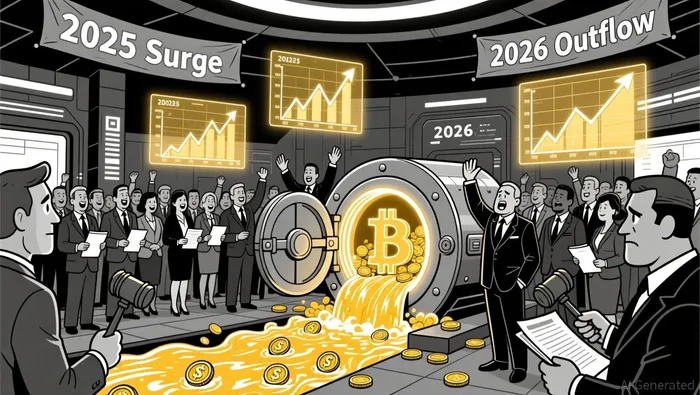
The 2023–2025 period saw a seismic shift in Bitcoin's institutional adoption. U.S.-listed ETFs, including Bitcoin-specific products, attracted over $1.3 trillion in inflows in 2025 alone, with the fourth quarter of 2025 setting records. This surge was driven by regulatory clarity (e.g., the approval of spot Bitcoin ETFs) and the entry of institutional-grade custodians. However, early 2026 saw a brief reversal, with $1.1 billion in outflows. JPMorgan analysts have noted "signs of stabilization" in these flows, suggesting that the worst may be over.
The institutionalization of Bitcoin is not just about ETFs. Institutional investors are increasingly viewing the asset as a strategic reserve, akin to a hybrid of digital gold and T-bills. This shift is supported by Bitcoin's market dominance (nearly 65% of the global crypto market) and its growing acceptance in capital market assumptions (CMAs). For example, long-term allocators now project a 15% base-case compound annual growth rate (CAGR) for Bitcoin over the next 25 years.
The rationale for these allocations hinges on Bitcoin's dual role as a hedge against monetary debasement and a diversifier in risk-adjusted portfolios. During tightening cycles, Bitcoin's price sensitivity to liquidity conditions-particularly broad money supply-becomes a double-edged sword. While liquidity contractions can amplify volatility, the maturation of Bitcoin's market structure is expected to compress volatility over time, improving its Sharpe ratio.
Macroeconomic Tailwinds and Long-Term Scarcity
Looking ahead, Bitcoin's supply dynamics and macroeconomic tailwinds position it for further institutional adoption. The 2024 halving event reduced Bitcoin's issuance by 50%, and the next halving (expected in 2028) will further constrain supply. This scarcity, combined with institutional demand, is likely to drive Bitcoin's price higher, particularly if the Fed enters an easing cycle between 2025 and 2027.
Moreover, Bitcoin's potential as a settlement currency for global trade and a reserve asset for central banks adds to its long-term appeal. Projections suggest Bitcoin could reach $2.9 million by 2050 under a base-case CAGR of 15%, though such outcomes depend on continued regulatory support and macroeconomic conditions.
Conclusion: A New Paradigm for Institutional Portfolios
Bitcoin's institutional adoption is no longer a question of "if" but "how." In a macroeconomic environment defined by tightening cycles and dollar strength, Bitcoin offers a unique combination of scarcity, decentralization, and diversification. While volatility remains a challenge, the asset's structural demand and evolving market infrastructure are reshaping its role in institutional portfolios. For investors willing to navigate the complexities of this new paradigm, Bitcoin represents a compelling strategic allocation-one that could redefine the future of asset management.







Comentarios
Aún no hay comentarios