
Bitcoin's Institutional Adoption Gains Momentum: Analyzing BlackRock's ETF Inflows and Structural Demand
BlackRock's ETF Dominance and Bitcoin's Institutional Takeoff
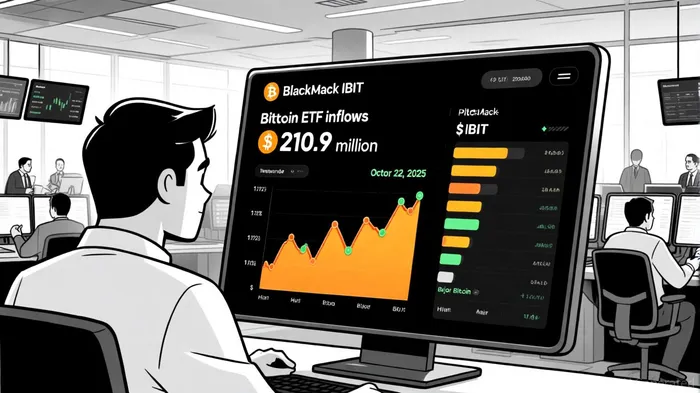
BlackRock's IBIT has not only attracted record inflows but also redefined institutional participation in Bitcoin. According to blockchain.news data, on October 22 the fund added 1,884 BTC ($203.83 million) to its holdings, pushing its total Bitcoin stash to over 800,000 BTC-valued at $86.91 billion. This surge is part of a larger pattern: Q3 2025 saw $17 billion in net inflows into BlackRock's digital asset ETFs, with year-to-date inflows hitting $34 billion, as Coinotag reported. These figures reflect a strategic shift by institutional investors, who are leveraging ETFs to gain exposure to Bitcoin while benefiting from custodial security and regulatory compliance.
The iShares platform's broader success-$205 billion in Q3 inflows-further highlights the appeal of structured products in a market where liquidity and transparency are paramount. For Bitcoin, this means a transition from niche speculation to a mainstream asset class, with ETFs acting as the bridge.
Structural Demand: Macroeconomic Tailwinds and Institutional Shifts
Beyond ETF inflows, Bitcoin's structural demand is being driven by macroeconomic factors. A weakening U.S. dollar and declining bond yields have positioned Bitcoin as a hedge against inflation and monetary policy uncertainty, CoinCentral reported. The asset's inverse correlation with the U.S. Dollar Index (DXY) and Treasury yields suggests that as traditional safe-haven assets lose luster, Bitcoin gains traction.
Institutional adoption is also accelerating beyond ETFs. Large Bitcoin holders-often termed "whales"-are increasingly converting self-custodied Bitcoin into ETF shares, particularly through platforms like IBIT. This trend, facilitated by the SEC's in-kind creation and redemption rules, has enabled $3 billion in conversions, FXStreet reported. By integrating Bitcoin into traditional wealth management frameworks, these investors gain access to custodial services, tax efficiency, and portfolio diversification benefits.
Meanwhile, EthereumETH-- ETFs face outflows, totaling $243.9 million in recent weeks, as institutional capital gravitates toward Bitcoin's perceived stability, Coinotag reported. This divergence underscores Bitcoin's role as a digital equivalent of gold, particularly in an environment of macroeconomic volatility.
Long-Term Value: A New Market Cycle?
The confluence of regulatory clarity, macroeconomic tailwinds, and institutional adoption is creating a foundation for Bitcoin's long-term value. With BlackRock's ETFs now holding $89.17 billion in assets-nearly 60% of the total Bitcoin ETF market-Bitcoin is no longer a speculative bet but a strategic allocation, according to recent reporting.
Moreover, falling bond yields and potential Federal Reserve rate cuts are likely to drive further liquidity into risk assets, with Bitcoin poised to benefit. The Andreessen Horowitz 2025 report reinforces this view, noting that Bitcoin's dominance over 50% of the cryptocurrency market reflects its maturation as a store of value (as noted above).
Conclusion
Bitcoin's institutional adoption is no longer a question of if but how fast. BlackRock's ETF inflows, supported by macroeconomic trends and regulatory progress, are accelerating this transition. For investors, the implications are clear: Bitcoin is evolving into a core asset class, with structural demand poised to outlast short-term volatility. As the lines between traditional finance and digital assets blurBLUR--, the next chapter of Bitcoin's story will be defined by its integration into institutional portfolios-and the long-term value it unlocks.





Comentarios
Aún no hay comentarios