
Bitcoin's Institutional Adoption: How Derivatives Markets Are Paving the Path to a $10 Trillion Market Cap
The BitcoinBTC-- derivatives market has emerged as a linchpin in the cryptocurrency's institutional ascent, transforming speculative fervor into systemic infrastructure. By 2025, the global crypto derivatives market had ballooned to over $28 trillion in annualized volume, with Bitcoin and EthereumETH-- derivatives accounting for 68% of all activity, according to a CoinLaw report. This surge is not merely speculative—it reflects a maturing ecosystem where institutional players are leveraging options and futures to hedge, arbitrage, and scale exposure, accelerating Bitcoin's trajectory toward a $10 trillion market cap.
The Derivatives Engine: Open Interest and Institutional Leverage
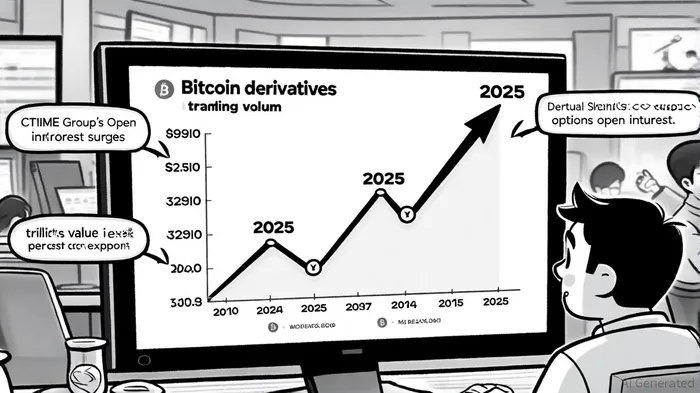
Open interest—a metric of the total number of outstanding derivative contracts—has become a barometer of institutional confidence. By mid-2025, Bitcoin futures open interest on the CME GroupCME-- alone reached $2.6 billion, according to a CME Group report, a 62% increase from $1.6 billion in November 2023, as reported in a Bloomberg article. Meanwhile, unregulated exchanges like Binance and OKX captured 36% of the derivatives market share, the CoinLaw report found, driven by their deep liquidity pools and diverse product suites. This bifurcation—regulated platforms for institutional compliance and unregulated venues for speculative liquidity—has created a robust infrastructure for large-scale capital flows.
Perpetual futures, which allow indefinite holding of leveraged positions, have become particularly emblematic of this shift. In late 2023, bullish perpetual futures bets surged to levels last seen during Bitcoin's 2021 rally, as the Bloomberg article noted, signaling renewed institutional optimism. By August 2024, aggressive shorting pushed the seven-day average annualized funding rate for Bitcoin perpetuals to -2.5%, according to a Bloomberg report, a red flag for potential short squeezes and a testament to the market's self-correcting mechanisms.
Options as a Gateway to Institutional Sophistication
Options trading has further deepened Bitcoin's institutional appeal. Deribit, the largest Bitcoin options platform, reported a record $14.9 billion in open interest in late 2023, according to the Bloomberg article, a figure that underscores the growing demand for risk management tools. Unlike futures, which are linear instruments, options allow institutions to construct complex hedging strategies, volatility arbitrage, and directional bets with defined risk profiles. This sophistication has attracted asset managers, pension funds, and even traditional hedge funds, many of whom now allocate 10–15% of their portfolios to crypto derivatives, the CoinLaw report found.
The $10 Trillion Thesis: Derivatives as a Catalyst
Bitcoin's derivatives market is not just a side show—it is a catalyst for its broader valuation. Institutional participation in derivatives now accounts for 42% of total trading volume, a figure the CoinLaw report says dwarfs retail activity and signals a shift toward capital-efficient, leveraged positioning. This dynamic is amplified by the compounding effects of leverage: for every $1 of spot Bitcoin traded, derivatives platforms facilitate $10–$15 in notional value, the CoinLaw analysis shows.
Moreover, the derivatives market acts as a flywheel for Bitcoin's adoption. As institutions deploy capital through futures and options, they demand clearer regulatory frameworks, custodial solutions, and risk analytics—pressures that drive mainstream acceptance. The potential approval of a U.S. spot Bitcoin ETF, for instance, is not just a regulatory milestone but a derivatives-driven inevitability. By 2025, the derivatives market's size and liquidity have made a spot ETF technically and politically feasible, according to a Bloomberg Professional insight, creating a self-fulfilling prophecy for Bitcoin's institutionalization.
Risks and Realities
Critics argue that derivatives markets are inherently speculative and prone to cascading liquidations. However, the 2024–2025 period demonstrated resilience: despite a -2.5% funding rate signaling aggressive shorting, Bitcoin's price remained range-bound, suggesting that institutional capital was using derivatives to stabilize volatility rather than exacerbate it—the Bloomberg report observed. This maturation of market structure—where large players act as stabilizers rather than destabilizers—reinforces the argument that derivatives are a net positive for Bitcoin's long-term trajectory.
Conclusion
Bitcoin's derivatives market is no longer a niche corner of the crypto ecosystem—it is the engine of its institutional adoption. With $28 trillion in annualized volume, 42% institutional participation, and a growing suite of risk management tools, the derivatives market is not just tracking Bitcoin's price but actively shaping its future. As this infrastructure continues to scale, the path to a $10 trillion market cap becomes not a question of if, but when.







Comentarios
Aún no hay comentarios