
Bitcoin's Inevitable Dip Below $100k: A Last Major Entry Point?
Macroeconomic Catalysts: From Rate Cuts to Geopolitical Tensions
The U.S. Federal Reserve's 25 basis point rate cut in September 2025 marked a turning point for Bitcoin's appeal as a non-yielding asset. While traditional fixed-income markets adjusted to lower yields, Bitcoin's lack of cash flow became less of a liability in an environment where inflation remained stubbornly above 3% and economic growth slowed. This policy shift, coupled with unresolved geopolitical tensions-particularly in the Middle East and U.S.-China trade relations-catalyzed a flight to safe-haven assets. Bitcoin's 8% rally in Q3 2025 underscored its growing role as a hedge against macroeconomic uncertainty.
However, the same forces that initially buoyed BitcoinBTC-- have since contributed to its recent selloff. Institutional outflows from spot Bitcoin ETFs, such as BlackRock's IBIT, totaled $3 billion in the month leading up to November 15, 2025, as investors recalibrated portfolios amid rising volatility. Harvard University's decision to triple its IBIT holdings-despite the ETF's 24% price decline-highlights the tension between strategic allocation and short-term market noise.
Technical Breakdowns and Sentiment Shifts
Bitcoin's Q4 2025 performance has been defined by a bearish technical narrative. The cryptocurrency recorded a 15.13% net loss for the quarter, with November alone accounting for 74% of this decline. Four consecutive lower lows since the $126k peak, coupled with a failure to hold key support levels, have eroded confidence. On-chain data from Glassnode reveals that nearly 99% of short-term holders are in unrealized losses, with 592k BTC at risk of forced selling.
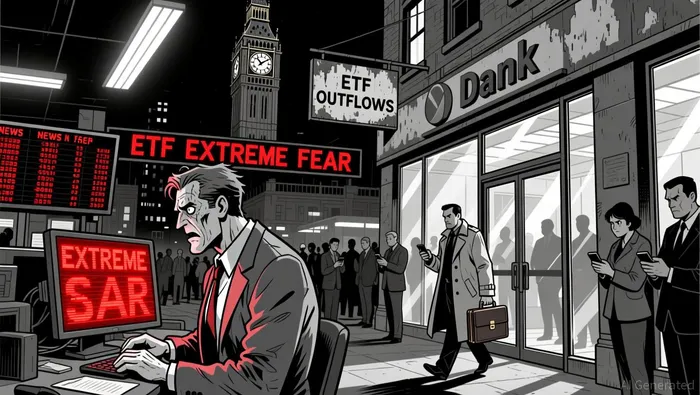
Market sentiment has deteriorated sharply. The Fear & Greed Index entered "extreme fear" territory for the first time in seven months, while implied volatility surged to 50% for Bitcoin and over 70% for EthereumETH--. These metrics suggest a market in distress, yet they also hint at potential contrarian opportunities. Historically, extreme fear has preceded rebounds in asset classes where fundamentals remain intact-a dynamic that could apply here if macroeconomic catalysts align.
Strategic Entry Points: Balancing Risk and Reward
For investors considering entry below $100k, the focus must shift to macroeconomic catalysts that could reignite demand. The Fed's dovish pivot, while already priced into Bitcoin, may gain momentum if inflation proves more persistent than anticipated. Additionally, geopolitical instability could drive further capital into Bitcoin as a decentralized alternative to traditional safe-haven assets like gold.
Institutional adoption remains a wildcard. Despite recent ETF outflows, entities like JPMorgan and MicroStrategy have continued to accumulate Bitcoin, with the latter holding $70 billion in BTC. These moves signal a transition from speculative exposure to strategic allocation-a trend that could stabilize Bitcoin's price floor in the long term.
Conclusion: A Calculated Bet on Resilience
Bitcoin's dip below $100k is notNOT-- merely a technical milestone but a reflection of broader macroeconomic forces. While the immediate outlook remains bearish, the interplay of central bank policy, geopolitical risk, and institutional adoption creates a compelling case for strategic entry. Investors who can weather short-term volatility may find themselves positioned to capitalize on a potential rebound-provided they align their strategies with the evolving macroeconomic landscape.





Comentarios
Aún no hay comentarios