
Bitcoin's Inevitable Dip Below $100,000: A Strategic Buying Opportunity for Long-Term Investors
Market Correction Dynamics: Liquidity Resets and ETF Flows
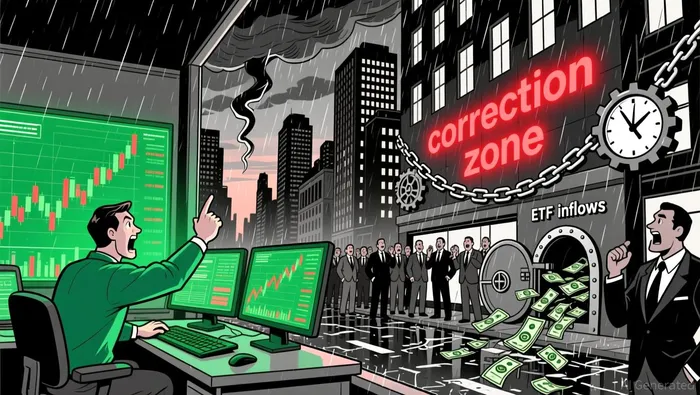
The recent decline has been driven by a combination of derivative market resets and shifting ETF flows. In October 2025, a $19 billion liquidation event occurred as funding rates and basis rates compressed, triggering forced hedging and liquidity adjustments. This dynamic, common in leveraged markets, temporarily amplified downward pressure. Meanwhile, BitcoinBTC-- ETFs have swung between inflows and outflows, with CoinShares reporting $5 billion in inflows in late October followed by $1 billion in outflows by early November. These swings highlight the sensitivity of spot prices to institutional hedging activity, particularly as dealers adjust collateral requirements to manage risk.
Critically, the market is now closely monitoring three key indicators: annualized futures basis, perpetual funding rates, and collateral adjustments. These metrics provide early signals of whether the correction is stabilizing or deepening. For now, the absence of large-scale institutional outflows suggests the dip is more cyclical than catastrophic.
Historical Context: A Minor Correction in a Larger Uptrend
Bitcoin's current decline pales in comparison to past "crypto winters." The 2018 and 2022 bear markets saw price drops of over 80%, eroding retail confidence and triggering prolonged downturns. However, the 2025 correction-though sharp-has been tempered by institutional participation. The launch of U.S. spot ETFs has injected long-term capital into the market, smoothing out volatility and reinforcing Bitcoin's structural uptrend.
Moreover, the recovery has been swift: Bitcoin rebounded from $101,000 to $106,000 within weeks, a pattern inconsistent with the protracted declines of previous bear markets. Analysts argue that the current correction reflects liquidity normalization rather than a loss of conviction. This distinction is critical for long-term investors: the market is recalibrating, not collapsing.
Macroeconomic Catalysts: Fed Policy and AI Infrastructure
The broader macroeconomic backdrop remains favorable. The U.S. Federal Reserve's 25-basis-point rate cut in September 2025 has made non-yielding assets like Bitcoin more attractive, particularly as traditional safe-haven investments (e.g., gold) surged 15.7% in Q3. Meanwhile, geopolitical tensions in the Middle East and U.S.-China trade dynamics have reinforced Bitcoin's role as a digital safe-haven asset.
A second catalyst is the convergence of Bitcoin mining and AI infrastructure. As demand for compute power outpaces supply, miners with existing infrastructure are repurposing facilities into AI data centers. For example, Core Scientific secured a $3.5B contract to provide high-performance computing (HPC) infrastructure. This transition not only diversifies miners' revenue streams but also aligns them with the AI boom, a sector expected to drive long-term economic growth.
Institutional strategies are increasingly structured around these macroeconomic linkages. Platforms like RockToken offer infrastructure-backed investment packages, providing stable exposure to Bitcoin while leveraging yield-generating opportunities. For long-term investors, this represents a dual benefit: capital appreciation from Bitcoin's price action and income from AI-related infrastructure.
Strategic Buying Opportunity: Positioning for the Long Term
For investors with a multi-year horizon, the current dip offers a disciplined entry point. Historical data shows that Bitcoin's recoveries are often rapid, particularly when supported by institutional capital and favorable macroeconomic conditions. The Fed's dovish pivot, combined with AI-driven infrastructure growth, creates a tailwind for both Bitcoin's price and the broader digital asset ecosystem.
However, timing is key. Investors should focus on dollar-cost averaging into positions rather than attempting to time the bottom. This approach mitigates short-term volatility while aligning with Bitcoin's long-term trajectory. Additionally, structured products like the SPDR® Galaxy Transformative Tech Accelerators ETF (TEKX) offer exposure to the AI-infrastructure nexus, diversifying risk while capturing macroeconomic tailwinds.
Conclusion
Bitcoin's dip below $100,000 is not a bear market-it is a correction within a larger uptrend. For long-term investors, the current environment presents a strategic opportunity to acquire Bitcoin at a discount, supported by macroeconomic catalysts and institutional resilience. As the market stabilizes and AI infrastructure gains momentumMMT--, those who act now may find themselves well-positioned for the next phase of Bitcoin's journey.





Comentarios
Aún no hay comentarios