
Bitcoin's Imminent Sub-$100K Slide: Navigating Fear, Market Signals, and Strategic Positioning
The Technical Case for a Breakdown
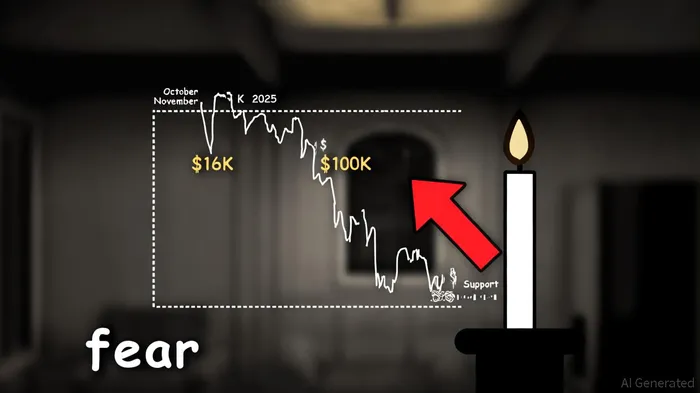
Bitcoin's price action in November 2025 has been defined by consolidation between the 100-day and 200-day moving averages. The $108K–$109K range has acted as a resilient support level, with institutional buyers stepping in to absorb dips, according to a CryptoPotato analysis. Conversely, the $114K–$116K zone has proven to be a distribution area, capping upward momentum. A daily close below $108K would expose the $102K–$104K institutional demand zone, a level that could trigger a cascade of stop-loss orders and further downward pressure, the analysis also notes.
On the 4-hour chart, the asset's range-bound behavior suggests a low-volatility phase, often a precursor to a sharp move. Retail investor activity has declined sharply, with active BTCBTC-- addresses dropping 26.1% year-over-year, according to a TradingView roundup. This retreat has reduced liquidity, making the market more susceptible to sudden shocks.
Institutional Sentiment and Macroeconomic Headwinds
Institutional demand has weakened, with BitcoinBTC-- ETFs experiencing seven-month lows in net inflows. The BlackRock iShares Bitcoin Trust (IBIT) alone contributed over $500 million in outflows, a trend reminiscent of the early April 2025 dip to $75,000, as the TradingView piece observes. Meanwhile, Standard Chartered's Geoff Kendrick warned in mid-October that Bitcoin could briefly dip below $100,000 due to U.S.-China trade tensions and President Trump's 100% tariff threats, as reported by Standard Chartered.
The macroeconomic landscape is mixed. While a Fed rate cut and improved U.S.-China trade alignment have eased some pressures, the broader market remains fragile. Prediction markets on Polymarket assign only a 33% chance of Bitcoin finishing November above $120,000, the TradingView piece notes. The Crypto Fear & Greed Index, currently in "fear" territory, and a Network Value to Sales (NVM) Ratio of 2.97 suggest Bitcoin is overvalued relative to its network fundamentals, the same report adds.
Risk Management in a Volatile Environment
For investors, the key is to balance caution with contrarian conviction. Here's how to position for both scenarios:
- Position Sizing: Allocate only a fraction of capital to Bitcoin, given the high volatility. Use trailing stop-loss orders to lock in gains if the price breaks above $116K or below $108K.
- Hedging: Consider short-term options or inverse ETFs to hedge against a potential $100K-level correction.
- Diversification: Pair Bitcoin exposure with macro-hedged assets like gold or U.S. Treasury bonds to mitigate systemic risks.
Contrarian Opportunities in the Shadows of Fear
A sub-$100K Bitcoin isn't the end-it's a test of market maturity. On-chain data reveals a paradox: while retail investors have retreated, Bitcoin's realized capitalization has surged past $1.1 trillion, and its realized price has climbed above $110,000, according to a CryptoIntelligence report. This suggests that long-term holders are accumulating at lower prices, a pattern often preceding bull cycles.
Institutional demand could rebound if the Fed's rate-cut cycle continues or if ETF inflows resume. Bitfinex analysts argue that a recovery to $140,000 is plausible if macroeconomic conditions align, the CryptoIntelligence piece adds. For contrarians, a dip to $102K–$104K could offer a high-conviction entry point, provided it's accompanied by a surge in on-chain activity and ETF inflows.
Conclusion
Bitcoin's imminent slide below $100K is not a death knell but a recalibration. The market is navigating a complex interplay of technical exhaustion, institutional caution, and macroeconomic uncertainty. For risk-aware investors, this volatility is a canvas for strategic positioning. The key lies in distinguishing between panic and opportunity-a skill that separates the resilient from the reactive.






Comentarios
Aún no hay comentarios