
Bitcoin Hypergrowth and Institutional-Grade Presale Opportunities: Navigating the 2025 Crypto Cycle
The 2025 BitcoinBTC-- cycle has emerged as a defining moment in the evolution of digital assets, driven by unprecedented institutional adoption and a maturing regulatory landscape. As traditional finance giants, sovereign wealth funds, and corporate treasuries increasingly allocate to Bitcoin, the cryptocurrency's role as a store of value and inflation hedge has been cemented. This institutional-grade positioning is notNOT-- only fueling hypergrowth in Bitcoin's price but also reshaping the dynamics of presale opportunities in the crypto ecosystem.
Institutional Adoption: The Catalyst for Hypergrowth
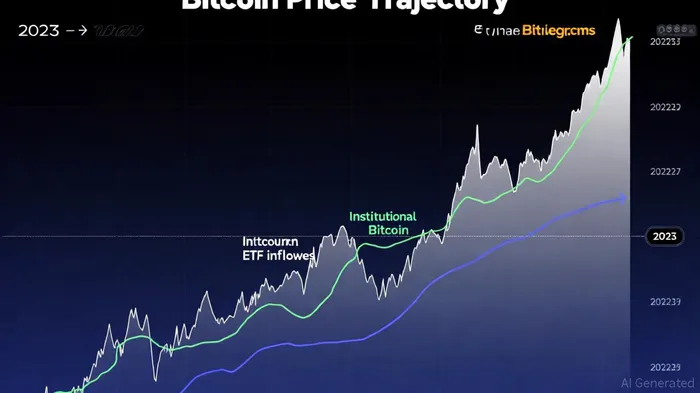
The surge in institutional investment has been most evident in the explosive growth of U.S. spot Bitcoin ETFs. By Q1 2025, BlackRock's iShares Bitcoin Trust (IBIT) alone attracted over $18 billion in assets under management, reflecting a broader trend of institutional capital seeking regulated, familiar vehicles to access Bitcoin Pinnacle Digest analysis and a Coinbase institutional survey. These ETFs have simplified compliance, tax treatment, and custody, enabling institutions to treat Bitcoin as a traditional asset, as the CoinbaseCOIN-- institutional survey found. By Q3 2025, record inflows into these ETFs pushed Bitcoin's price above $126,000, with major firms like JPMorganJPM-- and Standard Chartered projecting a target of $180,000–$200,000 by year-end, according to a CCN report.
Corporate adoption has further accelerated this trend. Companies like MicroStrategy and Tesla have allocated Bitcoin as a strategic reserve, with MicroStrategy's holdings surpassing 600,000 BTC by 2025, according to a Business Initiative report. Notably, small and medium businesses (SMBs) have also entered the fray, with 75% of business clients (many with fewer than 50 employees) adopting Bitcoin as part of disciplined dollar-cost averaging strategies, a trend highlighted by Pinnacle Digest. The River Business Report 2025 highlights that businesses now hold 6.2% of the total Bitcoin supply (1.30M BTC), with $12.5 billion in inflows over eight months, a finding Pinnacle Digest also reports.
Sovereign wealth funds (SWFs) and macroeconomic factors have added another layer of legitimacy. The establishment of the U.S. Strategic Bitcoin Reserve in March 2025 marked a watershed moment, signaling Bitcoin's acceptance as a non-correlated hedge against geopolitical instability and monetary inflation, per Business Initiative. Meanwhile, regulatory clarity-such as the Genius Act in the U.S. and MiCA in the EU-has further normalized institutional participation, as Pinnacle Digest notes.
Presale Opportunities: The Next Frontier for Institutional Capital
As Bitcoin's price stabilizes and volatility drops by up to 75% from historical levels, as reported by Pinnacle Digest, institutional investors are diversifying into presale projects that address scalability, interoperability, and real-world utility. These projects, often backed by institutional-grade security and infrastructure, are attracting both retail and institutional capital.
One standout example is Bitcoin Hyper (HYPER), a Layer 2 solution integrating Solana's virtual machine to enhance Bitcoin's scalability while preserving its security, as highlighted in the CoinNews presales guide. HYPER's presale has drawn significant interest, with over $373 million raised in early 2025 alone, according to CCN coverage. Similarly, MAGACOIN FINANCE leverages Ethereum's infrastructure to provide institutional-grade DeFi services, including secure lending and staking protocols, a use case discussed by Business Initiative. These projects exemplify the shift toward utility-driven innovation, a key driver of institutional confidence.
The appeal of presales lies in their alignment with macroeconomic trends. As interest rates stabilize and institutional allocations to digital assets rise (75% of institutions plan to increase exposure, per the Coinbase institutional survey), presales offer early access to projects with clear use cases and robust governance. For instance, BlockDAG, a blockchain project focused on high-throughput transactions, raised $373 million in 2025, underscoring investor appetite for solutions that address Bitcoin's scalability limitations, as reported by CCN.
Future Projections and Strategic Positioning
Analysts project Bitcoin to reach $200,000–$210,000 within 12–18 months, driven by ETF-driven inflows, corporate adoption, and regulatory normalization, a consensus echoed in Pinnacle Digest. However, the next phase of growth may hinge on institutional participation in presales and the integration of Bitcoin into retirement accounts and pension funds, a trend Pinnacle Digest also outlines. Harvard University's endowment, for example, added Bitcoin to its portfolio via the Harvard Management Company, signaling a broader acceptance of digital assets in institutional portfolios, according to CCN.
For investors, the key is to identify projects with strong institutional backing, real-world utility, and alignment with macroeconomic trends. Projects like HYPERHYPER-- and MAGACOIN FINANCE, which bridge Bitcoin's security with scalable infrastructure, are prime candidates. Meanwhile, regulatory developments-such as the U.S. Strategic Bitcoin Reserve's infrastructure investments-will likely continue to underpin long-term demand, as Business Initiative discusses.
Conclusion
The 2025 Bitcoin cycle is defined by institutional-grade positioning, where traditional finance's entry into crypto has transformed Bitcoin from a speculative asset into a core portfolio component. As presale projects gain traction, investors must prioritize those with clear utility, institutional-grade security, and alignment with macroeconomic tailwinds. The next chapter of Bitcoin's hypergrowth will not only be shaped by price action but also by the innovation and infrastructure built atop its foundational layer.





Comentarios
Aún no hay comentarios