
Bitcoin's Holder Dynamics and Institutional Inflows During a Bear Market: A Bottoming Process or Continued Capitulation?
Holder Dynamics: From OGs to ETFs and New Buyers
Bitcoin's holder distribution has undergone a significant reallocation since March 2024. OG long-term holders-those holding Bitcoin for over six months-have sold approximately 1.4 million BTC, valued at $121.17 billion at the time of analysis. This selling has been gradual, not panic-driven, and has coincided with a redistribution of supply to U.S. spot Bitcoin ETFs and Bitcoin treasuries. ETFs alone absorbed $78.05 billion of these sales, with assets under management surging from $42.77 billion to $120.82 billion between March 2024 and November 2025. Meanwhile, Bitcoin treasuries across 134 entities added 1.686 million BTC, worth $145 billion.
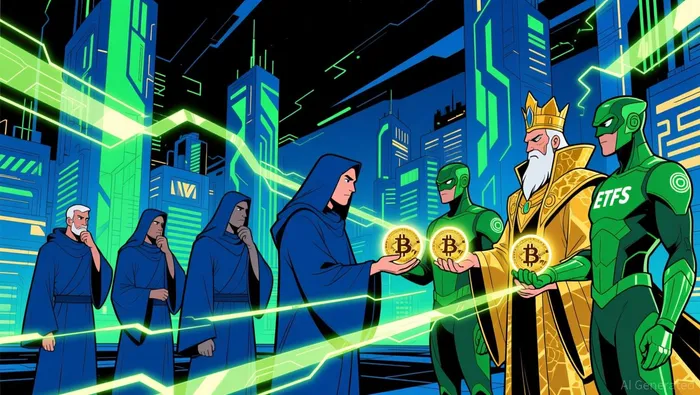 This shift reflects a maturing market structure. Short-term holders (STHs) are capitulating, with their SOPR (Spent Output Profit Ratio) near zero-a classic indicator of breakeven selling and exhaustion. In contrast, long-term holder SOPR remains modestly above one, suggesting measured profit-taking rather than panic. The redistribution of Bitcoin from OGs to institutional and retail buyers is decentralizing ownership and reducing reliance on early adopters, a positive sign for long-term resilience.
Institutional Inflows: A Structural Tailwind
Institutional demand remains a critical counterweight to retail and OG selling. U.S. spot Bitcoin ETFs have become a primary destination for redistributed supply, with inflows driven by financial advisors and institutions prioritizing Bitcoin's long-term returns. Despite a slowdown in weekly inflows, ETFs like the Fidelity Wise Origin Bitcoin Fund (FBTC) and Grayscale Bitcoin TrustGBTC-- (GBTC) continue to attract capital.
Bitcoin treasuries further underscore institutional confidence. The accumulation of 1.686 million BTC by 134 entities-despite a bearish price environment-highlights structural demand. This trend aligns with broader macroeconomic tailwinds, including global liquidity expansion and central bank easing, which are likely to support Bitcoin's institutional adoption.
On-Chain Indicators: Capitulation vs. Accumulation
On-chain metrics provide clarity on whether the current bear market is nearing a bottom. The MVRV (Market Value to Realized Value) ratio has dropped to 1.8, its lowest level since April 2025. Historically, values below 1 indicate undervaluation and often precede recovery phases. For example, Bitcoin's MVRV hit 3.7 in December 2017 before an 80% correction, but values below 1 have historically signaled bottoms. UTXO age distribution trends also support a bottoming narrative. Long-term UTXOs (over 8 years) have increased to 26.4 million, while short-term buckets (1–3 months) have declined by 38%. This suggests institutional and early adopters are holding for the long term, while retail participants are exiting. The NVT (Network Value to Transactions) ratio, a valuation tool akin to a P/E ratio, is also signaling undervaluation, with a low NVT suggesting the network is underpriced relative to its utility.
However, some caution is warranted. The Value Days Destroyed (VDD) Multiple is rising, and long-term holder supply is falling, indicating OGs are still distributing. A true capitulation phase would require a halt in LTH selling and stabilization above key moving averages like the 350-day. Until then, the market remains in a transitional phase.
Historical Context and Future Outlook
Bitcoin's bear markets are cyclical, with historical data showing an average 6% return over six months and 1% over a year after entering bear territory. The current bear market is the seventh in five years, but the shift toward institutional adoption and ETF-driven demand suggests a more mature market structure. For instance, Bitcoin's price surged 5.72x from its 2024 cycle low to November 2024, and if historical trends hold, it could reach ~$243,000 within a year.
The key differentiator in 2025 is the role of ETFs and treasuries in absorbing selling pressure. Unlike previous cycles, where retail panic often exacerbated declines, institutional buyers are now a stabilizing force. This structural shift, combined with on-chain metrics pointing to undervaluation, suggests the current bear market is nearing a bottom rather than entering a deeper capitulation phase.
Conclusion
The transfer of Bitcoin from OGs to ETFs and new buyers represents a bottoming process rather than continued capitulation. Institutional inflows, on-chain indicators like MVRV and UTXO age distribution, and historical patterns all point to a market recalibration. While short-term volatility persists, the structural demand from ETFs and treasuries, coupled with long-term holder accumulation, provides a strong foundation for a potential bull run. Investors should monitor key on-chain metrics and institutional activity for further confirmation, but the evidence suggests the worst of the bear market may already be behind us.







Comentarios
Aún no hay comentarios