
Bitcoin Holder Behavior and Market Conviction: A Case for the Next Bullish Breakout
The Rise of 18–24-Month Holders: A Signal of Conviction
On-chain data from platforms like CryptoQuant, including IXFI's Coin Info Center, highlights a 0.29% increase in addresses holding Bitcoin for over one year, while mid-term "Cruisers" (1–12 months) saw a 0.19% decline. Meanwhile, the 18–24-month holder group has grown in share of the circulating supply, reflecting a strategic shift toward long-term positioning, per a Coinotag analysis. This trend aligns with the structural changes introduced by ETFs, which have removed over 1.29 million BTC (6.17% of total supply) from the open market, effectively reducing volatility and stabilizing price dynamics, according to the US Bitcoin ETF Tracker.
The accumulation by these long-term holders is not merely a function of market cycles but a deliberate response to the ETF-driven institutionalization of Bitcoin. As Avocado_onchain notes in the Coinotag piece, this cohort's behavior signals a transition from "passive endurance" to "intentional market positioning," with investors locking in gains and avoiding short-term speculative pressures. The reduced turnover among 18–24-month holders also suggests a maturing market, where Bitcoin is increasingly viewed as a store of value rather than a speculative asset.
Price Consolidation and the ETF-Driven Supply Shift
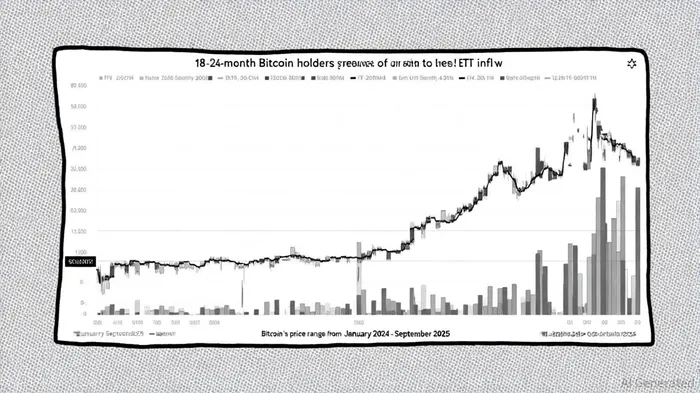
Bitcoin's price has remained in a consolidation phase since mid-2024, trading within a range of $100,678 to $105,700, per Coinotag. While this may appear as stagnation, on-chain metrics tell a different story. The Realized Cap-a valuation metric that aggregates the last price at which each BTC unit moved-has grown by $30 billion since April 2025, indicating strong underlying demand, according to the US Bitcoin ETF Tracker. Additionally, the 7-day simple moving average of Bitcoin's Spot Volume Delta turned positive, signaling net buyer dominance (US Bitcoin ETF Tracker).
The ETFs themselves have become major players in this dynamic. By absorbing a significant portion of Bitcoin's supply, they have created a "structural floor" for prices. For instance, BlackRock's iShares Bitcoin Trust (IBIT) and Fidelity's Wise Origin Bitcoin Fund (FBTC) alone hold over 100,000 BTC combined (US Bitcoin ETF Tracker). This institutional absorption mirrors the role of gold ETFs in traditional markets, where large holders act as stabilizing forces. The result is a market less susceptible to short-term volatility and more aligned with long-term capital flows.
Correlation Between Holder Behavior and ETF Inflows
The interplay between 18–24-month holder activity and ETF inflows is further underscored by transaction patterns. On-chain analysis reveals that Tuesdays have become the most active day for ETF-related transactions, with most activity concentrated during U.S. trading hours, as reported by IXFI's Coin Info Center. This synchronization suggests that institutional investors are leveraging ETFs to systematically accumulate Bitcoin, reinforcing the narrative of a conviction-driven market.
Moreover, the Coin Days Destroyed (CDD) metric-a proxy for the movement of long-dormant Bitcoin-has spiked during major ETF inflow waves in Summer 2024, Fall 2024, and Summer 2025, per Coinotag. These spikes indicate that older holders are transferring their Bitcoin to ETFs, effectively removing it from speculative trading. This shift not only reduces liquid supply but also aligns the interests of retail and institutional investors, fostering a more cohesive market structure.
The Case for a Breakout: Institutional Confidence and Conviction
The convergence of these factors-growing 18–24-month holder dominance, reduced liquid supply, and ETF-driven absorption-creates a compelling case for a Bitcoin breakout. Historical patterns show that periods of consolidation often precede sharp rallies when supply constraints and institutional demand align (Coinotag). The current environment mirrors the pre-2021 bull run, where long-term holder accumulation and reduced selling pressure set the stage for a multi-year rally.
Furthermore, macroeconomic tailwinds, including the potential for Federal Reserve rate cuts and continued corporate adoption (e.g., MicroStrategy's 11,000 BTC purchase in early 2025, according to an Amberdata report), add to the bullish case. As Bitcoin's correlation with equities during risk-on periods strengthens (Coinotag), it is increasingly being integrated into traditional portfolios, broadening its base of demand.
Conclusion
The growing activity of 18–24-month Bitcoin holders is not an isolated trend but a symptom of a broader structural shift. As institutional adoption through ETFs continues to absorb supply and reinforce long-term holder conviction, Bitcoin's market dynamics are evolving toward a more stable, durable model. While short-term consolidation persists, the alignment of on-chain metrics and macroeconomic factors suggests that the next phase of Bitcoin's journey could be defined by a breakout driven by institutional confidence and sustained accumulation.





Comentarios
Aún no hay comentarios