
Bitcoin as a Hedge Against AI-Driven Fiat Debasement
The global economy is undergoing a seismic shift driven by artificial intelligence (AI). From 2023 to 2025, private investment in AI-related technologies has surged to over $470 billion in the U.S. alone, dwarfing the $50 billion invested across EU countries. This exponential growth has not only reshaped industries but also intensified concerns about fiat currency devaluation. As governments and corporations pour capital into AI infrastructure-data centers, high-performance computing, and automation-the risk of inflationary pressures and currency debasement looms large. In this environment, Bitcoin's energy-backed value model and institutional adoption are positioning it as a compelling hedge against macroeconomic instability.
Elon Musk's Energy-Backed Vision: A Physics-Based Currency
Elon Musk has been a vocal advocate for Bitcoin's role as an energy-backed digital currency. He argues that Bitcoin's proof-of-work (PoW) mechanism ties its value to real-world energy consumption, a resource that cannot be artificially inflated like fiat currencies. "Energy is the only non-fakeable resource," Musk has stated, emphasizing that Bitcoin's security and scarcity are anchored to physics rather than government policy. This perspective gains traction as AI-driven automation and energy-intensive computing reshape economic systems. Unlike fiat, which can be devalued through quantitative easing or excessive government spending, Bitcoin's supply is fixed at 21 million, making it immune to algorithmic debasement.
Musk's vision aligns with growing macroeconomic anxieties. The U.S. Economic Policy Uncertainty Index hit a 40-year high in 2025, driven by conflicting policies and inflationary pressures. Meanwhile, AI's energy demands-particularly in data centers- have outpaced global power generation capacity in many regions. 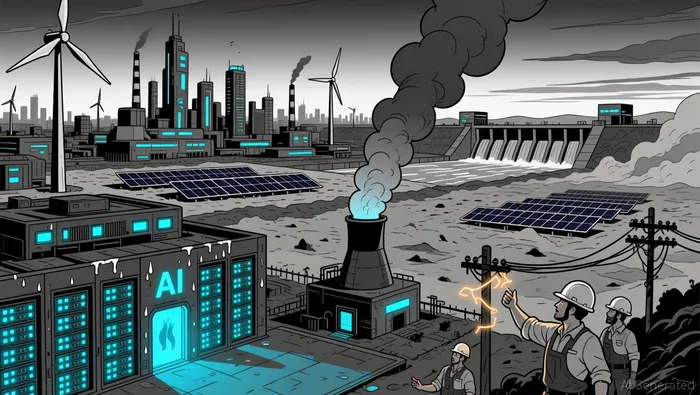 Bitcoin's PoW model, which requires significant energy inputs, contrasts sharply with fiat systems that rely on debt and liquidity injections. As energy becomes a scarcer and more strategic asset, Bitcoin's energy-backed value proposition becomes increasingly attractive.
Institutional Adoption: A Catalyst for Bitcoin's Legitimacy
Institutional adoption of BitcoinBTC-- has accelerated dramatically since 2023. Companies like MicroStrategy now hold 478,740 BTC, valued at approximately $46 billion, while BlackRock's Bitcoin ETF (IBIT) has attracted nearly $100 billion in assets under management. Regulatory clarity, such as the U.S. SEC's 2024 approval of spot Bitcoin ETFs, has been a critical catalyst. These developments signal a shift in how institutions view Bitcoin-from speculative asset to a strategic hedge against inflation and currency devaluation.
The U.S. government's exploration of a national digital asset reserve further underscores Bitcoin's growing legitimacy. Institutions are increasingly treating Bitcoin as a "digital gold," with corporate treasuries and endowments allocating capital to the asset. This trend mirrors the 2025 surge in gold prices, which rose 65% year-to-date as investors sought safe havens amid dollar weakness. Bitcoin's institutional adoption is not just a fad-it reflects a structural rethinking of value storage in an era of AI-driven economic uncertainty.
Energy-Backed Value Resilience in an AI-Driven World
Bitcoin's energy consumption, often criticized as wasteful, is its greatest strength in a world grappling with AI-driven inflation. The network's PoW mechanism requires miners to expend real energy to secure the blockchain, creating a direct link between Bitcoin's value and physical resources. This contrasts with fiat currencies, which derive value from government guarantees and can be devalued through excessive money printing.
Macroeconomic studies highlight the dual-edged nature of AI investment: while it drives productivity and GDP growth, it also risks creating asset bubbles and labor displacement. For example, major tech firms like Microsoft and Amazon increased capital expenditures by 50% in 2025 to support AI infrastructure. However, this speculative investment could backfire if returns fail to materialize, leading to market corrections that ripple through consumer spending and credit markets. In such scenarios, Bitcoin's energy-backed model offers a counterbalance. Its value is not tied to the success or failure of AI startups but to the immutable laws of energy and scarcity.
The Future of Value in an AI-Driven Economy
As AI reshapes global economic structures, the demand for hard assets will only grow. Bitcoin's unique position as an energy-backed, decentralized store of value makes it a natural hedge against fiat devaluation. Institutional adoption, regulatory progress, and macroeconomic tailwinds are accelerating this transition.
Elon Musk's vision of an energy-driven economy is not just theoretical-it is already taking shape. Bitcoin's PoW model ensures that its value is tied to real-world energy inputs, a critical differentiator in an era where fiat currencies are increasingly seen as fragile. As AI investment continues to outpace traditional economic growth, Bitcoin's role as a hedge against debasement will become even more pronounced.
For investors, the message is clear: in a world where AI-driven inflation and fiat devaluation are inevitable, Bitcoin offers a physics-based alternative. The asset's institutional adoption and energy-backed resilience are not just trends-they are the foundation of a new economic paradigm.






Comentarios
Aún no hay comentarios