
Is Bitcoin's Halving Still a Reliable Indicator in a Post-Scarcity Era?
The BitcoinBTC-- halving event, a programmed reduction in block rewards for miners, has long been a focal point for investors seeking to predict price movements. Historically, halvings in 2012, 2016, and 2020 were followed by sharp price surges, driven by the logic of supply scarcity and speculative demand. However, as Bitcoin approaches its final supply limit and institutional adoption accelerates, the reliability of halving as a standalone indicator is being re-evaluated. In a post-2020 era marked by shifting monetary dynamics, Bitcoin's price cycles are increasingly shaped by global liquidity trends rather than mere supply constraints.
The Diminishing Signal of Scarcity
The 2024 halving, which reduced Bitcoin's block reward by 50%, resulted in a modest 40% price increase over the following year-a far cry from the 100%+ gains seen after prior halvings according to analysis. This muted response challenges the traditional narrative that scarcity alone drives Bitcoin's value. Research suggests that investor behavior, rather than intrinsic supply-demand mechanics, has become the dominant force. For instance, speculative trading and media-driven attention often amplify short-term volatility, creating patterns inconsistent with classical economic models according to findings. As Bitcoin's supply nears its 21 million cap, the marginal impact of each halving diminishes, further eroding its predictive power.
The Rise of Liquidity-Driven Cycles
Post-2020, Bitcoin's price movements have shown a striking alignment with global monetary policy and money supply metrics. During the pandemic, Bitcoin began reacting to U.S. Federal Reserve announcements in ways mirroring equities and commodities. A tightening monetary policy, such as interest rate hikes, now correlates strongly with Bitcoin price declines, a trend absent in earlier cycles. This shift reflects Bitcoin's evolving identity: from a speculative asset to a macroeconomic barometer.
A key driver of this transformation is the M2 money supply. Between 2020 and 2023, Bitcoin's price exhibited a 0.78 correlation with M2 growth, particularly when lagged by 90 days. The 2020–2021 bull market, for example, coincided with unprecedented M2 expansion due to pandemic-era stimulus. In 2025, as M2 began expanding again, Bitcoin outperformed traditional inflation hedges like gold, signaling a new liquidity-driven cycle according to analysis. 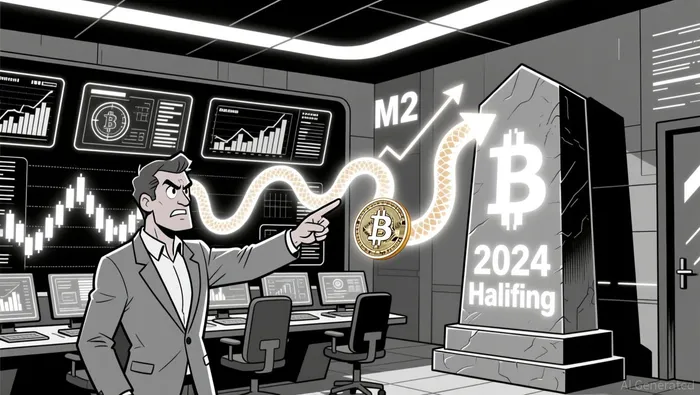 . This dynamic underscores Bitcoin's role as a global store of value in an era of monetary experimentation.
Institutional Adoption and Portfolio Rebalancing
The growing integration of Bitcoin into institutional portfolios has further cemented its ties to traditional markets. Bitcoin's correlation with the S&P 500 has strengthened, reflecting shared exposure to liquidity conditions and risk-on/risk-off sentiment. Institutional investors, once skeptical, now treat Bitcoin as a diversification tool, amplifying its sensitivity to macroeconomic signals. This shift contrasts with Bitcoin's early identity as a decentralized alternative to fiat currencies, where its price was less influenced by central bank actions according to research.
Implications for Investors
For investors, the lesson is clear: Bitcoin's price cycles are no longer predictable by halving events alone. Instead, monitoring global liquidity metrics-such as M2 growth, central bank policy, and interest rate trajectories-offers a more robust framework for analysis. The 2024 halving's underwhelming performance highlights the need to contextualize supply-side events within broader macroeconomic trends.
In a post-scarcity era, Bitcoin's value proposition is increasingly defined by its ability to absorb and reflect global liquidity dynamics. While halvings remain a structural feature of Bitcoin's design, their influence is being eclipsed by the asset's integration into mainstream financial systems. Investors who adapt their strategies to this new paradigm will be better positioned to navigate Bitcoin's evolving role in the global economy.






Comentarios
Aún no hay comentarios