
Bitcoin's Growing Institutional Adoption: A Strategic Asset for Macroeconomic Downturns
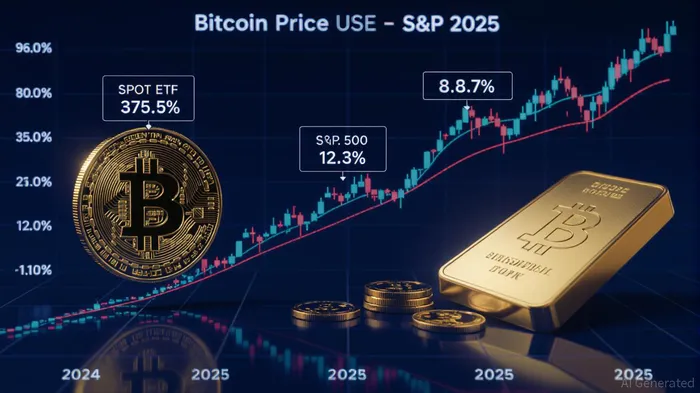
The past two years have witnessed a seismic shift in institutional perceptions of BitcoinBTC--. What was once dismissed as speculative noise is now a cornerstone of diversified portfolios, with 59% of institutional investors allocating BTC as of 2025 [1]. This transformation is not merely a function of price performance—though Bitcoin’s 375.5% return from 2023 to 2025 outpaces both gold and the S&P 500—but a recalibration of risk paradigms in an era of macroeconomic uncertainty [2].
Institutional Adoption: From Fringe to Foundation
Bitcoin’s institutional adoption has been catalyzed by regulatory clarity and structural innovation. The 2024 approval of spot Bitcoin ETFs and the 2025 U.S. BITCOIN Act normalized access for pension funds, endowments, and 401(k) providers, funneling $132.5 billion into ETFs by August 2025 [2]. This institutional influx has reduced Bitcoin’s volatility relative to earlier cycles, as large-cap portfolios now act as stabilizing forces [1].
Corporations like MicroStrategy and TeslaTSLA-- have further legitimized Bitcoin as a strategic reserve asset, with over 180 firms now holding BTC on balance sheets [1]. Meanwhile, nearly half of hedge funds and 15% of Bitcoin’s total supply are controlled by institutions, signaling a shift from speculative trading to long-term capital preservation [4].
Strategic Allocation in Downturns: Why Bitcoin Fits
Bitcoin’s unique properties make it an ideal hedge during macroeconomic downturns. Its fixed supply (21 million coins) ensures it cannot be inflated away, a critical advantage in eras of central bank overreach. Data from 2025 shows Bitcoin’s post-halving inflation rate has dropped to 0.83%, reinforcing its role as a durable store of value [3].
Moreover, Bitcoin’s low correlation with traditional assets—correlation coefficients with the S&P 500 have averaged -0.15 since 2023—makes it a powerful diversification tool [2]. During periods of geopolitical instability or currency devaluation, Bitcoin’s performance has diverged sharply from equities and bonds, offering asymmetric risk-reward profiles.
Macro-Resilience and Real-World Applications
Institutional investors are increasingly allocating 1–5% of portfolios to Bitcoin, particularly in high-risk environments [3]. This trend is supported by Bitcoin’s integration into traditional financial systems: major banks now offer custody solutions, and tokenized real-world assets (RWAs) are expanding Bitcoin’s utility beyond speculative trading [4]. For example, stablecoins pegged to fiat currencies now facilitate Bitcoin-based settlements, while tokenized treasuries enable cross-border liquidity management [1].
Conclusion: A New Era of Portfolio Construction
Bitcoin’s institutional adoption is no longer a niche experiment but a strategic imperative. As macroeconomic volatility persists—marked by inflationary pressures, debt crises, and geopolitical fragmentation—Bitcoin’s structural advantages position it as a critical diversifier. For institutions seeking to preserve capital during downturns, the data is clear: Bitcoin is no longer a speculative bet but a foundational asset class.
**Source:[1] Bitcoin Treasuries: The Quiet Revolution Reshaping Global Capital Flows [https://www.bitget.com/news/detail/12560604940997][2] The Crypto Market In 2025: Are Crypto Demand Trends ... [https://www.forbes.com/sites/digital-assets/article/the-crypto-market-in-2025-crypto-demand-trends/][3] Bitcoin's Role in Generational Wealth: A Macroeconomic Perspective [https://www.bitget.com/news/detail/12560604940076][4] How Institutions Are Quietly Embracing Crypto [https://insights4vc.substack.com/p/how-institutions-are-quietly-embracing]






Comentarios
Aún no hay comentarios