
Bitcoin's Growing Institutional Adoption: What the Recent CEX Inflow Signals for Retail Investors
In Q3 2025, Bitcoin's capital flow dynamics and market sentiment have undergone a seismic shift, driven by unprecedented institutional adoption and record inflows into centralized exchanges (CEXs). These developments signal a maturing market where institutional confidence is reshaping retail investor behavior, creating a complex interplay between macroeconomic forces, regulatory clarity, and technological adoption.
Capital Flow Dynamics: Institutional Dominance and CEX Inflows
The third quarter of 2025 witnessed a historic surge in institutional capital flowing into BitcoinBTC--. According to a CoinGecko report, U.S. spot Bitcoin ETFs accumulated $7.8 billion in net inflows during Q3 2025, dwarfing Q2's $4.2 billion and bringing year-to-date inflows to $55 billion; a contemporaneous BTCC write-up noted the same $7.8 billion figure. This momentum was fueled by the approval of spot Bitcoin ETFs, which provided institutional investors with a regulated on-ramp to allocate capital. BlackRock's iShares Bitcoin Trust (IBIT) alone amassed $18 billion in assets under management by April 2025, reflecting a broader trend of institutional validation, according to a Pinnacle Digest analysis.
Simultaneously, CEX inflows reached record levels. Binance reported a net inflow of $14.8 billion in Q3 2025, driven by stablecoin deposits and ETF-related trading activity. CEX.io noted that on-chain stablecoin transfers hit $15.6 trillion in the same quarter, with bots accounting for 71% of the volume. These inflows underscored the role of CEXs as critical infrastructure for institutional liquidity, while also highlighting the growing integration of stablecoins as a bridge between fiat and crypto markets.
Market Sentiment Analysis: Institutional Confidence vs. Retail Caution
The surge in institutional adoption has created a stark divergence in market sentiment. Institutional investors now view Bitcoin as a strategic asset for diversification and macroeconomic hedging. A Coinbase survey revealed that 59% of institutional investors allocate at least 10% of their portfolios to Bitcoin, with 75% planning to increase allocations in 2025. This shift is reflected in corporate treasuries, where firms like MicroStrategy and Twenty One Capital have accumulated over 1.29 million BTC (6% of total supply) as a hedge against inflation (see CoinGecko).
Retail investor behavior, however, tells a different story. While institutional inflows stabilized Bitcoin's volatility-reducing it by 75% since 2023-retail participation has cooled. Analytics Insight reported a 16% net loss in Bitcoin supply on exchanges, attributed to reduced retail trading activity and a 20% decline in social media mentions since February 2025. This cooling-off period contrasts with the record retail-sized stablecoin transfers (under $250) hitting all-time highs in September 2025, indicating that everyday use cases like remittances and cash-outs are driving adoption, according to CoinTribune.
Regulatory and Macroeconomic Catalysts
Regulatory clarity has been a linchpin for institutional adoption. The U.S. government's approval of spot Bitcoin ETFs and the GENIUS Act-which provided oversight for stablecoins-reinforced institutional confidence, summarized in a CoinEdition roundup. Additionally, macroeconomic factors such as the weakening U.S. dollar and geopolitical uncertainty elevated Bitcoin's appeal as a store of value. ChainCatcher noted that the U.S. strategic Bitcoin reserve and corporate treasury demand further legitimized Bitcoin as a reserve asset.
Implications for Retail Investors
For retail investors, the institutionalization of Bitcoin presents both opportunities and challenges. On one hand, reduced volatility and increased liquidity make Bitcoin more accessible to risk-averse investors. The democratization of access via ETFs-where 75% of shares are held by non-13F filers-has enabled smaller investors to participate in institutional-grade strategies, according to Coinwy's analysis. On the other, the dominance of institutional capital may amplify short-term price swings, as seen in late September 2025 when Bitcoin dipped below $113K amid macroeconomic jitters in a CoinEdition analysis.
Retail investors must also navigate the growing role of stablecoins. While bots dominate high-frequency trading, the surge in small-value stablecoin transactions suggests a parallel adoption path for everyday users. CoinTelegraph reported that over 70% of these retail transfers were tied to exchange activities, highlighting the importance of CEXs in facilitating on-ramp access.
Conclusion
Bitcoin's Q3 2025 trajectory reflects a market in transition. Institutional adoption, driven by ETF inflows and regulatory clarity, has transformed Bitcoin into a core asset for institutional portfolios. For retail investors, this shift signals a need to adapt to a more mature, institution-led market. While retail participation has cooled, the underlying infrastructure-stablecoins, CEXs, and ETFs-provides a foundation for long-term growth. As Bitcoin's volatility continues to decline and its role as a store of value solidifies, retail investors may find themselves at a crossroads: either embracing Bitcoin as a strategic asset or ceding influence to an increasingly institutionalized market.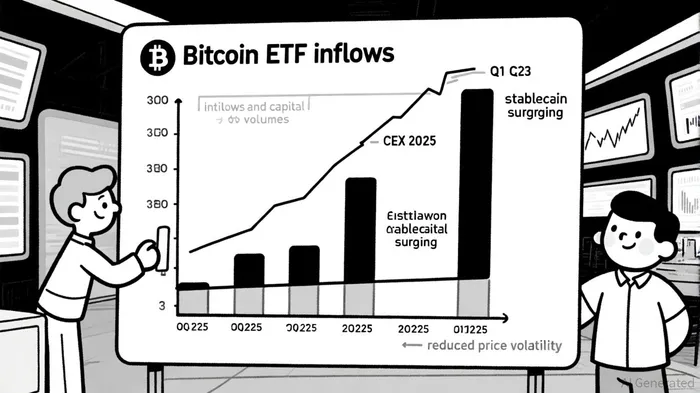





Comentarios
Aún no hay comentarios