
Bitcoin's Growing Downside Risk: A Macro and Speculative Analysis
Bitcoin's price trajectory in November 2025 has been increasingly shaped by a confluence of macroeconomic uncertainty and speculative positioning dynamics, both of which are amplifying downside risks for the asset. While BitcoinBTC-- has long been positioned as a hedge against inflation and a store of value, the interplay of rising U.S. inflation, cautious Federal Reserve policy, and volatile speculative flows suggests a fragile environment for the cryptocurrency.
Macroeconomic Uncertainty: Inflation, Fed Policy, and Global Growth
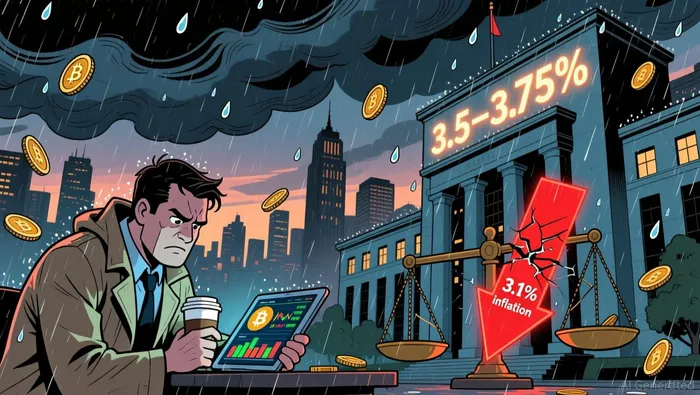 The U.S. inflation rate in November 2025 reached 3.1%, the highest level since May 2024, driven by steep tariffs and persistent supply-side pressures. This figure, above the Federal Reserve's 2% target, has forced the central bank into a delicate balancing act. While the Fed cut the benchmark interest rate to a range of 3.5–3.75% in December 2025 to stimulate employment, analysts warn that further cuts may be delayed if inflation remains stubborn. The Fed's hesitation to aggressively ease monetary policy reduces the appeal of non-yielding assets like Bitcoin, which competes with cash and bonds in a higher-rate environment.
Global GDP growth projections, meanwhile, present a mixed picture. While China's pro-growth policies have lifted 2025–2027 forecasts to 5.0%, 4.6%, and 4.5%, respectively, downward revisions in economies like Brazil and Russia-due to inflationary pressures and geopolitical tensions-highlight systemic fragility. According to research, the VIX volatility index, a barometer of market fear, peaked at 26.4 in November 2025, reflecting uncertainty around Fed policy, labor market data, and AI infrastructure investments. Such volatility often spillovers into crypto markets, where Bitcoin's price is closely tied to risk-on/risk-off sentiment.
Speculative Positioning: Leverage, Retail Behavior, and Volatility Metrics
Speculative positioning in Bitcoin has become a double-edged sword. Leveraged ETFs, such as the ProShares UltraShort Bitcoin ETF (SBIT) and UltraShort Ether ETF (ETHD), gained over 20% in late November 2025 as Bitcoin prices plummeted. These inverse leveraged products amplified losses for investors who had bet on continued price declines, exacerbating downward momentum. Retail investors, particularly those in leveraged crypto ETFs like the Defiance 2x Long MSTR ETF (MSTX), faced $1.5 billion in losses during the month.
The CBOE Bitcoin Volatility Index (BVOL) further underscores the precariousness of speculative positioning. By November 2025, the 30-day implied volatility for Bitcoin surged past 73%, reflecting heightened expectations of price turbulence. This spike was driven by thin liquidity, reduced volatility-selling by large holders (e.g., miners and OG investors), and institutional demand for downside protection. The Cboe Bitcoin U.S. ETF Index (CBTX) fell nearly 17% in November, triggering $2.4 billion in outflows from Bitcoin ETFs as retail and institutional investors fled the asset.
Synthesis: A Perfect Storm for Downside Risk
Bitcoin's downside risks in November 2025 stem from a perfect storm of macroeconomic and speculative factors. On the macro side, elevated inflation and a cautious Fed limit the asset's appeal as a hedge, while global growth uncertainties amplify risk-off sentiment. On the speculative side, leveraged exposure and thin liquidity create a self-reinforcing cycle of volatility and selling pressure. The BVOL index, now at multi-year highs, signals that markets are pricing in continued turbulence.
For investors, the lesson is clear: Bitcoin's price is increasingly sensitive to macroeconomic shifts and speculative flows. While its long-term appeal as a decentralized store of value remains intact, the near-term outlook is clouded by these interdependent risks. Prudent strategies may involve hedging against volatility, avoiding overexposure to leveraged products, and monitoring Fed policy cues closely.







Comentarios
Aún no hay comentarios