
Bitcoin's Great Decoupling: From M2 Correlation to Institutional Maturity
Bitcoin's monetary dynamics are undergoing a profound transformation. For years, the cryptocurrency's price has been closely tied to global M2 money supply growth, a relationship rooted in its role as a hedge against inflation and currency devaluation. However, recent trends suggest a structural shift: BitcoinBTC-- is decoupling from M2 and aligning with new drivers such as institutional adoption, regulatory clarity, and supply-side fundamentals. This evolution marks the emergence of Bitcoin as a maturing asset class, distinct from traditional markets and increasingly resilient to macroeconomic volatility.
Historical Correlation: M2 as a Proxy for Liquidity
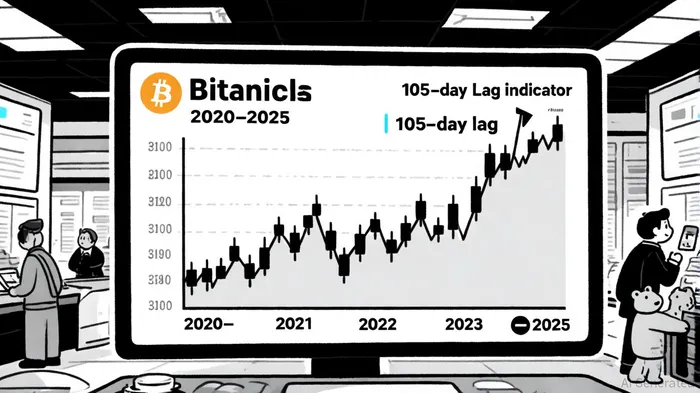
Bitcoin's price has historically mirrored M2 money supply expansions, particularly during periods of aggressive monetary stimulus. During the 2020–2021 pandemic response, the U.S. Federal Reserve's liquidity injections pushed global M2 to record levels, coinciding with Bitcoin's meteoric rise from under $10,000 to over $69,000 [2]. Analysts observed a lag of 70–107 days between M2 growth and Bitcoin price movements, with a 105-day offset showing the strongest correlation [3]. This delay reflects the time required for liquidity to permeate financial systems before influencing crypto markets.
However, this relationship is not static. During the 2022 bear market, Bitcoin's price plummeted despite elevated M2 levels, underscoring the influence of crypto-specific factors such as risk-off sentiment and internal market crises . This duality—strong correlation during bull cycles and weaker alignment during bear markets—highlights Bitcoin's complex interplay with macroeconomic trends.
The Great Decoupling: A New Paradigm
Since early 2023, Bitcoin has increasingly diverged from traditional macroeconomic indicators. By February 2025, its correlation with the S&P 500 had dropped to near zero [3], a stark contrast to its historical behavior. This decoupling is driven by Bitcoin's unique structural attributes: it operates outside the influence of earnings cycles, trade policies, and central bank interventions [2]. Instead, its price is now shaped by sovereign-level accumulation, spot ETF inflows, and supply-side compression events like halving cycles [2].
Institutional adoption has been a pivotal catalyst. The approval of U.S. spot Bitcoin ETFs in 2024, coupled with the Trump administration's August 2025 executive order allowing 401(k) accounts to invest in Bitcoin, unlocked access to an $8.9 trillion capital pool [1]. By Q2 2025, ETFs held 1.3 million BTC—6% of the total supply—while corporate entities like MicroStrategy accumulated 629,376 BTC, valued at $71.2 billion [1]. These developments have repositioned Bitcoin as a core institutional holding, not a speculative satellite asset.
Regulatory clarity has further accelerated this shift. The SEC's pivot from enforcement-driven policies to proactive compliance guidelines under Commissioner Hester Peirce reduced uncertainty for financial institutions [1]. Meanwhile, the EU's Markets in Crypto-Assets (MiCA) framework, effective late 2024, stabilized the global market by providing a unified regulatory structure [3].
Institutional Maturity and Risk-Adjusted Returns
Bitcoin's maturation is evident in its risk-adjusted performance. Its Sharpe ratio now exceeds most traditional asset classes, including U.S. equities and global bonds [2]. This is supported by improved liquidity metrics: record internal liquidity and declining exchange reserves indicate a shift toward strategic reserve allocation [3].
The U.S. Strategic Bitcoin Reserve, holding over 200,000 BTC, exemplifies this trend. By eliminating the “reputational risk” clause that previously barred banks from crypto engagement, the government has normalized Bitcoin's role in the financial ecosystem [3]. Banks now offer custody and trading services, embedding Bitcoin into mainstream portfolio construction.
Implications for Investors
For investors, Bitcoin's decoupling from M2 and alignment with institutional demand signal a new era. Traditional macroeconomic indicators like inflation or interest rates are no longer the sole drivers of Bitcoin's price. Instead, factors such as ETF inflows, corporate treasury strategies, and supply-side events (e.g., the 2024 halving) now play a dominant role.
This shift offers both opportunities and risks. On one hand, Bitcoin's non-correlation with equities enhances portfolio diversification. On the other, its growing institutional footprint introduces new dependencies, such as regulatory shifts or ETF outflows. Investors must now balance macroeconomic trends with Bitcoin-specific dynamics, including its fixed supply and the velocity of institutional adoption.
Conclusion
Bitcoin's journey from a speculative asset to a maturing global liquidity asset is defined by its decoupling from M2 and alignment with institutional forces. While historical correlations with money supply remain relevant, they are increasingly secondary to structural factors like regulatory clarity, ETF-driven demand, and corporate adoption. As Bitcoin's role in portfolio construction evolves, investors must adapt their frameworks to account for its unique position at the intersection of digital scarcity and institutional finance.






Comentarios
Aún no hay comentarios