
Bitcoin's Governance Crossroads: Multisig Quorums and the Erosion of Censorship Resistance
Bitcoin's governance model has long been celebrated for its decentralized, trustless architecture. Yet, recent debates around Luke Dashjr's controversial multisig quorum proposal have exposed a critical vulnerability: the tension between maintaining censorship resistance and addressing real-world regulatory pressures. This analysis explores how multisig quorum systems—while technically robust—risk centralizing control and enabling censorship, undermining Bitcoin's foundational principles.
The Dashjr Proposal: A Hard Fork for “Moral” Governance
Luke Dashjr, a prominent BitcoinBTC-- Core developer and maintainer of Bitcoin Knots, has been at the center of a contentious debate over a proposed hard fork to introduce a trusted multisig committee capable of retroactively altering the blockchain to remove illegal content like Child Sexual Abuse Material (CSAM) [1]. The plan involves using zero-knowledge proofs to replace flagged data while preserving transaction validity, effectively allowing node operators to “clean” their blockchains [2]. Dashjr has framed this as a necessary compromise: “The only options are Bitcoin dies or we trust someone” [2].
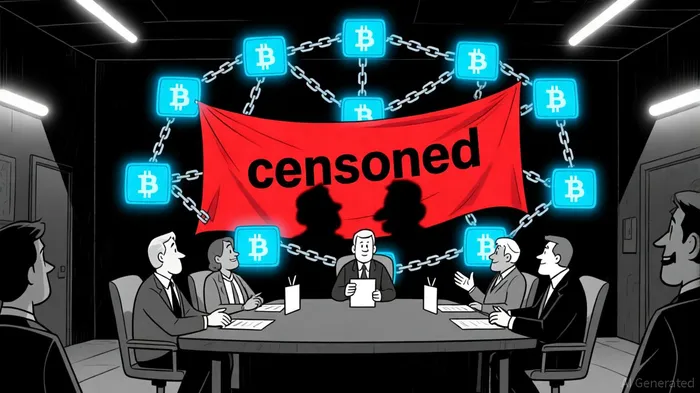
However, this proposal has been met with fierce opposition. Critics argue that creating a quorum system—even for noble purposes—introduces a centralized authority with the power to censor transactions. As one academic study notes, “Consensus protocols in public blockchains are designed to resist unilateral control, but governance mechanisms like multisig quorums create backdoors for centralized decision-making” [3]. The risk is not hypothetical: once a precedent is set for altering the blockchain, it could be exploited for broader censorship, such as KYC/AML enforcement or political suppression [4].
Multisig Quorums: Security vs. Centralization
Multisig systems are inherently designed to enhance security by distributing control across multiple signatories. For example, a 2-of-3 multisig setup eliminates single points of failure, making it a popular choice for institutional custody [5]. However, Dashjr's proposal flips this model on its head. Instead of empowering users, it creates a governance quorum where a select group of actors holds the power to alter the blockchain retroactively.
Technical limitations further exacerbate the centralization risk. Bitcoin's OP_CHECKMULTISIG opcode restricts quorum sizes to a maximum of 20 signatories for validity, with practical limits often lower due to coordination challenges [6]. This means any quorum system would inherently concentrate power in a small group, contradicting Bitcoin's ethos of decentralization. As one industry report warns, “A multisig quorum governed by a handful of entities is not a decentralized solution—it's a permissioned ledger in disguise” [7].
The Censorship Resistance Paradox
Bitcoin's censorship resistance is rooted in its peer-to-peer validation model, where no single entity can block transactions. This was starkly demonstrated during the 2025 Canadian “Freedom Convoy” protests, where Bitcoin fundraising circumvented traditional financial censorship [8]. However, Dashjr's proposal threatens to erode this advantage. If a quorum can retroactively alter transactions, it creates a governance loophole that regulators or malicious actors could exploit. For instance, a government could pressure the quorum to block transactions supporting sanctioned entities, effectively weaponizing the blockchain [9].
Moreover, the proposal's reliance on zero-knowledge proofs introduces new attack vectors. While ZK proofs obscure data, they require trust in the quorum's integrity. If the committee is compromised—or even perceived to be—users may lose confidence in the network's neutrality, triggering a collapse in adoption [10].
Investor Implications: Balancing Innovation and Principle
For investors, the Dashjr debate underscores a critical question: Can Bitcoin evolve without sacrificing its core values? On one hand, innovations like multisig quorums could address pressing issues like spam transactions and regulatory scrutiny. On the other, they risk alienating the community that values Bitcoin's immutability.
The U.S. government's recent pro-Bitcoin stance—exemplified by the Strategic Bitcoin Reserve Act and President Trump's digital asset executive order—adds another layer of complexity. While regulatory clarity could boost institutional adoption, it also increases pressure to implement compliance mechanisms like Dashjr's proposal [11]. Investors must weigh these competing forces: a more “regulated” Bitcoin may attract capital but could lose its appeal to privacy advocates.
Conclusion: A Fork in the Road
Bitcoin's governance model is at a crossroads. While Dashjr's proposal highlights the need to address real-world challenges, it also exposes the fragility of decentralization in the face of regulatory and ethical pressures. Multisig quorum systems, though technically sound, risk creating centralized gatekeepers that contradict Bitcoin's core principles. For investors, the key takeaway is clear: the future of Bitcoin will be defined not by its technical capabilities, but by the community's ability to balance innovation with the preservation of censorship resistance.






Comentarios
Aún no hay comentarios