
Bitcoin vs. Gold: Navigating the Store of Value Debate in a Shifting Macro Landscape
The Store of Value Debate: A New Chapter
In an era marked by inflationary pressures, geopolitical volatility, and central bank experimentation, the age-old debate between BitcoinBTC-- and gold as stores of value has taken on renewed urgency. While both assets share scarcity and low correlation with traditional markets, their recent performance has diverged sharply. Gold, the timeless safe-haven asset, has surged to record highs, outpacing Bitcoin in year-to-date (YTD) gains. By contrast, Bitcoin's price action has reflected its dual identity as both a speculative asset and a long-term hedge, leaving investors to grapple with its underperformance in the current macroeconomic climate.
Gold's Resurgence: A Timeless Hedge
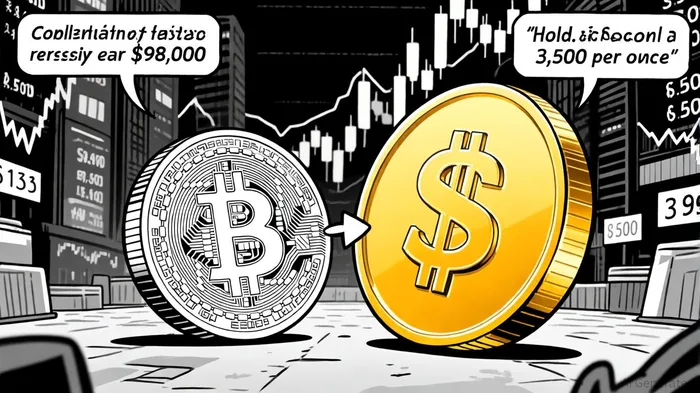
Gold's dominance in 2025 is no accident. According to a report by the World Gold Council, central banks have accelerated their gold purchases, with 95% of surveyed institutions anticipating increased gold reserves over the next 12 months [1]. This trend is driven by a global shift away from dollar-centric reserves, as nations diversify portfolios amid U.S. monetary policy uncertainty and geopolitical fragmentation. Gold's 29% YTD gain to $3,500 per ounce underscores its role as a stable store of value, particularly during periods of economic instability [2].
Data from Deutsche Bank analysts highlights gold's enduring appeal: its physical tangibility, historical track record, and near-zero correlation with equities make it a preferred asset for central banks and institutional investors seeking to hedge against fiat devaluation [3]. For example, the Euro Area's 2.1% inflation rate in August 2025 and the U.S.'s 2.7% rate [4]—while below peak levels—have kept investors wary of prolonged inflation, further bolstering demand for gold.
Bitcoin's Lag: Volatility vs. Structural Promise
Bitcoin's 4% YTD gain pales in comparison to gold's performance, a reality that has sparked skepticism about its inflation-hedging credentials. During the 2022 inflation spike, Bitcoin plummeted over 70% from its 2021 peak, while gold rose [1]. This volatility has made Bitcoin a less reliable short-term hedge, despite its 10-year compound annual growth rate of 85% versus gold's 11% [2].
However, Bitcoin's structural advantages—its fixed supply of 21 million coins and digital scarcity—suggest long-term potential. Institutional adoption is accelerating, with BlackRock's spot Bitcoin ETF (IBIT) attracting $14.9 billion in inflows by mid-2025, surpassing gold ETFs like SPDR Gold Shares (GLD) [3]. Yet, Bitcoin's price remains tethered to macroeconomic sentiment. For instance, while gold ETFs saw $8.3 billion in inflows in 2025, Bitcoin ETFs initially lagged before surging to $50 billion in cumulative inflows by July 2025 [4]. This reflects growing institutional trust but also highlights Bitcoin's susceptibility to market cycles.
Macroeconomic Drivers: Central Banks and Inflation Dynamics
The macroeconomic backdrop has been pivotal. From 2022 to mid-2024, central banks globally raised rates to combat inflation, but by late 2024, most began cutting borrowing costs as inflation eased [5]. This shift has created a dual narrative: short-term uncertainty (favoring gold) and long-term growth expectations (favoring Bitcoin).
Gold's outperformance aligns with its role as a flight-to-safety asset. For example, in May 2025, Bitcoin ETFs saw $5.23 billion in inflows, while gold ETFs faced outflows of $1.58 billion [6]. However, gold reclaimed the lead in September 2025 as investors anticipated further Fed rate cuts and sought hard assets [7]. This ebb and flow underscores the interplay between macroeconomic signals and asset preferences.
Strategic Portfolio Positioning: Balancing Short-Term and Long-Term Needs
For investors, the key lies in balancing gold's immediate reliability with Bitcoin's long-term potential. Gold remains a cornerstone for hedging against geopolitical shocks and fiat erosion, particularly in a world where central banks are increasingly diversifying reserves [1]. Meanwhile, Bitcoin's structural scarcity and growing institutional infrastructure—bolstered by custody solutions from Fidelity and Coinbase—position it as a digital alternative to gold [8].
A diversified approach is prudent. Allocating to both assets allows investors to capture gold's stability while participating in Bitcoin's potential for exponential growth. For example, 13F filings show a 5% increase in institutional Bitcoin ETF holders to 1,775 by Q1 2025 [9], signaling a shift toward treating Bitcoin as a core portfolio component.
Conclusion: The Future of Value Storage
The 2023–2025 period has reaffirmed gold's role as a tried-and-true store of value, while Bitcoin's journey remains a work in progress. As central banks navigate a new era of monetary policy and investors seek protection against inflation, both assets will play critical roles. The challenge for investors is to recognize that gold and Bitcoin are notNOT-- mutually exclusive but complementary tools for wealth preservation. In a world of uncertainty, the best strategy may be to hold both.





Comentarios
Aún no hay comentarios