
Bitcoin and Gold at Key Price Thresholds: What's Next for Safe-Haven Assets?
Macroeconomic Positioning: Dovish Policies and the "Digital Gold" Narrative
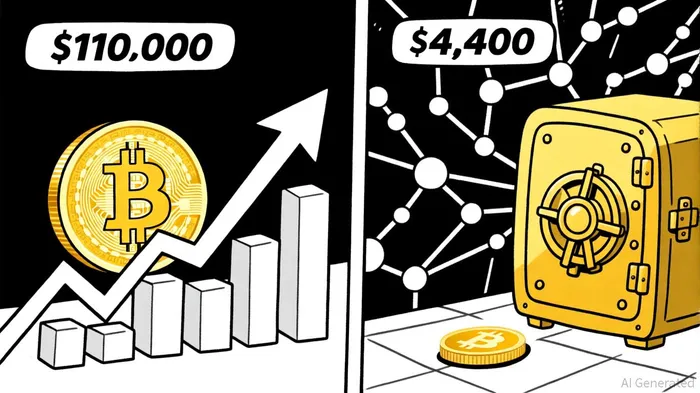
Bitcoin's ascent to $110,000 in October 2025 reflects its growing integration into mainstream finance, driven by institutional inflows exceeding $100 billion as of 2024, according to a Coinotag report. Analysts from Bull Theory argue that a mere 0.2% reallocation of global assets-$46.9 trillion-could inject $93.8 billion into Bitcoin, leveraging its 10x–12x liquidity multiplier, as noted in the Coinotag report. This dynamic is amplified by easing monetary policies, with the Federal Reserve's anticipated rate cuts in October and December 2025 likely to boost demand for scarce assets like Bitcoin, according to a Gate analysis.
Gold, meanwhile, faces headwinds as its traditional safe-haven appeal wanes. In India, gold prices plummeted ₹9,356 per 10 grams in the week leading to October 24, 2025, driven by improved US-China trade relations and a stronger dollar, according to a FinancialContent report. Yet, digital gold platforms like NASDAQ's TetherUSDT-- Gold (XAU₮) are bridging the gap, offering institutional-grade transparency and liquidity, as reported in an ADVFN article. This hybridization of physical and digital assets underscores a broader shift in how investors hedge against uncertainty.
Investor Sentiment Shifts: ETF Flows and Capital Reallocation
The October 2025 ETF landscape reveals a tug-of-war between Bitcoin and gold. While gold ETFs accumulated $35 billion in inflows since July 2025, according to a Coinotag report, Bitcoin ETFs saw a surge of $446.6 million in the week ending October 24, with BlackRock's IBIT and Fidelity's FBTC leading the charge, according to a TradingNews report. This marks a critical inflection point, as Bitcoin's BTC/gold ratio rose 8% amid gold's 6% correction, signaling a rotation of capital toward crypto, the Coinotag report adds.
On-chain data further highlights this shift: 62,000 BTC moved from inactive wallets into circulation in October 2025, suggesting long-term holders are re-entering the market, according to a Coinotag analysis. Meanwhile, EthereumETH-- ETFs recorded $243.9 million in outflows, reinforcing Bitcoin's dominance as a store of value, the TradingNews report noted.
The Correlation Conundrum: Bitcoin's Evolving Role in Portfolios
Bitcoin's 30-day volatility now rivals silver's, while its 0.7 correlation with gold and the S&P 500 signals growing mainstream acceptance, the Gate analysis suggests. This duality-both a speculative asset and a hedge-has attracted institutional investors seeking diversification. For instance, a 3-5% capture of gold's $28.7 trillion market could double Bitcoin's price, illustrating its potential as a digital alternative to physical gold, as argued in the Coinotag report.
However, challenges persist. Higher interest rates could divert capital to bonds, while a stronger dollar historically suppresses Bitcoin demand, according to a DavosTraders analysis. Yet, with the Fed's dovish pivot and inflationary pressures persisting, Bitcoin's appeal as a scarce asset remains robust, as the Gate analysis suggests.
What's Next? Scenarios for 2025–2026
- Bitcoin's $160,000 Target: Bull Theory's projection hinges on sustained institutional inflows and a 0.2% global asset reallocation, as the Coinotag report noted. If ETF demand absorbs supply and seller fatigue sets in-similar to gold's 2025 rally-Bitcoin could breach $150,000, the Coinotag report adds.
- Gold's Digital Renaissance: Platforms like Tether Gold may stabilize gold's role in portfolios, blending physical tangibility with crypto liquidity, the ADVFN article argues.
- Macro Volatility as a Catalyst: Geopolitical shocks or Fed policy surprises could reignite demand for both assets, though Bitcoin's lower volatility may give it an edge, the TradingNews report observed.
Conclusion
Bitcoin and gold are at a crossroads in 2025. While gold's traditional safe-haven status faces erosion, Bitcoin's institutional adoption and digital innovation position it as a formidable challenger. Investors must weigh macroeconomic signals-Fed policy, inflation, and dollar strength-while monitoring ETF flows and on-chain activity. As the BTC/gold ratio climbs and capital reallocates, the next chapter in the safe-haven saga promises volatility, opportunity, and a redefinition of value itself.






Comentarios
Aún no hay comentarios