
Bitcoin's Geopolitical Adoption Surge: How Nation-States Fuel a Self-Reinforcing FOMO and Institutional Demand Cycle
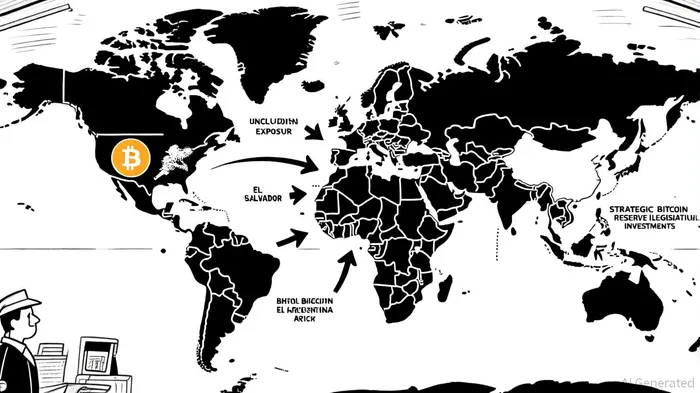
The global financial landscape is undergoing a seismic shift as BitcoinBTC-- transitions from a speculative asset to a strategic reserve. By 2025, 27 nations have integrated Bitcoin into their economic frameworks, with 13 more actively pursuing adoption through legislation or policy changes[1]. This surge in geopolitical adoption is not merely a trend—it is a self-reinforcing cycle of fear of missing out (FOMO) and institutional demand, driven by policy spillovers, macroeconomic pressures, and the asset's growing legitimacy as a hedge against inflation and currency devaluation.
The Nation-State Adoption Wave: A New Geopolitical Paradigm
Bitcoin's adoption by nation-states has accelerated dramatically since 2023, with governments viewing it as a tool for economic sovereignty and fiscal resilience. The United States, under President Donald Trump, set a precedent with an executive order mandating the retention of Bitcoin holdings rather than selling them[5]. This move inspired 16 other countries to enact or propose Strategic Bitcoin Reserve (SBR) legislation, including Arizona, Texas, and Louisiana at the state level[3]. Bhutan and El Salvador have pioneered the trend, with Bhutan amassing 13,000 BTC (28% of its GDP) through government-backed mining and El Salvador holding 6,100 BTC as a reserve asset[5].
The U.S. Treasury's March 2025 announcement of a national SBR, starting with 200,000 BTC, further cemented Bitcoin's role in macroeconomic strategy[2]. Meanwhile, countries like Argentina and Russia are exploring Bitcoin to counter hyperinflation and sanctions, respectively[3]. These moves are not isolated; they reflect a broader shift as central banks and sovereign wealth funds diversify away from traditional reserves like gold and the U.S. dollar.
The FOMO-Driven Institutional Arms Race
The self-reinforcing cycle of FOMO begins with early adopters. As Bitcoin becomes a strategic asset, nations and institutions fear being left behind in a global economy increasingly defined by digital finance. This dynamic is amplified by Bitcoin's scarcity—94.2% of its total supply is already in circulation, with long-term holders (LTHs) retaining 85% of the stock[3]. The result is a competitive scramble for exposure, with institutional investors and governments racing to secure Bitcoin before supply constraints drive prices higher.
Institutional demand has surged alongside this geopolitical momentum. U.S. spot Bitcoin ETFs, approved in early 2024, have attracted $65 billion in assets under management (AUM) by April 2025, with BlackRock's iShares Bitcoin Trust (IBIT) capturing 96.8% of U.S. ETF inflows[1]. Investment advisors now hold $17.4 billion in Bitcoin ETFs, nearly double that of hedge funds[4]. Sovereign wealth funds and corporate treasuries, including MicroStrategy and Oracle, are also allocating capital to Bitcoin, treating it as a yield-generating asset and inflation hedge[5].
Policy Spillovers and Geopolitical Leverage
The adoption of Bitcoin by nation-states creates policy spillovers that further accelerate demand. For example, the U.S. SBR model has inspired similar initiatives in Switzerland, Saudi Arabia, and Brazil, with governments leveraging Bitcoin's portability and decentralization to bypass traditional financial systems[3]. Russia and China are exploring Bitcoin for international trade settlements to circumvent Western sanctions, while Argentina's potential adoption of Bitcoin as a reserve asset could redefine its economic strategy in the face of hyperinflation[6].
These developments are reshaping global financial power dynamics. Bitcoin's integration into national treasuries is not just about asset diversification—it is about geopolitical leverage. By adopting Bitcoin, nations gain a non-sovereign, programmable asset that can be used to facilitate cross-border trade, reduce reliance on the U.S. dollar, and assert economic independence[4]. This has created a “race to the top,” where late adopters face pressure to join the trend to remain competitive.
The Macroeconomic Catalyst: Bitcoin as a Systemic Asset
Bitcoin's growing adoption is also reshaping its role in the macroeconomic ecosystem. Its price correlation with traditional equity indices like the Nasdaq-100 (0.87 in 2024) and reduced volatility—attributed to institutional participation—signal its integration into mainstream finance[2]. Analysts project Bitcoin to reach $200,000–$210,000 within 12–18 months, driven by supply constraints, institutional demand, and the expansion of SBRs[1].
The Federal Reserve's anticipated interest rate cuts in 2025 will further enhance Bitcoin's appeal as a non-sovereign asset in a low-yield environment[3]. Meanwhile, the rise of Bit-Bonds and Bitcoin-backed derivatives is creating new financial instruments that institutionalize the asset's role in global markets[5].
Conclusion: The Inevitability of Bitcoin's Geopolitical Dominance
The self-reinforcing cycle of FOMO and institutional demand is not a temporary phenomenon—it is a structural shift in global finance. As more nations adopt Bitcoin as a strategic reserve, the asset's legitimacy, liquidity, and price will continue to rise. The game-theoretic nature of adoption ensures that early movers gain competitive advantages, while latecomers face escalating costs to catch up.
For investors, the implications are clear: Bitcoin is no longer a speculative bet but a systemic asset. The next phase of its adoption will be defined by institutionalization, regulatory clarity, and the geopolitical realignment of global financial power. In this new era, FOMO is not just a psychological driver—it is a macroeconomic inevitability.






Comentarios
Aún no hay comentarios