
Bitcoin Fund Outflows Signal Shift in Crypto Investor Strategy - What Altcoins Are Winning and Why
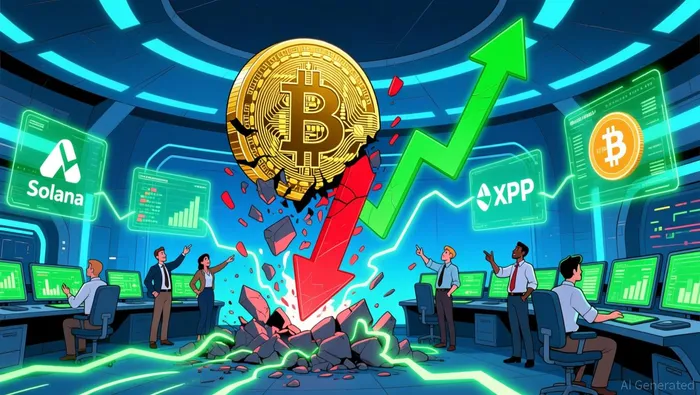
The crypto market's portfolio reallocation dynamics in late 2025 and early 2026 reveal a striking shift in investor priorities. BitcoinBTC-- ETFs, once the dominant onramp for institutional capital, experienced a net outflow of $4.57 billion in Q4 2025, coinciding with a 20% price decline for the asset. This exodus, however, did not signal a collapse in digital asset demand but rather a recalibration of risk and reward. As Bitcoin's dominance waned, capital flowed into altcoins with clearer utility and regulatory clarity, particularly SolanaSOL-- (SOL) and XRPXRP--. These assets attracted $3.64 billion and $3.75 billion in ETF inflows, respectively, outpacing even Bitcoin's $26.96 billion annual net flows. This article dissects the drivers behind this reallocation, focusing on the technological, regulatory, and market forces propelling Solana and XRP to prominence.
The Bitcoin Outflow: A Correction, Not a Collapse
Bitcoin's Q4 2025 outflows reflect a combination of profit-taking and macroeconomic pressures. After a record-breaking 2025-where global digital asset ETFs saw $50.77 billion in net inflows-investors began to reassess exposure as the asset's price correction exposed vulnerabilities in its ETF structure. BlackRock's iShares Bitcoin TrustIBIT-- (IBIT), the largest Bitcoin ETF, absorbed $25.01 billion in annual flows but faced a $400 million three-day outflow in late 2025, underscoring investor caution. The decline was exacerbated by structural selling pressures, including miner liquidations and leveraged position unwinds. Yet, Bitcoin's role as a core holding in crypto portfolios remains intact, with inflows rebounding in early 2026 as prices stabilized.
Altcoin Inflows: Solana and XRP as Institutional Satellites
While Bitcoin's outflows signaled a temporary retreat, altcoins emerged as beneficiaries of a more nuanced reallocation. Solana and XRP, in particular, captured institutional attention through a combination of technological innovation and regulatory progress.
 Solana's Institutional Playbook
Solana's $3.64 billion in ETF inflows in 2025 was driven by its high-throughput architecture and yield-bearing staking mechanisms. The network's Firedancer validator client, launched in Q1 2025, slashed validator costs by 50–80% and enabled parallel processing, enhancing scalability to over one million transactions per second. Meanwhile, the Alpenglow consensus upgrade in Q4 2025 introduced near-instant block finality, making Solana a viable backbone for institutional-grade applications. These upgrades, coupled with the launch of regulated Solana ETFs in the U.S. and Kazakhstan, attracted Digital Asset Treasury Companies (DATCOs) seeking yield and liquidity. Morgan Stanley's Q4 2025 filing for a proprietary Solana ETF further legitimized the asset, integrating it into wealth management portfolios.
XRP's Regulatory Breakthrough
XRP's $3.75 billion in ETF inflows was fueled by a post-SEC lawsuit resolution in August 2025, which cleared the way for re-listing on U.S. exchanges and ETF approvals. The asset's cross-border utility, particularly through Ripple's On-Demand Liquidity (ODL) service in Japan, reinforced its appeal as a settlement layer for global remittances. By early 2026, seven U.S.-based XRP ETFs had recorded 43 consecutive days of positive flows, with institutional investors accumulating the token at a 57% decline in exchange-held supply. This shift to cold storage and ETF custodial positions signaled confidence in XRP's role as a foundational infrastructure asset rather than a speculative play.
The Broader Market Realignment
The 2025 reallocation reflects a maturing crypto market where capital prioritizes utility over hype. Unlike the 2021 bull cycle, where altcoins like MATIC and AVAXAVAX-- surged on speculative fervor, 2025's "alt season" was defined by institutional-grade use cases. Solana's DeFi ecosystem and XRP's cross-border partnerships demonstrated tangible value, contrasting with the 85% of new tokens that traded below their initial valuations. Regulatory clarity-particularly the GENIUS Act's legitimization of blockchain assets-also played a pivotal role, enabling products like staking ETFs and structured ETPs.
Implications for 2026 and Beyond
The Q4 2025 reallocation suggests a structural shift in how capital is allocated in crypto. Bitcoin and EthereumETH-- will remain core holdings, but altcoins with robust use cases and regulatory alignment are emerging as satellites in diversified portfolios. For Solana, the challenge lies in addressing governance centralization concerns, while XRP must sustain its institutional momentum amid evolving regulatory scrutiny. Investors should monitor the performance of these assets against macroeconomic indicators and further technological upgrades, such as Solana's Internet Capital Markets vision and XRP's expansion into payroll solutions.
In conclusion, the Bitcoin outflows of late 2025 were not a rejection of digital assets but a recalibration toward a more mature, utility-driven market. As Solana and XRP demonstrate, the future of crypto investing lies in assets that bridge the gap between innovation and institutional adoption.





Comentarios
Aún no hay comentarios