
Bitcoin as a Financial Lifeline in Internet-Blackout Scenarios: Resilience Amid Geopolitical and Economic Instability
In an era marked by geopolitical tensions, economic volatility, and the fragility of centralized systems, BitcoinBTC-- has emerged as a decentralized alternative with unique resilience during internet blackouts. This analysis explores how Bitcoin functions as a financial lifeline in crisis scenarios, drawing on real-world case studies and technical innovations that enable its operation even when traditional infrastructure fails.
Technical Resilience: Bitcoin Beyond the Internet
Bitcoin's decentralized architecture allows it to operate independently of centralized internet infrastructure. Experimental projects like Blockstream Satellite broadcast the full blockchain via geostationary satellites, enabling nodes to sync even during regional internet outages. Similarly, ham radio experiments demonstrate the protocol's adaptability to alternative communication channels, such as Rodolfo Novak's 2019 transmission of a Bitcoin transaction over the 40-meter band. Mesh networks and LoRa radio systems further extend Bitcoin's reach in disaster zones, with tools like TxTenna and Darkwire enabling peer-to-peer transactions without reliance on cellular or fiber networks.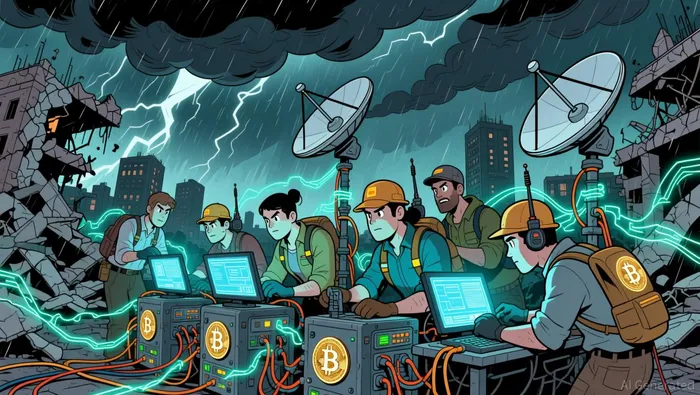 These innovations underscore Bitcoin's potential as a robust financial tool in environments where traditional systems falter.
Case Study 1: Venezuela – Crypto as a Hedge Against Hyperinflation
Venezuela's economic collapse, marked by hyperinflation exceeding 10 million percent in 2018, has driven widespread adoption of Bitcoin and stablecoins. By 2025, an estimated 10% of retail transactions in the country were conducted via crypto, with stablecoins dominating daily commerce. The decentralized nature of cryptocurrencies allowed Venezuelans to bypass government-imposed financial controls and access global markets. For instance, remittances from abroad totaled $5.4 billion in 2023, with Bitcoin serving as a critical conduit. The 2026 U.S. intervention against Nicolás Maduro's regime further accelerated crypto adoption, as citizens sought to evade sanctions and protect assets from seizure. Despite government crackdowns, the demand for decentralized finance persisted, highlighting Bitcoin's role as a tool for financial autonomy in crisis.
Case Study 2: Ukraine – Cross-Border Transactions During War
Ukraine's conflict with Russia has cemented its status as a global leader in crypto adoption. During the 2022–2025 period, Bitcoin became a vital tool for cross-border transactions, especially when the National Bank of Ukraine temporarily closed financial borders. By 2025, Ukraine ranked 8th globally in crypto adoption, with 15–16% of its population owning digital assets. The government itself accumulated a Bitcoin reserve of 46,351 BTCBTC-- (worth $5.6 billion as of mid-2025), recognizing the strategic value of digital assets in wartime economics. However, the unregulated nature of the crypto space also attracted criminal activity, including scams and money laundering schemes. Ukraine's evolving regulatory framework, including a 23% tax on crypto gains and alignment with the EU's MiCA standards, reflects efforts to balance innovation with oversight.
Economic Critiques and Limitations
While Bitcoin's utility in crisis scenarios is evident, its structural limitations remain a subject of debate. From a Post-Keynesian perspective, Bitcoin lacks the debt-based IOU structure that underpins traditional money, while Austrian economists argue it fails to evolve as a spontaneously accepted medium of exchange. Empirical analyses highlight its volatility, scalability constraints, and fragile market structure, which undermine its reliability as a store of value or medium of exchange. For example, Bitcoin's price during geopolitical shocks-such as the 2026 U.S. strike on Venezuela-exhibited sharp fluctuations, limiting its hedging capacity.
The Future of Bitcoin in Crisis Scenarios
Bitcoin's role as a financial lifeline is likely to expand as alternative infrastructure matures. Projects like LNMesh, which extend the Lightning Network to mesh networks, could enable offline micropayments during power outages. However, prolonged global internet shutdowns may fragment the Bitcoin network into isolated chains, complicating cross-border transactions until consensus is restored. Investors must weigh these technical possibilities against Bitcoin's economic limitations, recognizing its value as a decentralized tool in specific contexts rather than a universal solution.
Conclusion
Bitcoin's resilience during internet blackouts and geopolitical crises underscores its potential as a financial lifeline in unstable environments. While technical innovations like satellite and mesh networks enhance its accessibility, economic critiques highlight the need for caution. For investors, Bitcoin represents both an opportunity and a risk-a decentralized asset that can thrive in chaos but remains vulnerable to its own volatility and scalability challenges. As nations like Venezuela and Ukraine continue to test its limits, the broader implications for global finance will become increasingly clear.






Comentarios
Aún no hay comentarios