
Bitcoin's Fear & Greed Index: A Contrarian Compass for Navigating Market Cycles
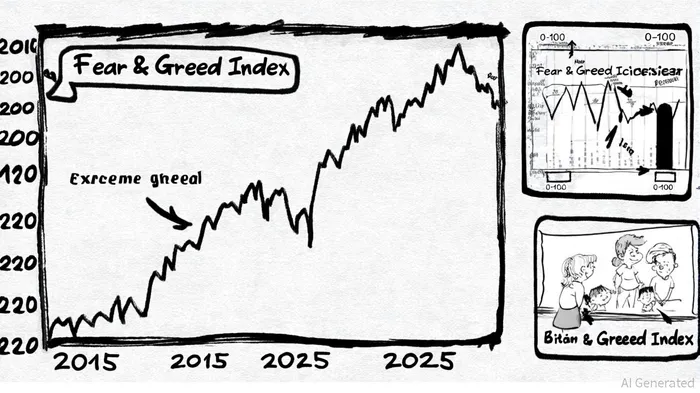
The BitcoinBTC-- Fear & Greed Index, a sentiment metric ranging from 0 (extreme fear) to 100 (extreme greed), has emerged as a critical tool for contrarian investors. Historical data from 2015 to 2025 reveals a striking evolution in its predictive power. While the index showed only a moderate 39.7% correlation with Bitcoin prices over the 7.5-year period, this relationship sharpened to 84% in the last six months of the dataset (February–August 2025), according to Renaud Cuny's analysis. This shift reflects a structural change in market dynamics, driven by institutional investors who systematically buy during fear-driven selloffs and sell during greed-fueled euphoria, a pattern Cuny documents in his work.
Historical Contrarian Patterns
Bitcoin's price cycles have long been shaped by investor psychology. For instance, the 2022 crypto winter—marked by extreme fear levels (<30 on the index)—coincided with a 70% price drop from its 2021 peak. Yet, this period also set the stage for a multi-year recovery, with Bitcoin rebounding to new all-time highs by late 2024, according to the index's historical trends. Similarly, the 2020 pandemic crash saw the index plunge to 12, only for Bitcoin to surge 200% within six months as shown on Coincodex's Fear & Greed. These examples underscore a recurring theme: extreme fear often precedes market bottoms, while extreme greed signals overbought conditions.
A study by Renaud Cuny found that the Fear & Greed Index accurately predicted 87% of Bitcoin's significant price moves in the last six months of the dataset. This high accuracy rate is partly due to the index's composite nature, incorporating volatility, momentum, and social media sentiment, as reflected in Bitdegree's live index. Notably, Cuny notes that Bitcoin prices have historically led the index by two days, offering a subtle but actionable edge for systematic traders.
Strategic Entry Points: A Contrarian Framework
For cyclical investors, the Fear & Greed Index acts as a psychological barometer. When the index dips below 30 (extreme fear), it often signals capitulation among retail investors, creating buying opportunities for long-term holders. Conversely, readings above 70 (extreme greed) indicate speculative frenzy, typically preceding profit-taking or corrections.
Institutional behavior amplifies these signals. Corporate treasuries and ETFs, for example, have increasingly adopted systematic strategies to purchase Bitcoin during fear-driven dips, driven by portfolio diversification mandates — a trend highlighted in Cuny's analysis. This institutional discipline has reduced the lag between sentiment extremes and price action, making the index a more reliable contrarian indicator in recent years.
Limitations and Nuances
While the Fear & Greed Index is a powerful tool, it is not infallible. False signals can occur during macroeconomic shocks (e.g., the 2023 banking crisis), where sentiment and price diverge due to external factors. Additionally, the index's reliance on social media sentiment can amplify noise during volatile periods. Investors should pair it with fundamental metrics like hash rate trends and on-chain activity for a holistic view.
Conclusion
Bitcoin's market cycles are increasingly governed by sentiment-driven feedback loops. The Fear & Greed Index, once a niche tool, has evolved into a robust contrarian indicator, particularly in the era of institutional participation. By identifying extremes in fear and greed, investors can align their strategies with the market's psychological pendulum, capitalizing on cyclical turning points. However, as with any metric, it must be used judiciously—anchored to broader market context and disciplined risk management.







Comentarios
Aún no hay comentarios