
Bitcoin's Exposure Risk via Index Delistings: Assessing MSCI's Impact on MicroStrategy and Institutional Strategies
MSCI's Delisting Criteria and the 50% Threshold
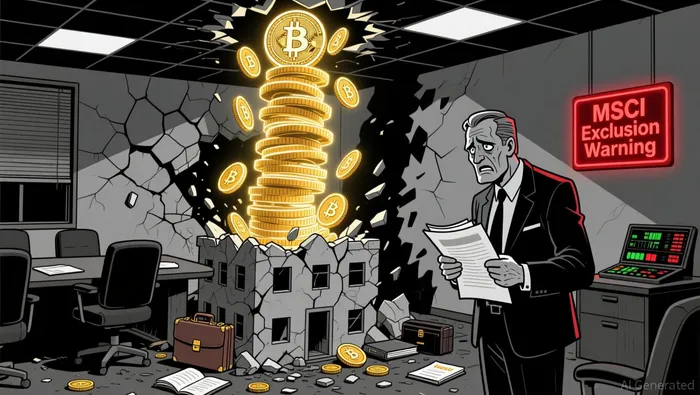
MSCI has proposed excluding companies where digital assets constitute 50% or more of total assets from its Global Investable Market Indexes. This rule, part of a consultation process closing on December 31, 2025, aims to address concerns about the volatility and speculative nature of crypto holdings. If finalized, the criteria would trigger a delisting review in February 2026. For companies like MicroStrategy, whose Bitcoin portfolio now dwarfs its traditional business operations, this rule could redefine institutional exposure to crypto assets.
MicroStrategy's Position: A Double-Edged Sword
MicroStrategy's aggressive Bitcoin accumulation has transformed it into a de facto digital asset treasury company (DAT). As of November 2025, its total assets exceed $69 billion, with Bitcoin accounting for over 100% of this value. While this strategy has generated substantial unrealized gains-$3.9 billion in Q3 2025 alone-the company's reliance on Bitcoin exposes it to regulatory and market risks. A MSCIMSCI-- delisting could erode institutional investor confidence, trigger liquidity challenges, and force a reevaluation of its capital structure.
The company's funding strategy, which prioritizes preferred stock over common stock, has mitigated dilution risks. However, a delisting could amplify pressure to sell Bitcoin to meet debt obligations, particularly if its adjusted Net Asset Value (mNAV) dips further below 1x-a scenario that became increasingly likely as Bitcoin prices fell below $108,000 in late 2025. Such forced selling could exacerbate downward price pressures, creating a self-fulfilling prophecy of instability.
Historical Context: Lessons from DATs
The risks of leveraged crypto strategies are not unique to MicroStrategy. Over the past two years, numerous DATs-companies pivoting to Bitcoin or other crypto holdings-have faced collapse due to forced selling dynamics. For example, firms that raised billions via convertible notes and private placements in 2024 and 2025 struggled when crypto prices declined, leading to cascading liquidations. These events drew parallels to the 2008 mortgage REIT crisis, where leverage and illiquidity amplified market downturns.
MicroStrategy's approach, while more conservative in terms of debt management, shares structural vulnerabilities with these DATs. Its "42/42" plan to raise $84 billion for Bitcoin purchases by 2027-double its prior target-relies on sustained investor confidence. A MSCI delisting could disrupt this trajectory, particularly if institutional investors perceive the company as a speculative asset rather than a stable corporate entity.
Broader Implications for Institutional Crypto Strategies
The potential delisting of MicroStrategy from MSCI indices underscores a systemic risk for institutional crypto strategies. If MSCI's criteria are implemented, it could signal a broader regulatory shift toward excluding crypto-heavy companies from major indices, reducing their visibility and liquidity. This would disproportionately affect firms with high leverage or opaque business models, as seen in the collapse of DATs like SRM Entertainment and Safety Shot(https://finance.yahoo.com/news/money-losing-companies-colorful-histories-111442906.html).
Moreover, the delisting could accelerate a bifurcation in the market between "blue-chip" crypto adopters (like MicroStrategy) and speculative DATs. While the former may retain institutional support, the latter could face intensified scrutiny, leading to further consolidation or exits. This dynamic highlights the importance of diversification and risk management in institutional crypto portfolios.
Conclusion
MSCI's proposed delisting criteria represent a pivotal moment for institutional crypto strategies. For MicroStrategy, the risk of exclusion from major indices hinges on its ability to maintain a balance between Bitcoin's volatility and corporate stability. Investors must monitor the company's mNAV, debt structure, and Bitcoin price trends closely, as a delisting could trigger forced selling and market instability. Broader lessons from DAT collapses emphasize the need for caution in leveraging public markets for crypto investments. As the consultation period concludes in December 2025, the coming months will determine whether institutional crypto strategies evolve toward resilience-or repeat the mistakes of the past.





Comentarios
Aún no hay comentarios