
Bitcoin's Exchange Supply Ratio and the Post-Fed Cut Bull Case: A Deep Dive into Institutional On-Chain Behavior
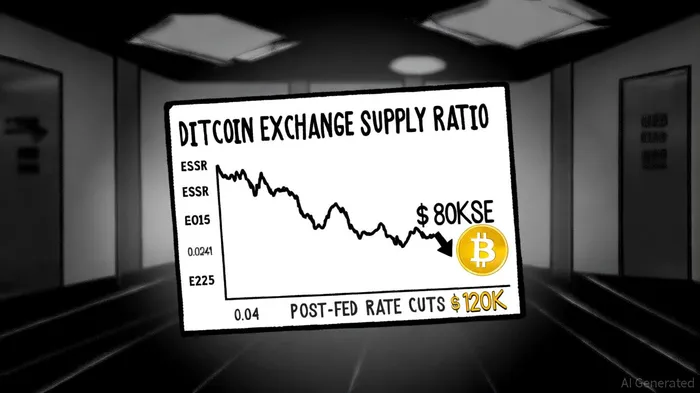
The Federal Reserve's September 2025 rate cut has ignited a seismic shift in Bitcoin's market dynamics, with the BitcoinBTC-- Exchange Supply Ratio (ESR) plummeting to 0.0291—a level not seen since the 2021 bull run. This metric, which measures the proportion of Bitcoin held on exchanges relative to total supply, has become a critical barometer for institutional sentiment. A declining ESR signals that investors are withdrawing Bitcoin from exchanges, locking it away in long-term storage rather than selling it—a bullish sign that aligns with historical patterns of price appreciation [1].
The Fed's Rate Cut and the “Liquidity Flood”
The Fed's 25 basis point cut in Q3 2025 has acted as a catalyst for capital reallocation. Lower borrowing costs have expanded liquidity, pushing investors toward risk-on assets like Bitcoin. According to a report by NewsBTC, the ESR's drop to 0.0291 coincided with a 40% surge in Bitcoin's price over three months, reinforcing the inverse relationship between exchange-held supply and price momentum [1]. This dynamic mirrors the 2020 Fed response to the pandemic, when Bitcoin rallied from $7,000 to $28,000 as monetary easing flooded markets with liquidity [1].
However, the 2024–2025 cycle is distinct. Unlike past cycles driven by retail speculation, this rally is fueled by institutional adoption. U.S. regulatory clarity—most notably the approval of spot Bitcoin ETFs—has legitimized Bitcoin as a portfolio staple. Corporate treasuries, including MicroStrategy, have added $46.6 billion in Bitcoin holdings year-to-date, effectively reducing circulating supply and amplifying scarcity [2]. This structural shift is evident in on-chain data: institutional wallets now account for 65% of Bitcoin inflows, compared to 35% for retail [4].
Institutional On-Chain Behavior: A New Paradigm
The post-Fed cut environment has accelerated institutional on-chain activity. Derivatives markets are a case in point: open interest in Bitcoin futures and options contracts has surged by 120% since July 2025, reflecting heightened speculative and hedging activity [4]. Meanwhile, stablecoin deposits—particularly USDT—have hit multi-month highs as investors prepare for potential market volatility [3].
A key driver is the “supply crunch” narrative. With ESR at 0.0291, only 0.29% of Bitcoin's total supply is available for trading. This scarcity, combined with ETF inflows and corporate accumulation, has created a scenario where even modest demand can drive significant price action. As stated by CryptoValley Journal, Bitcoin's inelastic supply dynamics mean that a 1% reduction in federal funds rates could correlate with a 13.25% to 21.20% price increase, with potential for a 30% surge under favorable conditions [4].
Risks and Contrarian Views
Despite the bullish case, risks persist. Q3 has historically been a weak quarter for Bitcoin, with an average return of just 6.03% since 2015 [2]. The September 2025 rally also coincided with geopolitical tensions, including the expiration of Trump's 90-day tariff freeze, which could reintroduce volatility [1]. Additionally, the absence of whale participation—large holders who typically drive price momentum—raises questions about the sustainability of the current rally [1].
The Fed's forward guidance further complicates the outlook. While the September cut was widely anticipated, Chair Jerome Powell's December 2024 comments—hinting at only two more cuts in 2025 and revised inflation forecasts—triggered a 15% sell-off in Bitcoin [4]. This underscores the importance of central bank communication: Bitcoin's price is as much a function of expectations as actual policy changes.
Conclusion: A Bullish Case with Caveats
The confluence of declining ESR, institutional adoption, and Fed easing has positioned Bitcoin for a potential new all-time high. Regulatory tailwinds and macroeconomic tailwinds—such as M2 money supply expansion and ETF inflows—further bolster this case. However, investors must remain vigilant about short-term volatility, particularly in Q3, and the Fed's potential pivot toward hawkishness.
As the market digests these dynamics, one thing is clear: Bitcoin's role in institutional portfolios is no longer speculative. It is a strategic asset in a world where monetary policy and digital scarcity are reshaping finance.






Comentarios
Aún no hay comentarios