
Bitcoin's Evolving Role as a Risk-On Asset: Lessons from Market Stress Events
Bitcoin's journey from a speculative digital asset to a contested "digital gold" narrative has been punctuated by its performance during market stress events. Over the past five years, its behavior has diverged sharply from traditional safe-haven assets, revealing a complex interplay between macroeconomic forces, investor sentiment, and institutional adoption. This analysis examines Bitcoin's evolving role as a risk-on asset, drawing on historical data from the 2020 pandemic crash and the 2022 macroeconomic turmoil, while contextualizing its sensitivity to interest rates and geopolitical shocks.
The 2020 Pandemic Crash: Resilience Amid Uncertainty
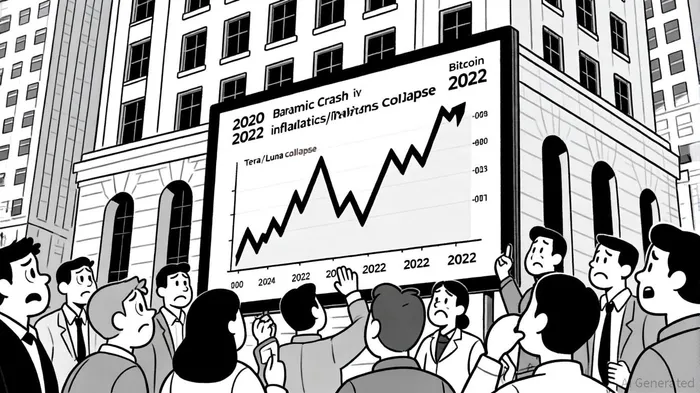
When the global economy shuttered in early 2020, BitcoinBTC-- plummeted from $10,000 to $4,000 within weeks, mirroring the broader market selloff, according to a LinkedIn analysis. However, its subsequent recovery to nearly $29,000 by year-end defied expectations, as shown in a ScienceDirect study. The ScienceDirect study also found Bitcoin's trading volume surged during this period, suggesting its adoption as a digital safe haven amid liquidity-driven panic. Yet, its price action also reflected speculative fervor rather than a traditional safe-haven role, as it moved in tandem with equities for much of the year, as noted in a SpringerOpen paper.
2022: A Test of Volatility and Macro Sensitivity
The 2022 market environment-marked by inflationary pressures, aggressive rate hikes, and the Terra/Luna collapse-exposed Bitcoin's fragility. From $40,000, it tumbled to $17,000 by late 2022, outperforming equities in relative terms but failing to stabilize as a hedge, as discussed in the LinkedIn analysis. This decline was exacerbated by spillovers from traditional markets, with Bitcoin's volatility amplifying macroeconomic shocks, a pattern the SpringerOpen paper also documents. A key factor was its heightened sensitivity to interest rates: as central banks raised rates to combat inflation, Bitcoin's discount rate for future cash flows widened, eroding its valuation, according to a CME Group analysis.
Investor Behavior: From Safe Haven to Speculative Play
Investor behavior during these crises underscores Bitcoin's dual identity. During the 2020 crash, retail and institutional investors flocked to Bitcoin as a store of value, driving up trading volumes, as the ScienceDirect study reports. However, the 2022 selloff revealed a preference for liquidity over conviction, with investors abandoning Bitcoin amid rising risk-off sentiment, per the LinkedIn analysis. This duality-acting as both a speculative asset and a partial safe haven-highlights its context-dependent utility. As the CME Group analysis notes, Bitcoin's beta coefficient (a measure of market sensitivity) rose to levels comparable to high-beta equities during 2020–2021, cementing its identity as a risk-on asset.
Correlation with Equities: A New Normal
Bitcoin's correlation with equities has evolved dramatically. Pre-2020, its relationship with the S&P 500 was near-zero, aligning with its "digital gold" narrative, as the SpringerOpen paper describes. However, the 2020 crash triggered a sharp rise in correlation to 0.58, a level that persisted through 2022, according to the CME Group analysis. This shift reflects Bitcoin's integration into diversified portfolios and its exposure to macroeconomic variables like interest rates. During the 2022 rate hike cycle, Bitcoin and growth stocks fell in lockstep, illustrating its alignment with risk-on dynamics noted in the CME Group analysis.
Implications for Investors
For investors, Bitcoin's evolving role demands a recalibration of portfolio strategies. While it retains allure as a hedge against inflation and currency devaluation, its heightened correlation with equities and sensitivity to interest rates limit its utility during broad-based downturns. The 2022 experience, in particular, underscores the importance of treating Bitcoin as a high-volatility, macro-sensitive asset rather than a traditional safe haven.
Conclusion
Bitcoin's performance during market stress events reveals a maturing but still volatile asset class. Its transition from a speculative play to a risk-on asset with macroeconomic exposure redefines its role in modern portfolios. As central banks continue to navigate inflation and geopolitical risks, Bitcoin's future will hinge on its ability to balance institutional adoption with its inherent volatility-a dynamic that investors must monitor closely.






Comentarios
Aún no hay comentarios