
Bitcoin's Evolving Role in a Rising Stablecoin Economy: Reassessing Long-Term Price Potential Amid Shifting Use Cases and Macro Dynamics
The Transactional Shift: Stablecoins as Bitcoin's Rival
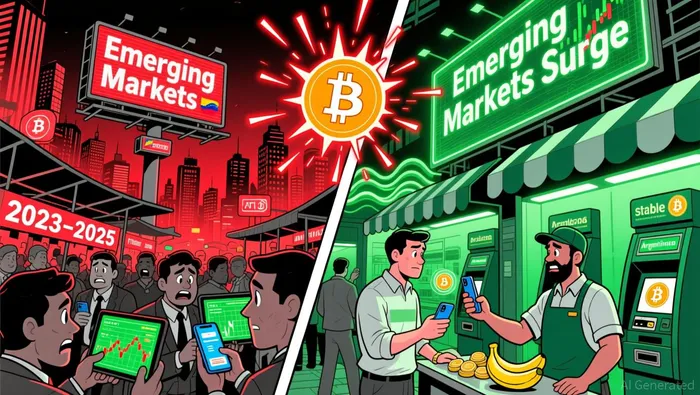
Bitcoin's early narrative as a "digital gold" or "store of value" emerged partly in response to its volatility, which limited its utility as a medium of exchange. However, the rise of stablecoins-particularly dollar-pegged tokens like TetherUSDT-- (USDT) and USD Coin (USDC)-has disrupted this dynamic. By 2025, stablecoins accounted for 30% of all on-chain crypto transaction volume, with annualized transaction volumes exceeding $4 trillion in August 2025, an 83% increase from 2024, according to a Trmlabs report. This growth is most pronounced in emerging markets, where hyperinflation and capital controls have made stablecoins a practical alternative to both local currencies and BitcoinBTC--.
For example, in Venezuela, where inflation reached 269% in 2025, stablecoins have become the de facto medium of exchange for everyday transactions, bypassing Bitcoin's volatility, according to a Bitbo.io article. Similarly, in Argentina, dollar-pegged stablecoins are used to hedge against the peso's instability, reducing demand for Bitcoin as a transactional tool. Cathie Wood of Ark Invest has acknowledged this shift, cutting her 2030 Bitcoin price target from $1.5 million to $1.2 million, citing stablecoin adoption as a key factor, according to a CryptoTimes article. While Bitcoin retains its role as a store of value, its competition with stablecoins in transactional use cases is undeniable.
Macroeconomic Forces and Monetary Policy: Bitcoin's New Constraints
Bitcoin's price dynamics are increasingly influenced by macroeconomic factors, particularly U.S. monetary policy. Historically, Bitcoin exhibited little correlation with traditional assets, but post-2020, it has mirrored the behavior of equities and commodities in response to Federal Reserve decisions. For instance, Bitcoin prices have fallen sharply during U.S. monetary tightening cycles, with the decline persisting for months-a pattern more pronounced than in traditional markets, according to a ScienceDirect study. This suggests Bitcoin is now treated as a speculative asset rather than a hard-hedge against inflation.
The interplay between stablecoins and Bitcoin further complicates this dynamic. While stablecoins are pegged to the U.S. dollar, their growth has created a paradox: as stablecoins absorb transactional demand, Bitcoin's price becomes more sensitive to macroeconomic shifts. For example, the $45 billion in stablecoin reserves on Binance in late 2025 signaled bullish momentumMMT-- for Bitcoin, as increased stablecoin liquidity often precedes buying pressure, according to a Coinotag article. However, this relationship is not linear. If stablecoins continue to dominate transactional use cases, Bitcoin's price may become more decoupled from traditional monetary policy, relying instead on institutional adoption and speculative demand.
Regulatory Developments: A Double-Edged Sword
Regulatory clarity has been a mixed blessing for Bitcoin's long-term prospects. On one hand, the U.S. passage of the GENIUS Act in July 2025 provided a federal framework for stablecoin issuance, legitimizing their role in the financial system, according to a CryptoTimes article. This has accelerated stablecoin adoption in emerging markets, where they now compete directly with Bitcoin for utility. On the other hand, Bitcoin's institutional adoption-bolstered by ETFs and corporate holdings-has created a new layer of stability. For instance, American BitcoinABTC-- Corp. (ABTC) has accumulated 4,004 Bitcoin as part of its strategy to build a "strategic reserve," signaling growing confidence in Bitcoin's role as a long-term store of value, according to a Investing.com article.
However, regulatory scrutiny of stablecoins could indirectly benefit Bitcoin. If central banks impose stricter controls on stablecoin issuance or pegging mechanisms, demand for Bitcoin as a decentralized alternative may rebound. This scenario is not without precedent: in 2023, China's crackdown on stablecoins led to a surge in Bitcoin adoption among users seeking to circumvent capital controls, according to a ScienceDirect study.
Reassessing Price Targets: Bullish and Bearish Scenarios
The conflicting price forecasts for Bitcoin in late 2025 reflect the uncertainty created by these shifting dynamics. Optimists like Michael Saylor and Tom Lee remain bullish, predicting prices of $150,000–$250,000 by year-end, driven by institutional inflows and Bitcoin's maturation into a regulated asset class, according to a Yahoo Finance article. Bull Theory's analysis suggests that a mere 0.2% reallocation of global assets into Bitcoin could inject $93.8 billion into the market, potentially pushing the price to $160,000, according to a Yahoo Finance article.
Conversely, analysts like Houston Morgan and Bitfinex have revised their targets downward to $125,000, citing market exhaustion and structural selling pressure from long-term holders, according to a Coinotag article. The Crypto Fear & Greed Index plummeted to 21 in October 2025, reflecting extreme fear among investors as Bitcoin dropped to a four-month low of $100,800, according to a Coinotag article. These bearish signals highlight the fragility of Bitcoin's price in a market where stablecoins are increasingly fulfilling its original transactional role.
Conclusion: A Tenuous Balance
Bitcoin's long-term price potential hinges on its ability to coexist with stablecoins while maintaining its unique value proposition. As stablecoins dominate transactional use cases, Bitcoin must rely on its scarcity, institutional adoption, and speculative demand to justify its price. However, this balance is precarious: if stablecoins continue to erode Bitcoin's utility, its price may stagnate despite macroeconomic tailwinds. Conversely, regulatory shifts or renewed speculative fervor could propel it toward ambitious price targets.
For investors, the key takeaway is clear: Bitcoin's role in a rising stablecoin economy is not a zero-sum game. The interplay between these two asset classes will define the next phase of crypto's evolution, and understanding this dynamic is essential for navigating the uncertainties ahead.





Comentarios
Aún no hay comentarios