
Bitcoin's Evolving Macroeconomic Role: A Liquidity Barometer in a Post-Inflation Narrative
The Liquidity Barometer Thesis
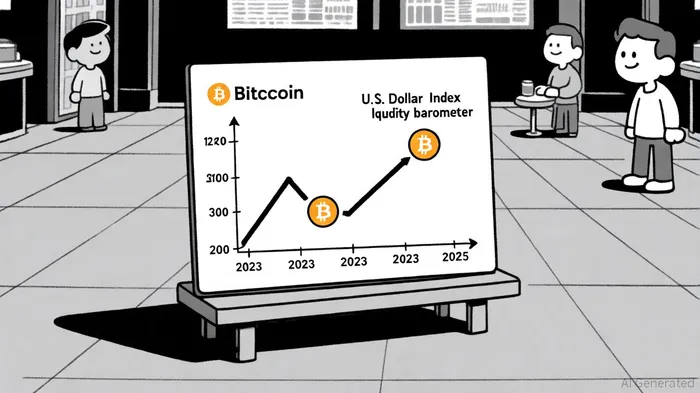
Bitcoin's correlation with global liquidity is now well-documented. According to a report by Lyn Alden and a Binance Alpha 2.0 report, Bitcoin moves in the same direction as global liquidity in 83% of 12-month periods, making it a more sensitive indicator of liquidity trends than traditional assets. This dynamic is reinforced by its inverse correlation with real interest rates and the DXY. For instance, declining bond yields, a weaker dollar, and anticipated Federal Reserve rate cuts have historically driven Bitcoin higher, while tightening liquidity and rising rates have pressured its price, as shown in a ScienceDirect analysis.
The cryptocurrency's liquidity barometer role is further validated by its behavior during liquidity expansions and contractions. When central banks inject capital into markets-through quantitative easing or accommodative policies-Bitcoin tends to thrive. Conversely, during liquidity crunches, such as those seen in 2022, Bitcoin often underperforms. This pattern positions it as a leading indicator of broader market sentiment, reflecting investors' expectations about monetary conditions rather than just inflation, a trend noted in the Binance Alpha 2.0 report.
Bitcoin in a Post-Inflation Narrative
While Bitcoin is often touted as an inflation hedge, recent studies reveal a more nuanced picture. Research from NYDIG, in an NYDIG report, clarifies that Bitcoin's price is not consistently correlated with inflation metrics like CPI or PPI but is instead driven by liquidity and monetary policy shifts. For example, during periods of dollar weakness and liquidity-driven economic conditions, Bitcoin aligns with gold, another asset sensitive to fiat currency devaluation, a point also noted in the NYDIG report.
Academic analyses further support this narrative. A time-series study found that Bitcoin Granger causes changes in forward inflation rates, suggesting it could act as a leading indicator of inflation expectations. Another study confirmed Bitcoin's inflation-hedging properties during the pandemic but noted its lack of safe-haven status, as prices decline during financial uncertainty, according to a pandemic-era study. These findings highlight Bitcoin's dual role: it can hedge against inflation in certain contexts but is not immune to macroeconomic volatility.
Institutional Adoption and Liquidity Dynamics
Institutional adoption is reshaping Bitcoin's liquidity profile. JPMorgan's recent initiative to accept Bitcoin and EthereumETH-- as collateral for institutional loans could unlock $10–$20 billion in immediate lending capacity, signaling broader acceptance of crypto in traditional finance, according to a CryptoSlate article. This move institutionalizes crypto-backed credit and integrates Bitcoin into global liquidity systems, amplifying its role as a barometer.
Meanwhile, Bitcoin's own liquidity has tightened. Long-term holders have accumulated over 373,700 BTC in a single month, reducing sell-side liquidity to 3.12 million BTC-a seven-year low, as reported in the Binance Alpha 2.0 report. This scarcity could drive upward price pressure, especially as platforms like Binance Alpha 2.0 report record trading volumes, reflecting heightened retail and institutional participation.
Geopolitical and Trade Impacts
Bitcoin's sensitivity to macroeconomic and geopolitical events further cements its barometer status. The recent U.S.-China trade deal framework, which averted 100% additional tariffs, triggered a 1.8% rally in Bitcoin to $68,500, alongside gains in Ether and SolanaSOL--, according to a US-China trade report. This mirrors historical patterns where trade de-escalations boost crypto liquidity, underscoring Bitcoin's role in gauging global economic stability.
Conclusion: A New Era for Bitcoin
Bitcoin's evolving macroeconomic role is no longer speculative-it is a reality backed by data and institutional action. As central banks navigate post-inflationary environments and global liquidity shifts, Bitcoin's inverse relationship with the dollar and real rates, coupled with its responsiveness to policy and geopolitical developments, positions it as a critical asset for investors. For those seeking exposure to liquidity trends, Bitcoin offers a unique lens into the future of global finance.






Comentarios
Aún no hay comentarios