
Bitcoin's Evolving Correlation with Equities and Commodities: A New Era for Portfolio Diversification and Volatility Management
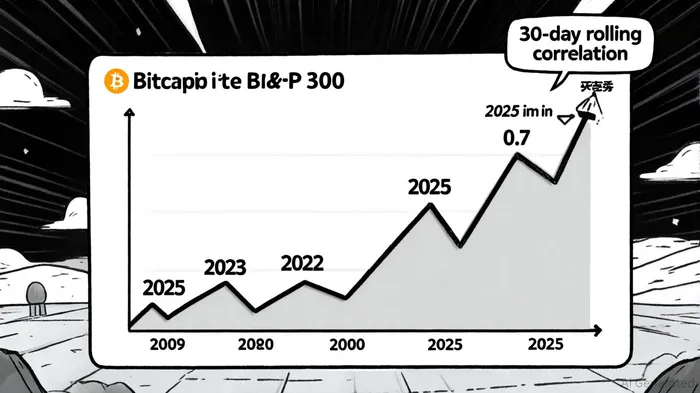
Bitcoin's relationship with global equities and commodities has undergone a seismic shift over the past decade, challenging long-held assumptions about its role as a "non-correlated" asset. Once hailed as digital gold-a store of value insulated from traditional market dynamics-Bitcoin now exhibits a positive correlation of approximately 0.5 with major equity indices like the S&P 500 and Nasdaq-100, particularly during periods of macroeconomic stress, according to a CME Group analysis. This transformation, driven by institutional adoption, regulatory innovation, and systemic market interdependencies, has profound implications for portfolio diversification and volatility management.
The Macroeconomic Drivers of Correlation Shifts
Bitcoin's evolving behavior mirrors broader macroeconomic trends. During the 2020 pandemic, for instance, its correlation with equities spiked as liquidity crunches forced investors to sell across asset classes, including crypto, as noted in the CME GroupCME-- analysis. Similarly, the 2025 geopolitical and earnings-related volatility saw BitcoinBTC-- align closely with risk assets, reflecting its integration into diversified portfolios. Institutional adoption-via ETFs, futures, and corporate treasury strategies-has amplified this alignment, making Bitcoin a high-beta extension of equity markets, according to the same CME Group analysis.
Monetary policy also plays a pivotal role. Bitcoin's inverse correlation with the U.S. Dollar Index (DXY) underscores its sensitivity to inflationary pressures and loose monetary conditions, according to a PMC study. During the 2020-2022 period, Bitcoin thrived under Fed easing but faltered during tightening cycles, mirroring the performance of risk assets. This dynamic suggests Bitcoin is no longer a standalone hedge but a barometer of systemic risk, reacting to central bank actions much like traditional markets, according to a JU blog post.
Portfolio Diversification: A Double-Edged Sword
Bitcoin's utility as a diversifier remains context-dependent. In low-uncertainty environments, its low correlation with equities and commodities offers meaningful risk-adjusted returns. A 10-year analysis found Bitcoin's Sharpe ratio (0.85) outperformed gold (0.28) and approached the S&P 500 (0.54), while its Sortino ratio (3.2 as of September 2025) highlighted superior downside protection, as shown in a Visual Capitalist chart. However, during extreme stress events-such as the 2020 pandemic or 2025 tariff shocks-Bitcoin's volatility (3.6x gold, 5.1x equities) amplifies losses, eroding diversification benefits, according to the iShares volatility guide.
Studies using ADCC-GARCH models reveal Bitcoin's dual nature: it acts as a diversifier for most traditional assets but behaves as a risk asset during global shocks, consistent with findings from the PMC study. For example, during the 2020 pandemic, Bitcoin's volatility connectedness with equities and commodities surged, making it a synchronized rather than independent asset, as documented in a ScienceDirect paper. This asymmetry underscores the need for strategic allocation, with Bitcoin serving as a hedge only during high economic policy uncertainty (EPU) periods, according to a ScienceDirect study.
Volatility Management: Lessons from 2025
The 2025 market stress events provide a case study in Bitcoin's volatility dynamics. Corporate treasuries adopted structured strategies-such as dollar-cost averaging (DCA) and hybrid custody models-to mitigate Bitcoin's price swings, according to a Business Initiative article. Businesses allocated 10% of net income to Bitcoin via DCA, treating it as a long-term strategic asset akin to real estate. That Business Initiative article noted this approach reduced short-term exposure while leveraging Bitcoin's potential as a hedge against geopolitical instability.
However, Bitcoin's volatility remains a challenge. Historical drawdowns exceeding 80% and recovery periods of three years highlight the risks of overexposure, as noted in the iShares volatility guide. Institutional investors now use derivatives and on-chain metrics (e.g., MVRV Z-Score) to time entries, balancing growth potential with risk management, as outlined in a Nasdaq outlook.
The Road Ahead: Policy, Geopolitics, and Structural Shifts
Bitcoin's future correlation profile will hinge on macroeconomic and regulatory developments. The European Union's MiCA framework and U.S. ETF approvals have normalized Bitcoin's role in portfolios, increasing its sensitivity to traditional market forces, according to an OKX analysis. Meanwhile, geopolitical tensions-such as Middle East conflicts in 2025-have reinforced Bitcoin's appeal as an alternative safe haven, albeit with mixed effectiveness, as discussed in that OKX analysis.
As Bitcoin's supply dynamics (e.g., 2024 halving) and institutional demand evolve, its correlation with equities and commodities will likely stabilize further. Yet, investors must remain vigilant: Bitcoin's high-beta nature ensures it will continue to amplify both gains and losses during market cycles.
Conclusion
Bitcoin's journey from a non-correlated asset to a synchronized risk asset reflects the maturation of the crypto market. While it retains diversification potential in low-uncertainty environments, its role during stress events is increasingly aligned with equities and commodities. For investors, the key lies in strategic allocation-leveraging Bitcoin's upside during expansionary cycles while hedging its volatility through structured strategies. As macroeconomic and regulatory landscapes evolve, Bitcoin's place in the portfolio will remain a dynamic, context-dependent proposition.





Comentarios
Aún no hay comentarios