
Bitcoin ETFs: A New Era of Institutional Adoption and Retail Participation
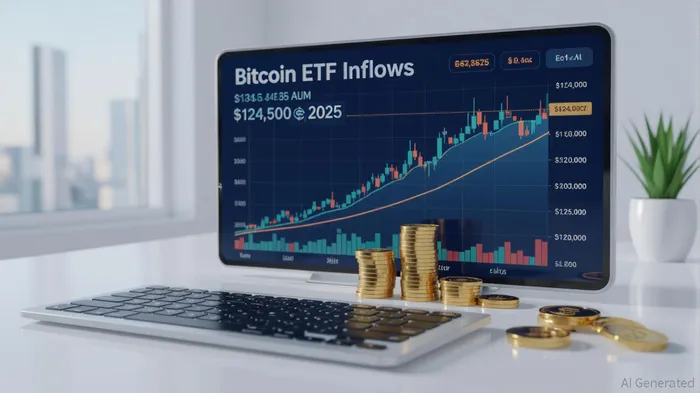
The launch of U.S. spot BitcoinBTC-- ETFs in early 2024 marked a seismic shift in the cryptocurrency market, catalyzing unprecedented institutional and retail participation. By Q3 2025, these ETFs had attracted over $134.6 billion in assets under management, with cumulative net inflows reaching $118 billion during the same quarter[3]. This influx of capital has not only reshaped Bitcoin's price dynamics but also redefined its role in modern portfolio construction. As institutional players and retail investors alike embrace crypto-backed ETFs, the strategic implications for Bitcoin's price trajectory and diversification benefits are becoming increasingly profound.
Institutional Adoption: A Catalyst for Price Appreciation
The institutional adoption of Bitcoin has accelerated dramatically in 2025, driven by the regulatory clarity provided by the SEC's approval of spot Bitcoin and EthereumETH-- ETFs. According to a report by Blockchain News, U.S. spot Bitcoin ETFs have become the primary conduit for institutional capital, with ETFs acquiring nearly three times the amount of Bitcoin mined in December 2024[3]. This demand-supply imbalance has directly contributed to Bitcoin's historic highs, pushing its price above $124,000 in late 2024[3].
Ethereum, too, has benefited from institutional interest, particularly after the SEC's May 2024 approval of spot ETH ETFs[1]. Institutional investors are not only purchasing Ethereum through ETFs but also staking the asset, which locks up supply and further supports price appreciation[2]. Beyond Bitcoin and Ethereum, inflows into SolanaSOL-- (SOL) and XRPXRP-- ETFs have shown growing momentum, with global net inflows reaching $1.35 billion and $2.02 billion, respectively[4]. This diversification of institutional portfolios into altcoins reflects a broader recognition of crypto's potential to generate alpha in a low-yield environment.
Bitcoin's Price Trajectory: Inflows and Macro Tailwinds
The correlation between Bitcoin ETF inflows and price movements has become increasingly evident in 2025. Data from Financial Content indicates that Bitcoin's price surged to an all-time high of $109,000 in Q1 2025, only to face sharp corrections due to macroeconomic uncertainties and regulatory developments[4]. However, the sustained inflows into ETFs have acted as a stabilizing force, with analysts predicting Bitcoin could reach $150,000 or even $200,000 by year-end 2025[5].
A key driver of this optimism is the U.S. government's establishment of a “Strategic Bitcoin Reserve” under a pro-crypto administration[4]. This move, coupled with the approval of new ETFs like the VanEck Solana ETF, signals a structural shift in how institutions view Bitcoin—as a strategic asset rather than a speculative gamble[4]. Additionally, the fixed supply of Bitcoin and its decentralized nature position it as a hedge against inflation and geopolitical instability, further bolstering its appeal in uncertain times[4].
Portfolio Diversification: Balancing Risk and Reward
While Bitcoin's volatility remains a barrier for conservative investors, its role in portfolio diversification has gained traction. Studies suggest that Bitcoin historically demonstrates low to moderate correlations with traditional asset classes, offering potential diversification benefits[2]. For instance, Bitcoin's annualized standard deviation of approximately 60% contrasts sharply with the 15% seen in U.S. large-cap equities[1]. However, this volatility can be mitigated through strategic allocation, particularly as crypto markets mature and regulatory frameworks solidify[2].
In 2025, major pension funds and corporations have begun allocating significant portions of their portfolios to Bitcoin, recognizing its potential to enhance risk-adjusted returns[4]. A primer by 21Shares highlights that including Bitcoin in a diversified portfolio can reduce overall risk while capturing growth in a non-correlated asset class[2]. That said, investors must balance Bitcoin's high volatility with their risk tolerance and investment horizon.
Strategic Implications and the Road Ahead
The strategic implications of Bitcoin ETFs extend beyond price appreciation. As institutional adoption deepens, the asset is increasingly viewed as a “digital gold,” with its fixed supply and decentralized properties offering a compelling alternative to fiat currencies[4]. Moreover, the approval of new ETFs and the growing participation of retail investors via platforms like RobinhoodHOOD-- and Web3 wallets are democratizing access to crypto, further legitimizing its role in mainstream finance[4].
Looking ahead, the interplay between macroeconomic factors and ETF inflows will likely shape Bitcoin's trajectory. A study by Sarkar (2025) notes a correlation coefficient of 0.78 between global M2 money supply growth and Bitcoin price appreciation during 2020–2023[1], suggesting that inflationary pressures and monetary expansion could continue to drive demand. Additionally, technological advancements like Ethereum's staking mechanisms and Solana's high-throughput blockchain are expected to attract further institutional capital[2].
Conclusion
Bitcoin ETFs have ushered in a new era of institutional adoption and retail participation, fundamentally altering the cryptocurrency landscape. The unprecedented inflows into these funds have not only driven Bitcoin's price to historic highs but also reinforced its role as a strategic asset in diversified portfolios. While challenges such as volatility and regulatory scrutiny remain, the growing acceptance of crypto-backed ETFs signals a shift toward mainstream adoption. For investors, the key lies in balancing Bitcoin's unique risks with its potential to deliver uncorrelated returns in an increasingly interconnected financial world.






Comentarios
Aún no hay comentarios