
Bitcoin ETFs Defy Price Correction with Strong Institutional Inflows
Institutional Inflows and Market Structure
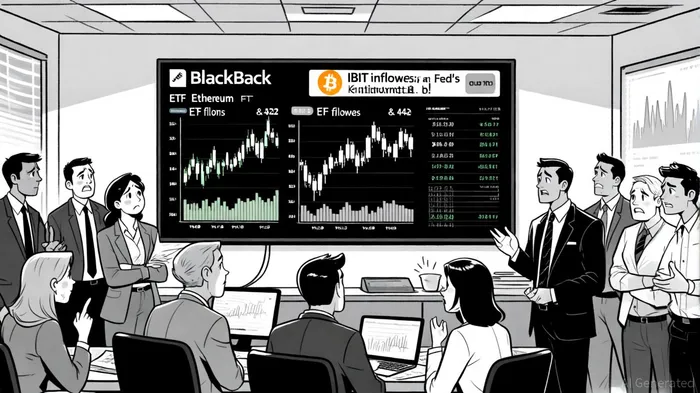
The surge in ETF inflows is notNOT-- merely a liquidity story-it is reshaping Bitcoin's market structure. As of October 2025, Bitcoin ETFs hold over 800,000 BTC, with BlackRock's IBITIBIT-- alone approaching $100 billion in net assets, as reported earlier by Coinotag. This institutional-grade custody of Bitcoin has created a new layer of demand, effectively decoupling price action from traditional speculative cycles. For instance, during the week of October 6–10, Bitcoin ETFs recorded a net inflow of $2.71 billion, with IBIT accounting for 97% of that total, according to a Coinotag analysis. Such concentrated inflows signal a shift from retail-driven volatility to institutional-driven stability, as large players use ETFs to accumulate Bitcoin in a regulated, tax-efficient manner.
A critical development is the integration of institutional-grade custody platforms into the ETF ecosystem. In October 2025, BlackRockBLK-- transferred $226 million in Bitcoin and Ethereum to Coinbase Prime, a move attributed to ETF liquidity management and portfolio rebalancing, according to a CryptoNinjas report. This activity reflects the maturation of crypto infrastructure, where institutions are no longer just trading Bitcoin but embedding it into broader financial systems. JPMorgan's upcoming crypto-backed loan program, expected to inject $50 billion in secondary market liquidity by late 2025, further reinforces this trend, as highlighted in a 4T analysis.
Smart Accumulation and Bull Market Indicators
Historical patterns suggest that Bitcoin ETF inflows are not just a reflection of market sentiment but a leading indicator of bull cycles. Data from Glassnode reveals that every $500 million in new ETF capital has historically lifted Bitcoin by 2.5–3.0%, as noted by 4T. This dynamic played out in late October 2025, when a $931 million inflow-spurred by the Fed's rate cut announcement and lower-than-expected U.S. CPI data-pushed Bitcoin above $110,000, according to a Bitcoinsistemi article.
Moreover, on-chain metrics paint a picture of disciplined accumulation. Despite short-term outflows of -2,000 BTC in late October, dormant wallets have resumed activity, transferring Bitcoin into ETF custodial structures, 4T reports. This "smart accumulation" mirrors patterns observed in late 2024 and early 2025, where institutional buying preceded price recoveries. The current institutional share of Bitcoin's market cap-6.78%-also aligns with pre-bull market conditions, outpacing Ethereum's 5.55% and signaling a consolidation of institutional demand, as previously analyzed by 4T.
The Road to a Potential Bull Run
The structural changes in Bitcoin's market are not isolated to ETFs. The approval of multi-asset ETFs, such as ProShares' CoinDesk 20 ETF, could further diversify institutional exposure, reducing single-asset volatility and enhancing liquidity, 4T suggests. Meanwhile, macroeconomic catalysts-like the Fed's October 29 rate cut-remain pivotal. Analysts project that Bitcoin could test $120,000–$125,000 by year-end, assuming ETF inflows continue and geopolitical tensions ease, according to 4T.
However, risks persist. Ethereum's outflows and the cyclical nature of ETF flows highlight the need for caution. Investors should monitor on-chain metrics, such as the ratio of ETF inflows to spot trading volume, to gauge whether institutional buying is outpacing retail selling, as noted in a Coinotag analysis on ETF outflows.
Conclusion
Bitcoin ETFs are no longer a niche experiment-they are a cornerstone of institutional crypto strategy. The interplay of smart accumulation, custody innovation, and macroeconomic tailwinds suggests that the current inflows may be the early innings of a broader bull market. As BlackRock, Fidelity, and JPMorgan continue to build infrastructure, the line between traditional finance and crypto is blurring. For investors, the message is clear: institutional confidence in Bitcoin is no longer speculative-it is structural.





Comentarios
Aún no hay comentarios