
Bitcoin ETF Outflows Amid Regulatory Shifts: How Altcoin ETFs Are Reshaping Capital Allocation
Regulatory Tailwinds for Altcoin ETFs
The U.S. Securities and Exchange Commission (SEC) has dramatically accelerated the approval timeline for commodity-based crypto ETPs, reducing it from 240 days to 60–75 days under new generic listing standards. This shift has unlocked a floodgate of opportunities for altcoin ETFs, with major players like 21Shares, VanEck, and Bitwise submitting filings for products focused on Solana (SOL), XRP, Cardano (ADA), and even memecoins like DOGE.
The regulatory green light has also spurred innovation, with staking-based and thematic ETFs targeting DeFi infrastructure and AI-related tokens entering the fray. For example, the Grayscale Digital Large Cap Crypto Fund-approved under the new framework now includes exposure to altcoins with strong fundamentals, signaling institutional confidence in diversification.
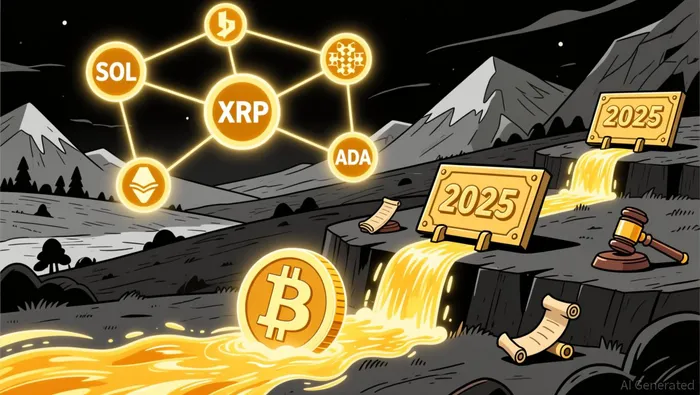
BlackRock's Dominance and Bitcoin ETF Outflows
Despite the regulatory optimism for altcoins, Bitcoin ETFs have experienced a paradoxical dynamic: massive inflows into BlackRock's iShares Bitcoin Trust ETF, coupled with net outflows from other Bitcoin funds. According to data from K33 Research, BlackRock's fund attracted $28.1 billion in inflows in 2025, effectively offsetting $1.27 billion in outflows from competing Bitcoin ETFs. Without this behemoth, the sector would have faced a net outflow, underscoring BlackRock's outsized influence on price momentum.
This concentration of capital raises concerns for altcoin ETFs. Analysts warn that without BlackRock's participation, altcoin products may struggle to replicate Bitcoin's success. For instance, a Solana staking ETF is projected to attract $6 billion in its first year, while XRPXRP-- ETFs could see $4–8 billion in inflows-figures that pale in comparison to Bitcoin's dominance but still represent a significant shift in capital allocation.
The Altcoin ETF Paradox: Potential vs. Dependency
While altcoin ETFs are gaining traction, their success hinges on institutional backing. JPMorgan estimates that a Solana ETF could draw $3–6 billion and an XRP ETF $4–8 billion, based on historical adoption rates from Bitcoin and EthereumETH-- ETFs. However, these projections assume a scenario where major asset managers like BlackRockBLK-- extend their support beyond Bitcoin-a scenario not guaranteed.
The absence of such support could stifle momentum. Vetle Lunde of K33 Research cautions that altcoin ETFs may underperform without the gravitational pull of industry giants, limiting their ability to drive price appreciation in the underlying assets. This dependency highlights a broader tension: while regulatory clarity is democratizing access to crypto, the ETF ecosystem remains concentrated in the hands of a few.
Market Response and the Road Ahead
Despite these challenges, the market has responded positively to regulatory progress. Ethereum ETFs, for example, saw significant institutional inflows in August 2025, signaling a growing appetite for diversified crypto exposure. Meanwhile, international precedents-such as Canada's successful Solana ETF launch provide a blueprint for U.S. issuers.
However, delays persist. A recent government shutdown pushed final approval decisions for several altcoin ETFs into late 2025 or early 2026. This uncertainty underscores the need for patience, as the full impact of these products may take months to materialize.
Conclusion
The interplay between Bitcoin ETF outflows and altcoin ETF inflows reflects a maturing market where regulatory clarity and institutional innovation are kingmakers. While BlackRock's dominance in Bitcoin ETFs has created a lopsided capital flow, the regulatory tailwinds for altcoins are undeniable. Investors must navigate this duality: betting on the long-term potential of diversified crypto exposure while acknowledging the structural challenges posed by market concentration.
As the SEC continues to refine its framework, one thing is clear: the future of crypto ETFs is no longer just about Bitcoin. It's about building a portfolio that balances stability, innovation, and regulatory alignment.





Comentarios
Aún no hay comentarios