
Bitcoin ETF Outflows: Recalibration or Capitulation? A Deep Dive into Institutional Behavior in 2025
The Case for Recalibration
Data from November 2025 suggests that institutional investors are notNOT-- abandoning crypto entirely but rather repositioning their portfolios. BlackRock's iShares Bitcoin TrustIBIT-- (IBIT) recorded a staggering $523.15 million outflow on November 19, marking its largest-ever single-day net outflow. Over the preceding month, the ETF shed $2.19 billion in assets, driven by a prolonged U.S. government shutdown and uncertainty around Federal Reserve rate decisions. Analysts like Vincent Liu of Kronos Research argue that these movements reflect a "recalibration" rather than a collapse. Institutions are testing entry points, reducing short-term exposure, and awaiting clarity on macroeconomic conditions.
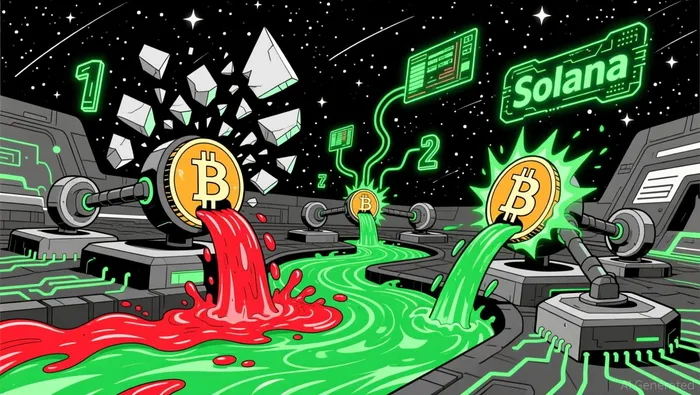
This recalibration is further underscored by the contrasting performance of Solana ETFs. In early November, Solana's BSOL ETF attracted $197 million in inflows, with 16 consecutive days of net positive flows accumulating to $420 million. This shift highlights a growing appetite for high-performance blockchains that offer scalability and innovation-a trend analysts attribute to institutional diversification strategies.
The Case for Capitulation
Yet, the data also paints a more alarming picture. Bitcoin's futures and options markets reveal a fragile structure. Open interest in Bitcoin perpetual futures surged by over 36,000 tokens ($3.3 billion) in the week ending November 19, driven by aggressive long exposure on offshore exchanges like Binance. While this might seem bullish, K33 Research warns that such leveraged bets often precede sharp corrections. Historically, Bitcoin has fallen in six of seven similar market setups over the past five years.
Meanwhile, onshore activity remains anemic. The CME's narrow futures premiums and risk-averse positioning signal a lack of conviction in short-term recovery. ETF outflows have exacerbated this, with products shedding over 40,000 BTC in the past month. For context, this represents a liquidity reset rather than a systemic crisis-no major insolvencies have emerged-but the absence of institutional support raises concerns about Bitcoin's ability to rebound without a catalyst.
Broader Market Shifts: Solana's Rise and Bitcoin's Resilience
The reallocation of capital to Solana underscores a maturing crypto market. Institutional investors are no longer treating Bitcoin as the sole "safe haven" but are instead evaluating ecosystems based on utility, scalability, and growth potential. This shift mirrors traditional markets, where diversification is key to managing risk. However, Bitcoin's price stability post-outflows remains a critical metric. Despite the $543.59 million outflow from Bitcoin ETFs in early November, the asset has held above key support levels-a sign of underlying resilience.
Conclusion: A Market in Transition
The current environment reflects a hybrid of recalibration and cautious optimism. Institutions are not fleeing crypto but are instead navigating a complex macroeconomic landscape. The U.S. government shutdown, inflationary pressures, and Fed policy uncertainty have forced a strategic pause. Yet, the surge in leveraged longs and the absence of systemic insolvency risks suggest that Bitcoin's fundamentals remain intact.
For investors, the key takeaway is to monitor both on-chain metrics and institutional sentiment. While the market's fragility is undeniable, history shows that Bitcoin often rebounds after periods of liquidity resets. The question is not whether the outflows are a crisis but whether they represent a temporary correction or a structural shift in institutional appetite for digital assets.
[2] Bitcoin Daredevils Leave Market on Edge as Levered Bets Misfire [https://www.bloomberg.com/news/articles/2025-11-19/bitcoin-daredevils-leave-market-on-edge-as-levered-bets-misfire]
[3] BlackRock's bitcoin ETF posts record-setting outflows worth $523 million [https://www.theblock.co/post/379437/blackrock-bitcoin-etf-record-outflows?utm_medium=rss&utm_source=rss]







Comentarios
Aún no hay comentarios