
Bitcoin ETF Outflows Mask Hidden Buying Trends and Structural Strength
The narrative of Bitcoin's bearish momentum in late 2025, driven by ETF outflows and declining on-chain activity, obscures a more nuanced reality: hidden demand is surging in off-exchange markets, signaling structural strength in the asset class. While public metrics like ETF redemptions and exchange balances paint a grim picture, the rise of institutional-grade OTC (over-the-counter) trading infrastructure reveals a parallel story of accumulation and resilience. This duality underscores the need to reframe Bitcoin's demand dynamics through the lens of off-exchange flows, which are increasingly decoupling from traditional on-chain indicators.
The ETF Outflow Illusion
Bitcoin ETFs have seen persistent outflows in late 2025, with a single session recording $151 million in net redemptions. Over November alone, U.S. spot BitcoinBTC-- ETFs lost over $3.4 billion as investors de-risked amid macroeconomic uncertainty. These figures have fueled bearish sentiment, reinforcing the narrative of a "risk-off" market. However, such outflows fail to account for the structural shift toward OTC trading, where institutional demand is thriving.
OTC Trading: The New Epicenter of Demand
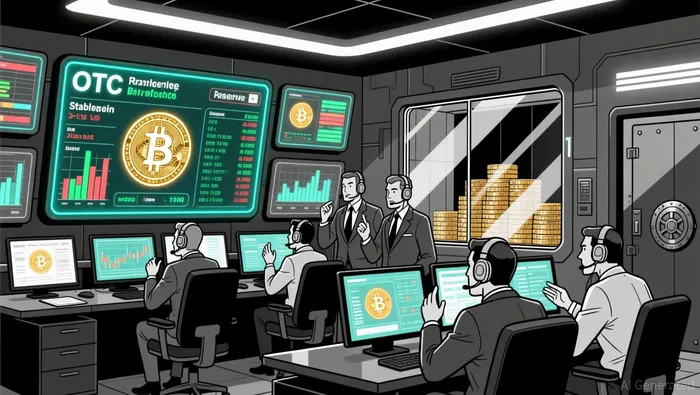
OTC desks have become the primary conduit for large-scale Bitcoin transactions, particularly for institutional investors seeking to avoid market impact. In 2025, OTC trading volumes surged by 106% year-on-year, with stablecoin-based trades driving 147% of the growth. This shift reflects a broader trend: institutions are leveraging OTC markets to execute multi-billion-dollar trades with precision, bypassing the slippage and volatility of public exchanges.
A critical metric here is the 155,000 BTC held in OTC desk balances according to CoinGlass. These reserves represent a "hidden stockpile" of Bitcoin that is not reflected in exchange balances or ETF holdings. As these OTC reserves deplete-driven by sustained institutional demand-the pressure to source liquidity from public markets will intensify, creating a supply shock that could catalyze upward price action. This dynamic mirrors the 2024 OTC boom, where a 177% year-on-year surge in trading volumes coincided with a stabilization in Bitcoin's price despite macroeconomic headwinds according to Gravity Team.
Macroeconomic Resilience and the Post-Crash Rebound
The October 2025 market crash further highlighted the resilience of OTC markets. During periods of extreme volatility, traders flocked to OTC desks to execute large transactions without exacerbating price swings. This behavior underscores the role of OTC infrastructure as a stabilizing force in a fragmented crypto ecosystem. Unlike public exchanges, where panic selling can drive cascading liquidations, OTC desks offer tailored execution, price guarantees, and access to deep liquidity pools-features critical for institutional participants.
November's 21% drop in Bitcoin's on-exchange trading volume is often cited as evidence of waning interest. Yet this decline masks the diversion of capital to OTC channels, where demand remains robust. The devaluation of Bitcoin's price by 17.5% during the month according to TradingView may have spooked retail investors, but institutional buyers continued to accumulate through OTC routes, insulated from the noise of public markets.
Divergent Asset Flows: Bitcoin vs. Altcoins
The ETF outflow trend is not uniform across the crypto market. While Bitcoin faces redemptions, EthereumETH-- and SolanaSOL-- ETFs have seen inflows, reflecting a selective rotation toward high-growth altcoins according to The Block. This divergence suggests that Bitcoin's role as a "safe haven" within crypto is intact, even as investors seek higher returns elsewhere. The OTC market's focus on Bitcoin-evidenced by its dominance in stablecoin-based trades according to Gravity Team-further reinforces its structural importance.
The Road Ahead: When Will the "Uncorking" Begin?
The depletion of OTC desk balances is a key watchpoint for 2026. As these reserves shrink, the demand for Bitcoin will increasingly spill over into public exchanges, creating a liquidity bottleneck that could drive prices upward according to CoinGlass. This "uncorking" effect is contingent on two factors:
1. Continued institutional participation in OTC markets, which remains strong despite November's downturn.
2. Macroeconomic clarity, as upcoming data releases will determine whether the current accumulation phase transitions into a broader bull market.
Conclusion
Bitcoin's ETF outflows are a surface-level metric that fails to capture the depth of institutional demand now flowing through OTC channels. The rise of OTC 2.0-characterized by electronic trading platforms, stablecoin integration, and institutional-grade liquidity-has created a parallel market where Bitcoin's structural strength is being quietly built. For investors, the lesson is clear: look beyond ETFs and on-chain balances to understand the true pulse of Bitcoin's demand. The next leg of the bull case may not be driven by public sentiment, but by the invisible hand of institutional OTC buying.






Comentarios
Aún no hay comentarios