
Bitcoin ETF Outflows and Market Sentiment: Strategic Entry Points in a Potentially Undervalued Market
The Interplay of ETF Flows and Bitcoin's Price Volatility
Bitcoin's price in October 2025 has been a rollercoaster, driven by the ebb and flow of institutional capital through spot BitcoinBTC-- ETFs. According to a BeInCrypto report, Q3 2025 saw mixed patterns, with late-August and early-September outflows totaling $1.17 billion amid a price drop to $113,000. However, the quarter ended with a Phemex report showing a net inflow of $7.8 billion, underscoring the resilience of institutional demand. This duality—short-term outflows versus long-term inflows—reflects the growing integration of Bitcoin into traditional finance, even as macroeconomic uncertainties persist.
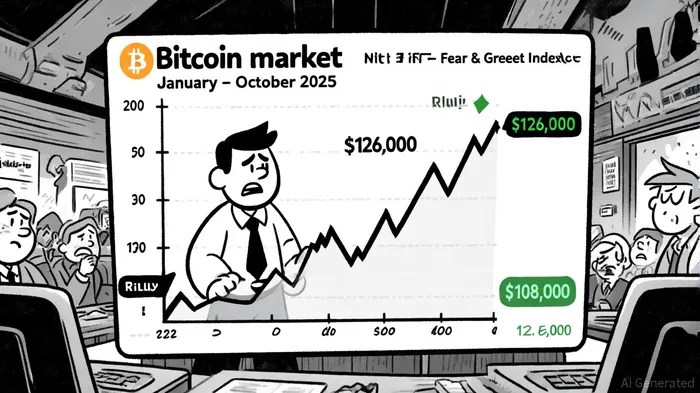
The most striking example of this dynamic emerged in early October, when BlackRock's IBIT recorded $3.5 billion in inflows, directly correlating with Bitcoin's surge to an all-time high of $126,080. Yet, by mid-October, ETF outflows reversed the momentum. On October 16 alone, a Coindesk report showed U.S. spot Bitcoin ETFs lost $530.9 million, pushing Bitcoin's price down to $108,000. These swings highlight the dual role of ETFs as both stabilizers and amplifiers of volatility, depending on macroeconomic triggers such as U.S.-China trade tensions and geopolitical risks, as highlighted by The Coin Republic.
Market Sentiment: Fear as a Contrarian Indicator
Bitcoin's Fear & Greed Index, a composite metric of volatility, social media activity, and search trends, plummeted to 24 in mid-October 2025—a level classified as "extreme fear," according to a Pintu analysis. This reading, the lowest in a year, aligns with historical patterns where oversold conditions have preceded rebounds. For instance, during the August 2025 outflow period, analysts like Anthony Pompliano described the market as "oversold," citing technical indicators and seasonal trends as catalysts for a potential Q4 recovery in a FinancialContent analysis.
The index's contrarian value is further reinforced by on-chain data. While large holders reduced positions in October, retail investors increased accumulation, suggesting a bottoming process, according to Pintu's reporting. This divergence mirrors 2020–2024 recovery cycles, where retail buying during institutional outflows laid the groundwork for subsequent rallies, as noted by Ecoinometrics.
Historical Recovery Patterns: ETF Outflows as Buying Opportunities
Historical case studies from 2020–2025 reveal a recurring theme: ETF outflows often precede price recoveries rather than prolonged downturns. For example, April 2025 saw $812.3 million in ETF outflows, yet Bitcoin's price rebounded to the mid-$80,000s as macroeconomic optimism and institutional rebalancing took hold, according to a Yahoo Finance report. Similarly, the March 2025 stabilization of outflows signaled a potential inflection point, with CoinGape reporting that "the long sequence of outflows appeared to be over."
The October 2025 correction follows a similar playbook. Despite mid-month outflows, Bitcoin's price found support around $110,000, a level historically associated with accumulation ahead of seasonal strength in Q4, per a Bitrue blog. Analysts at Bitwise argue that the current environment mirrors 2020's "Uptober" rally, where fear-driven selling was followed by a 22% average gain for Bitcoin in October (FinancialContent analysis cited above).
Strategic Entry Points: Balancing Risk and Reward
For investors seeking entry points, the October 2025 correction offers a nuanced landscape. The Fear & Greed Index's sub-30 reading historically signals favorable entry windows, as contrarian buyers step in (Pintu analysis cited above). Additionally, the stabilization of ETF outflows in late October—coupled with MicroStrategy's $27.2 million Bitcoin purchase—suggests institutional confidence remains intact, according to a CoinGabbar report.
However, risks persist. Miner activity, including large BTC deposits to exchanges, could indicate near-term sell pressure, as noted in a Cointelegraph piece. Investors should also monitor the U.S. dollar's strength and Federal Reserve policies, which continue to influence capital flows into alternative assets like Bitcoin, per a Coinfomania analysis.
Conclusion: A Market at a Crossroads
Bitcoin's October 2025 volatility, driven by ETF flows and sentiment extremes, underscores both the challenges and opportunities in the digital asset market. While short-term outflows have tested price resilience, historical patterns and contrarian indicators suggest the current correction may be a prelude to a Q4 rebound. For strategic investors, the combination of oversold conditions, institutional inflow momentum, and seasonal trends presents a compelling case for cautious optimism.
As the market navigates this inflection point, the key will be distinguishing between transient corrections and structural shifts. For now, the data leans toward the former—a temporary pullback in a market still defined by long-term institutional adoption.





Comentarios
Aún no hay comentarios