
Bitcoin ETF Outflows and Market Sentiment in 2025: A Shift in Institutional Confidence and Asset Reallocation
In 2025, the institutional investment landscape in digital assets has undergone a dramatic transformation, marked by a sharp reversal in BitcoinBTC-- ETF flows and a strategic reallocation toward EthereumETH-- and altcoins. This shift reflects evolving macroeconomic conditions, regulatory clarity, and a broader diversification of institutional crypto portfolios.
The Q2 2025 Surge and September Reversal
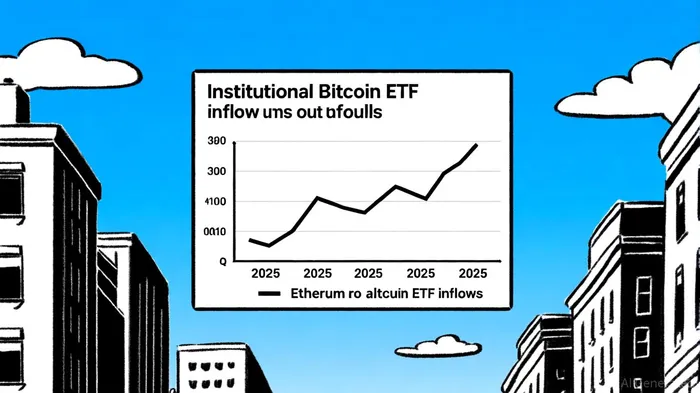
Institutional confidence in Bitcoin reached a historic high in Q2 2025, with a staggering $33.6 billion poured into Bitcoin ETFs, driven largely by investment advisors who held $17.4 billion in these products [1]. This inflow underscored Bitcoin's growing acceptance as a core asset class, particularly as firms sought to hedge against inflation and diversify portfolios amid global economic uncertainty. However, by early September, the tide turned. U.S. Bitcoin ETFs recorded a net outflow of $253.4 million on September 25, 2025, with major players like Fidelity's FBTC experiencing a $114.8 million exodus [2]. This reversal coincided with heightened market volatility and macroeconomic headwinds, including rising interest rates and geopolitical tensions, which prompted institutions to reassess risk exposure [3].
The Rise of Ethereum and Altcoins
While Bitcoin's dominance waned, Ethereum and altcoins emerged as beneficiaries of institutional capital. The approval of Ethereum ETFs in 2025 catalyzed a $12 billion influx into Ethereum-centric funds in Q2 alone [2]. By August, Bitcoin's market dominance had fallen from 65% to 59%, as institutions diversified into altcoins like SolanaSOL-- and ChainlinkLINK--, which offered higher staking yields and utility in tokenized real-world assets [3]. Ethereum's Q3 ETF inflows of $2.96 billion further solidified its role as a strategic asset, driven by its infrastructure for decentralized finance (DeFi) and cross-border payments [3].
Altcoins such as XRPXRP--, AVAXAVAX--, and MAGACOIN FINANCE also gained traction, with 59% of surveyed institutions allocating more than 5% of their assets to digital assets in 2025 [1]. Regulatory frameworks like the U.S. CLARITY Act and the EU's MiCAR normalized crypto holdings, enabling institutions to explore altcoins with practical use cases in sectors like DeFi and cross-border transactions [3].
Drivers of Reallocation: Regulation, Strategy, and Macroeconomics
The reallocation from Bitcoin to a broader crypto portfolio was fueled by three key factors:
1. Regulatory Clarity: The U.S. CLARITY Act and EU MiCAR provided a legal framework for institutional adoption, reducing compliance risks and enabling diversified holdings [3].
2. Strategic Diversification: Institutions sought to balance Bitcoin's volatility with the higher yields and utility of Ethereum and altcoins, particularly in tokenized assets and DeFi protocols [2].
3. Macroeconomic Pressures: Rising interest rates and inflationary pressures in late 2025 led to a risk-off sentiment, prompting investors to prioritize assets with tangible utility over speculative exposure [3].
Outlook and Implications
The 2025 trends suggest a maturing institutional crypto market, where Bitcoin remains a cornerstone but no longer dominates as it once did. While short-term outflows from Bitcoin ETFs reflect caution, the broader ecosystem's growth—driven by Ethereum's infrastructure and altcoin innovation—signals long-term confidence. Investors should monitor regulatory developments and macroeconomic indicators, as these will continue to shape asset allocation strategies in 2026 and beyond.






Comentarios
Aún no hay comentarios