
Bitcoin ETF Outflows and Digital Asset Market Dynamics: Investor Sentiment and Portfolio Reallocation in Q3 2025
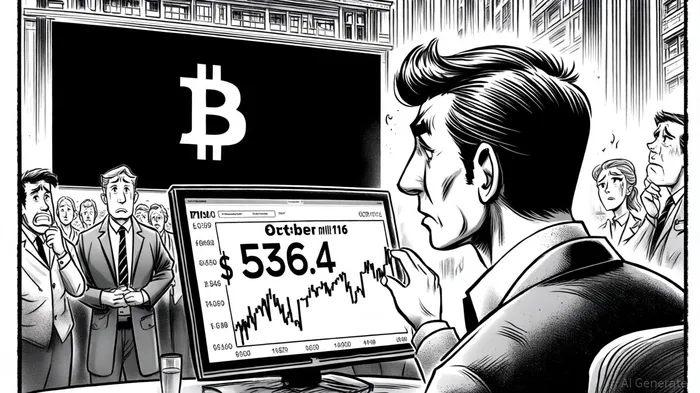
The third quarter of 2025 has been a rollercoaster for BitcoinBTC-- ETFs, marked by sharp outflows juxtaposed with resilient inflows that underscore the complexity of investor sentiment and portfolio reallocation dynamics. While U.S. spot Bitcoin ETFs recorded a record $536.4 million in outflows on October 16-the largest since August 2025-according to a Coindesk report, the quarter concluded with a net inflow of $7.8 billion, adding to the $21.5 billion accumulated in 2025 alone, per a BeInCrypto summary. This duality reflects a market grappling with macroeconomic headwinds while maintaining long-term conviction in digital assets.
Institutional Caution and Retail Resilience
The outflows in late September and October were largely driven by institutional investors, who retreated amid rising interest rates, geopolitical tensions, and leveraged liquidations exceeding $20 billion, according to a Benzinga analysis. BlackRock's iShares Bitcoin Trust (IBIT) and Fidelity's FBTC, two of the largest funds, saw outflows of $269 million and $132 million, respectively, on October 16, as reported by Benzinga. Analysts attribute this to portfolio rebalancing, as institutions shifted capital toward fixed-income products and AI-driven equities. For instance, global AI spending is projected to grow at a 29% CAGR through 2028, drawing inflows into tech ETFs that outperformed Bitcoin's volatility, according to the Deloitte outlook.
Retail investors, however, have shown a different trajectory. Despite the October selloff, retail inflows totaled $1.19 billion in the same period, with the Fear & Greed Index transitioning from bearish to neutral-to-greedy levels, per Benzinga. This divergence highlights a maturing market: while institutions prioritize risk mitigation, retail demand remains speculative yet stable, underpinned by Bitcoin's historical performance during October, a traditionally bullish month for crypto, as noted in a CCN report.
Sector Reallocation and Macroeconomic Drivers
The capital reallocation away from Bitcoin ETFs has been most pronounced in AI and technology sectors. Q3 saw tech ETFs attract inflows as the S&P 500 surged 13%, fueled by AI-driven productivity gains and corporate earnings, a trend noted by Coindesk. Fixed-income assets also gained traction, with nearly $50 billion flowing into active bond ETFs in August alone as investors anticipated the Fed's rate cuts, according to reporting from Coindesk. This shift mirrors broader trends: rising rates made traditional assets more attractive, while Bitcoin's correlation with equities weakened, prompting institutions to view it as a less reliable hedge, in line with insights from the Deloitte outlook.
Yet, Bitcoin's fundamentals remain intact. Despite the October dip to $108,000, the asset held key support levels, and EthereumETH-- ETFs absorbed $236 million in inflows, signaling a temporary, rather than structural, shift in sentiment, per Benzinga. Analyst Eric Balchunas emphasized that ETFs are prone to seasonal volatility, particularly in September, and that the $57 billion in cumulative inflows since inception indicate enduring institutional interest, as summarized by BeInCrypto.
Implications for Digital Asset Markets
The Q3 dynamics suggest a maturing ecosystem where Bitcoin ETFs are no longer seen as speculative fads but as strategic assets subject to macroeconomic cycles. While outflows reflect short-term caution, they also highlight Bitcoin's role in diversified portfolios-a hedge against inflation and a complement to AI-driven growth stories. The challenge lies in balancing institutional risk aversion with retail optimism, particularly as geopolitical tensions and rate uncertainty persist.
For investors, the key takeaway is to view these outflows through a long-term lens. As one analyst noted, "Bitcoin ETFs are still on a historically strong trajectory, even with quarterly fluctuations," a conclusion also reflected in the BeInCrypto summary. The coming months will test whether the market can sustain its bullish momentum or if further reallocation into AI and tech will redefine the digital asset landscape.





Comentarios
Aún no hay comentarios