
The Bitcoin ETF Landscape in 2025: Institutional Adoption and the Battle for Market Share
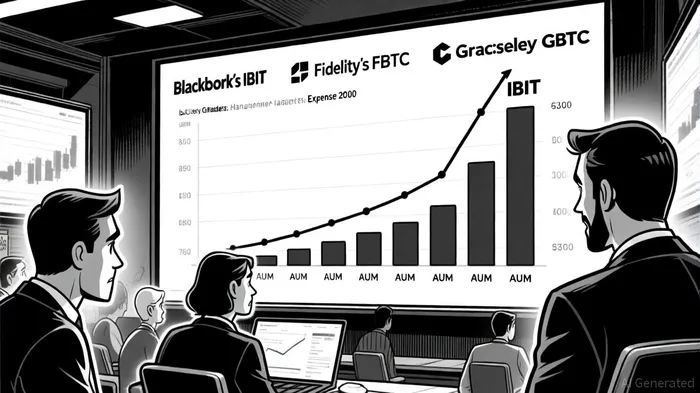
The BitcoinBTC-- ETF market in 2025 has evolved into a high-stakes arena where institutional adoption and fee structures are reshaping investor behavior and market dynamics. BlackRock's iShares Bitcoin ETF (IBIT) currently dominates with 56% of spot Bitcoin ETF assets under management (AUM), totaling $76 billion, according to a TheStreet analysis. However, Fidelity's Wise Origin Bitcoin ETF (FBTC) and Grayscale's Bitcoin ETF (GBTC) are mounting a formidable challenge, leveraging competitive pricing, institutional partnerships, and product innovation to capture market share. This competition is notNOT-- merely a battle for assets-it is a reflection of broader shifts in investor confidence and the integration of Bitcoin into traditional portfolios.
Market Share Dynamics: The Fee War and Institutional Trust
The defining feature of the Bitcoin ETF landscape is the stark contrast in expense ratios. IBIT and FBTC both charge 0.25%, aligning with industry benchmarks for cost efficiency, as previously reported by TheStreet. In contrast, Grayscale's GBTC, with a 1.5% fee, has seen $17.7 billion in outflows since its conversion to an ETF, despite maintaining the highest daily trading volume at $396 million, a disparity that underscores the critical role of fees in institutional decision-making. As one industry analyst notes, "Lower expense ratios directly enhance net returns, making them a non-negotiable factor for long-term investors," according to a Markaicode analysis.
BlackRock's dominance is further bolstered by its institutional credibility. IBIT's $76 billion AUM reflects trust in BlackRock's risk management frameworks and regulatory compliance, which are particularly appealing to large pension funds and endowments, as covered by TheStreet. Fidelity, however, is leveraging its existing institutional relationships-such as its Fidelity Digital Assets custodial services-to offer a self-custody model for FBTC, addressing security concerns that have historically hindered institutional adoption, according to Mutual Fund Nation. Grayscale, meanwhile, is pivoting with its Bitcoin Mini ETF (BTC), which charges a mere 0.15% fee, targeting retail investors while retaining institutional clients through its broader product suite, a trend also noted by TheStreet.
Investor Confidence and Entry Points
Recent inflows into Bitcoin ETFs reveal a surge in institutional confidence. In early October 2025, IBIT alone attracted $466.55 million in a single session, while FBTC and ARK/21Shares' ARKB added $2.25 billion collectively over four days, as reported by Yahoo Finance. These figures signal a strategic shift: institutions are viewing Bitcoin not as a speculative asset but as a core component of diversified portfolios. A report by Russell Investments notes that 75% of institutional investors now anticipate allocating to digital assets within five years, driven by regulatory clarity and the maturation of crypto infrastructure.
Yet, entry points remain contentious. The high fees of GBTC have pushed some investors toward lower-cost alternatives, even as others remain loyal to Grayscale's brand. For example, Fidelity's initial 0% expense ratio for FBTC (until July 2024) attracted early adopters, while its seamless integration with Fidelity's brokerage platforms has made it a default choice for existing clients, according to Mutual Fund Nation. This highlights a key insight: institutional adoption is not solely about fees but also about ecosystem compatibility and trust in custodial models.
Strategic Innovations and the Road Ahead
Fidelity and Grayscale are also innovating beyond pricing. Fidelity's self-custody model for FBTC appeals to institutions wary of third-party risks, while Grayscale's foray into stablecoins and tokenized real-world assets (RWAs)-such as BlackRock's BUIDL tokenized Treasuries-signals a broader strategy to anchor itself in the evolving digital asset ecosystem, as covered by Yahoo Finance. Meanwhile, BlackRock's dominance is being tested by Fidelity's aggressive marketing and Grayscale's product diversification.
For investors, the implications are clear. The competition among these ETFs is driving down costs, enhancing liquidity, and fostering innovation. However, the choice between IBIT, FBTC, and GBTC (or its lower-fee BTC variant) will depend on specific priorities: institutional-grade security, cost efficiency, or exposure to a broader crypto ecosystem. As the market consolidates, entry points for new investors will likely become more accessible, with ETFs serving as on-ramps to Bitcoin's institutionalization.
Conclusion
The Bitcoin ETF race in 2025 is a microcosm of the broader crypto market's transition into mainstream finance. While IBIT's dominance is formidable, Fidelity and Grayscale are redefining the rules of engagement through fee innovation, institutional partnerships, and tailored product offerings. For investors, this competition is a double-edged sword: it lowers barriers to entry but demands a nuanced understanding of risk, cost, and long-term value. As the market evolves, the winners will be those who align their strategies with the twin forces of institutional trust and cost efficiency.





Comentarios
Aún no hay comentarios