
Bitcoin ETF Inflows Signal Institutional Bullishness: A Macro-Driven Accumulation Play
The recent surge in BitcoinBTC-- ETF inflows has ignited a paradigm shift in institutional adoption, with macroeconomic forces and market sentiment converging to create a compelling bullish narrative. Over the past five days, U.S. spot Bitcoin ETFs have absorbed $2.25 billion in inflows, with BlackRock's iShares Bitcoin Trust (IBIT) dominating the flow, contributing $466.55 million on October 3 alone, according to Crypto News. This momentum, coupled with Bitcoin's price breakout above $120,000, underscores a structural shift in how institutional capital is allocating to digital assets.
Macro-Driven Accumulation: ETFs as a Supply-Demand Imbalance Engine
The mechanics of ETF inflows are reshaping Bitcoin's market dynamics. When institutional investors purchase shares in spot Bitcoin ETFs, the providers must acquire BTC from the open market to meet demand. This process effectively removes Bitcoin from circulating supply, tightening liquidity and creating upward price pressure. For instance, the $985.08 million inflow on October 3-largely driven by IBIT-translated to approximately 8,200 BTC being absorbed from exchanges, reducing available selling pressure, as reported by Cryptonomist. Over four consecutive days, cumulative inflows of $2.25 billion have removed over 18% of Bitcoin's circulating supply from active trading, a metric historically correlated with price surges, according to Mitrade.
This supply-side tightening is amplified by broader macroeconomic trends. The Federal Reserve's anticipated rate cuts, coupled with persistent inflation concerns, have positioned Bitcoin as a hedge against monetary devaluation. As noted by 21Shares analysts in an Altsignals piece, "Bitcoin's role as a store of value is being reinforced by ETF-driven institutional adoption, which mirrors gold's traditional safe-haven appeal in a low-interest-rate environment." The U.S. Dollar Index (DXY) has weakened year-to-date, further boosting demand for Bitcoin as an alternative reserve asset, according to FBS.
Institutional Adoption: From Skepticism to Strategic Allocation
The institutional landscape has evolved dramatically in 2025. By late September, U.S. spot Bitcoin ETFs had amassed $110 billion in assets under management (AUM), with BlackRock's IBITIBIT-- commanding 89% of the market share at $87.2 billion, according to BitcoinStrategy. This dominance reflects a broader trend: over 335 entities now hold 3.75 million BTC, including 141 public companies that have added 245,510 BTC to their balance sheets in H1 2025-four times the amount acquired by ETF issuers, as reported by The Financial Analyst.
The regulatory clarity provided by the GENIUS Act and the CLARITY Act has further accelerated adoption. These legislative milestones have reduced custody risks and operational complexities, enabling institutions to treat Bitcoin as a legitimate portfolio diversifier. As JPMorgan's crypto strategist observes, "The ETF structure has normalized Bitcoin's volatility, reducing it from 4.2% pre-ETF to 1.8% post-ETF, making it a viable asset for traditional investors," a development covered by BeInCrypto.
Market Sentiment and the "Uptober" Narrative
The recent inflow data aligns with the "Uptober" phenomenon-a historical pattern of strong Bitcoin performance in October. The $14.8381 billion in 2025 ETF inflows already surpass the same period in 2024, signaling a self-reinforcing cycle of demand, the Mitrade data shows. This trend is supported by sentiment indicators: Bitcoin's on-chain profit ratio has reached 78%, while open interest remains elevated, suggesting sustained accumulation by long-term holders, per Cointelegraph.
Analysts caution that short-term volatility, such as the September outflows triggered by the Fed's hawkish pivot, is a natural part of the ETF lifecycle. However, the broader trajectory remains bullish. Eric Balchunas of Bloomberg notes, "ETFs follow a 'two steps forward, one step back' pattern, but the long-term growth trajectory is undeniable," as summarized by BeInCrypto. With October inflows extending to a fifth consecutive day, the market is pricing in a new phase of institutional-driven accumulation.
Looking Ahead: A $165,000 Target by Year-End?
The confluence of macroeconomic tailwinds and institutional demand has led to aggressive price forecasts. 21Shares and JPMorgan project Bitcoin could test $140,000–$150,000 by year-end, with some models suggesting a $165,000 target if ETF inflows continue at current rates, an Altsignals piece projects. This optimism is further bolstered by the impending Bitcoin halving in April 2026, which is expected to reduce supply by 50%, compounding the scarcity narrative.
However, risks remain. The Fed's potential delay in rate cuts could temporarily dampen risk-on sentiment, and regulatory scrutiny of altcoin ETFs (e.g., SolanaSOL--, XRP) may divert some capital. Yet, Bitcoin's first-mover advantage and institutional trust ensure its dominance in the ETF landscape. As Michael Saylor of MicroStrategy emphasizes, "Bitcoin is no longer a speculative asset-it's a strategic reserve asset, and ETFs are the vehicle accelerating its adoption," as discussed in Dzilla.
Conclusion
The recent Bitcoin ETF inflows represent more than a short-term rally; they signal a structural shift in how institutional capital views digital assets. With macroeconomic drivers (Fed policy, dollar weakness, inflation) and supply-side dynamics (ETF absorption, corporate treasuries) aligning, Bitcoin is entering a new era of accumulation. For investors, the $120,000 breakout is notNOT-- just a price milestone-it's a macroeconomic signal that institutional adoption is now a defining force in the crypto market.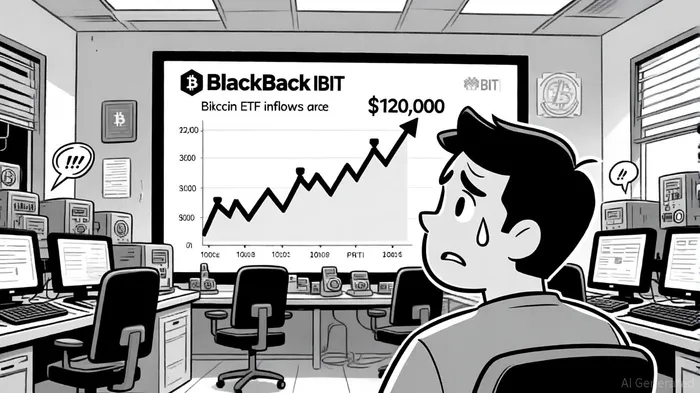





Comentarios
Aún no hay comentarios