
Bitcoin ETF Inflows Signal Institutional Adoption and Long-Term Value Capture
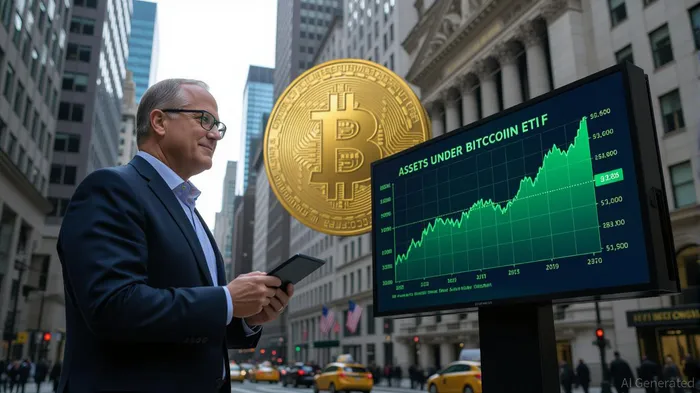
The surge in net inflows into U.S. spot BitcoinBTC-- exchange-traded funds (ETFs) has become a defining narrative of 2025, signaling a seismic shift in institutional adoption and reinforcing Bitcoin's legitimacy as a mainstream asset class. According to a report by BlockNews, BlackRock's iShares Bitcoin Trust (IBIT) has shattered records, amassing over $50 billion in assets within 11 months of its 2024 launch—the fastest ETF growth in history[1]. This unprecedented demand, coupled with the collective $107 billion in assets now held by 12 U.S. spot Bitcoin ETFs, underscores a broader institutional validation of Bitcoin as a strategic investment vehicle[1].
Institutional Legitimacy: From Skepticism to Strategic Allocation
The approval of U.S. spot Bitcoin ETFs in 2024 marked a watershed moment, but the subsequent inflows have transformed speculation into action. BlackRock's dominance in this space is particularly telling: its early listing of options tied to IBITIBIT-- has made it one of the most-traded ETF options, reflecting deep institutional participation[2]. Meanwhile, Fidelity and Grayscale have further diversified the landscape, enabling a range of institutional players—from pension funds to endowments—to allocate capital with the same regulatory clarity and liquidity as traditional assets[1].
This shift is not merely quantitative but qualitative. As stated by Business Standard, the success of these ETFs has driven Bitcoin's price above $100,000 for the first time, with daily inflows of $553 million in late 2025 reinforcing a direct correlation between institutional demand and price performance[2][3]. The $115,000 peak in September 2025, as noted by Google Finance, highlights how ETF-driven capital flows are now a primary driver of Bitcoin's market dynamics[3].
Tokenization and the Next Frontier
BlackRock's recent exploration of tokenized ETFs on public blockchains adds another layer to this narrative. A Coindesk report reveals that the firm is leveraging its experience with the tokenized money market fund BUIDL—now managing $2.2 billion—to pioneer blockchain-based ETFs[3]. Such innovations could revolutionize settlement efficiency and trading hours, potentially amplifying Bitcoin's institutional appeal. Tokenized ETFs, with their 24/7 trading and near-instant settlement, align with the digital-native nature of Bitcoin, addressing lingering frictions in traditional markets[3].
Price Trajectory: A Self-Fulfilling Prophecy?
The interplay between ETF inflows and Bitcoin's price trajectory raises questions about causality. While critics argue that ETFs merely reflect broader market sentiment, the data suggests a more direct relationship. For instance, the $553 million in daily inflows during late 2025 coincided with Bitcoin's ascent to $115,000, indicating that institutional capital is not just flowing into Bitcoin but actively shaping its price[3]. This dynamic creates a flywheel effect: as more institutions allocate capital via ETFs, Bitcoin's liquidity and price stability improve, attracting further inflows.
Conclusion: A New Era of Institutional Adoption
The surge in U.S. spot Bitcoin ETF inflows is more than a market trend—it is a structural shift. By bridging the gap between traditional finance and digital assets, these ETFs have transformed Bitcoin from a speculative asset into a cornerstone of institutional portfolios. As BlackRockBLK-- and others push the boundaries of tokenization, the next phase of adoption may arrive faster than anticipated. For investors, the message is clear: Bitcoin's institutional legitimacy is no longer a question of if, but how quickly the world will adapt to this new reality.





Comentarios
Aún no hay comentarios