
Bitcoin ETF Dominance and Fed Rate Cut Expectations: A Strategic Buy-In Opportunity at the Asia Market Open
The Altcoin Surge and Bitcoin ETF Outflows: A Reallocation of Institutional Capital
Bitcoin's dominance in the crypto asset class has faced a notable challenge in 2025, as institutional capital has increasingly shifted toward altcoin ETFs. SolanaSOL--, XRPXRP--, and even DogecoinDOGE-- have attracted significant inflows, with Solana ETFs alone recording $568 million in cumulative inflows since their launch. This trend reflects a broader reallocation toward assets with perceived growth potential, driven by the rapid approval of altcoin ETFs under the SEC's "universal listing standard" and "8(a) clause" fast-track mechanisms.
Meanwhile, Bitcoin and EthereumETH-- ETFs have experienced net outflows in November 2025, signaling a temporary cooling in institutional demand for the traditional crypto benchmark. This divergence underscores a strategic pivot by institutional investors toward emerging assets, particularly as regulatory frameworks for staking yields and stablecoin operations gain clarity. For example, Bitwise's BSOLBSOL-- ETF, which distributes on-chain staking yields, represents a bold test of regulatory boundaries, while the GENIUS Act's legitimization of stablecoins has further bolstered confidence in digital asset infrastructure.
Fed Rate Cut Expectations and Asia's Risk-On Sentiment
The Federal Reserve's projected rate cuts in December 2025 have amplified risk-on sentiment in Asia, directly influencing Bitcoin ETF inflows. With Fed funds futures indicating an 80% probability of a 25-basis-point cut, Asian markets have responded with a surge in appetite for high-yield assets. On November 25, Bitcoin ETFs saw a reversal of outflows, with $129 million in net inflows led by major players like Fidelity and BlackRockBLK--. This shift coincided with broader market optimism, as Bitcoin rebounded toward $89,000 amid expectations of monetary easing.
The timing of market openings has also played a pivotal role. Asian and European sessions have shown greater stability compared to U.S. trading hours, where volatility and selling pressure have been more pronounced. For instance, Bitcoin climbed above $90,000 during the Asia market open on November 27, driven by improved risk appetite and a weakening U.S. dollar. This dynamic highlights the strategic advantage of entering Bitcoin ETFs during Asia's open, where macroeconomic clarity and reduced volatility create favorable conditions for institutional accumulation.
Regulatory Clarity and the Legitimization of Stablecoins
U.S. regulatory developments, particularly the GENIUS Act, have further solidified the institutional case for crypto assets. By mandating 1:1 reserves for stablecoins in high-quality liquid assets, the act has enhanced transparency and reduced systemic risks. This regulatory maturation has resonated globally, with 55% of traditional hedge funds in 2025 incorporating digital assets into their portfolios, citing improved regulatory clarity as a key driver.
In Asia, where blockchain adoption has been historically robust, the GENIUS Act's influence is compounded by local regulatory advancements such as Hong Kong's Stablecoin Ordinance and the EU's MiCA framework. These measures have encouraged institutional investors to explore tokenized fund structures and blockchain-based solutions, with over 50% of respondents in a 2025 survey expressing interest in such products. The convergence of U.S. and global regulatory frameworks is thus fostering a more institutional-friendly environment, amplifying capital flows into crypto ETFs.
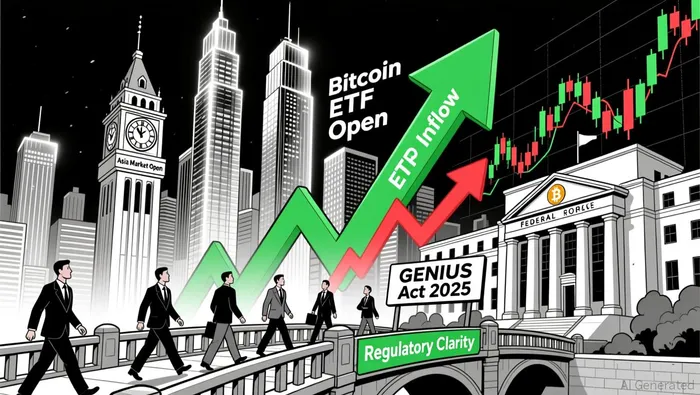
Strategic Buy-In Opportunities: Timing the Asia Market Open
The December 2025 Fed meeting has emerged as a pivotal event for Bitcoin's trajectory, with institutional investors closely monitoring its outcome. While short-term macroeconomic headwinds-such as rising Treasury yields and a stronger dollar-pose challenges, long-term holders have continued to accumulate Bitcoin, preventing it from falling below $85,000. This resilience, coupled with the anticipated rate cut, creates a strategic window for buy-ins during the Asia market open, where liquidity is less strained and sentiment is more constructive.
For example, institutional allocations to BlackRock's IBIT have seen renewed interest from sovereign investors, including Texas and Abu Dhabi's Mubadala Investment Co., which tripled its holdings in November. These moves signal confidence in Bitcoin's long-term value proposition, even as ETF outflows persist in the short term. By aligning entry points with Asia's market open and leveraging the Fed's policy shift, institutional investors can capitalize on discounted valuations and position for a potential rebound.
Conclusion: A Macro-Driven Rebalance
The interplay between Bitcoin ETF dynamics, Fed rate cut expectations, and Asia's risk-on environment has created a compelling case for strategic buy-ins. While institutional capital has temporarily shifted toward altcoins, the underlying fundamentals of Bitcoin-bolstered by regulatory clarity and macroeconomic tailwinds-remain intact. The Asia market open, with its favorable timing and sentiment, offers a unique opportunity to navigate this rebalance, positioning for both short-term volatility and long-term growth.
As the Fed's December decision looms, the key will be to balance macroeconomic signals with institutional positioning, leveraging the Asia market's liquidity and stability to secure entry points. In a landscape defined by rapid regulatory evolution and shifting capital flows, the ability to act decisively during the Asia open could determine the success of a crypto-driven investment strategy in 2025.





Comentarios
Aún no hay comentarios