
Bitcoin as an Energy-Backed Hedge Against Fiat Devaluation: A Comparative Analysis
In an era of unprecedented monetary expansion and geopolitical uncertainty, the search for reliable hedges against fiat devaluation has intensified. BitcoinBTC--, the first decentralized digital currency, has emerged as a controversial yet compelling candidate. This analysis examines Bitcoin's role as an energy-backed monetary asset, comparing it to traditional reserves like gold and oil, and evaluates its effectiveness as a hedge against currency erosion.
The Energy-Backed Value Proposition
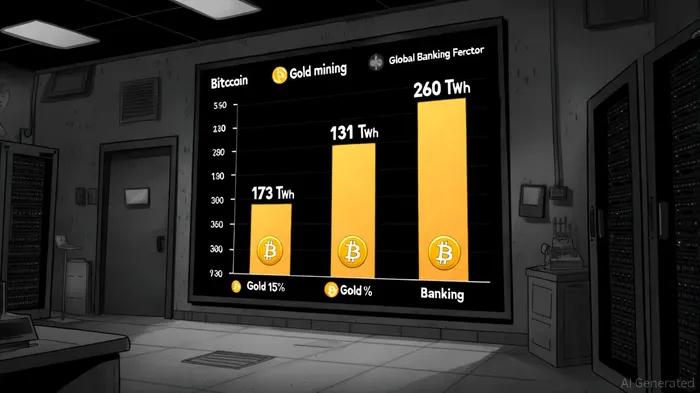
Bitcoin's proof-of-work (PoW) mechanism ties its value directly to energy consumption. The network's annual energy use of ~173 terawatt-hours (TWh) rivals that of developed nations like Norway and exceeds gold mining's 131 TWh consumption, according to a GoMining analysis. Critics argue this energy intensity is wasteful, but proponents highlight its transparency: Bitcoin's security is mathematically verifiable, unlike gold's opaque industrial energy costs, as noted in a Cointelegraph piece. Over 50% of Bitcoin mining now uses renewable energy, outpacing gold mining's 15% renewable adoption, per a Cointelegraph explainer. This shift positions Bitcoin as a modern, energy-efficient alternative to traditional reserves.
Gold, long the benchmark for energy-backed assets, relies on energy-intensive extraction and refining processes. However, its value is not inherently tied to energy consumption but rather to industrial and ornamental demand. Oil, another energy-linked asset, serves more as a commodity than a store of value, with prices driven by geopolitical and supply shocks rather than intrinsic scarcity, as discussed in a Tokenist digest.
Bitcoin vs. Traditional Hedges: Scarcity and Volatility
Bitcoin's fixed supply of 21 million coins creates a deflationary model, contrasting with fiat currencies' infinite supply and gold's limited but unbounded scarcity. This programmable scarcity has made Bitcoin a favored hedge in hyperinflationary economies. In Argentina and Turkey, where annual inflation exceeds 100%, Bitcoin adoption has surged as citizens seek to preserve purchasing power, according to an Anndy analysis. By 2025, over 1,000 institutions, including the U.S. government, hold Bitcoin as part of their treasuries, signaling growing recognition of its strategic value, a Forbes report notes.
However, Bitcoin's volatility complicates its role as a hedge. While it delivered a 15-year internal rate of return (IRR) of 64.5% compared to gold's 7.1%, its price often mirrors equity markets during macroeconomic stress, according to a Cointelegraph review. For instance, Bitcoin fell 60% in 2022 alongside the S&P 500, challenging its safe-haven narrative, as reported in a Netcoins blog post. This duality-as both a risk-on asset and a localized inflation buffer-highlights its context-dependent effectiveness.
Energy Efficiency and Environmental Considerations
Bitcoin's energy efficiency per transaction (770 kWh) far exceeds traditional systems like Visa (1.1 kWh per transaction), according to a MarketGlimpses study, though its absolute consumption remains high. Innovations such as immersion cooling and dynamic mining software are reducing energy waste, while renewable energy adoption mitigates carbon footprints, as described in a Coinbuzznow article. In contrast, gold mining's environmental impact includes toxic byproducts like cyanide, which Bitcoin's digital nature avoids, per a Bitclassic article.
Institutional Adoption and Macroeconomic Dynamics
The U.S. Strategic Bitcoin Reserve, holding ~200,000 BTC, underscores Bitcoin's growing legitimacy as a reserve asset. This contrasts with the $789 billion U.S. gold reserves, yet Bitcoin's market cap ($1.2 trillion as of 2025) suggests it is increasingly viewed as a complementary hedge; the Cointelegraph explainer cited above provides a comparative breakdown. Central banks in El Salvador and Brazil have also explored Bitcoin integration, reflecting its potential to diversify reserves in fiat-weak economies, as highlighted in the Forbes report.
Bitcoin's correlation with global liquidity conditions further strengthens its macroeconomic relevance. During quantitative easing, it often outperforms gold, while tightening cycles see it underperform-a pattern mirroring equities, as noted in the Anndy analysis. This dynamic aligns with its dual role as both a speculative asset and a long-term inflation hedge.
Conclusion: A Nuanced Hedging Tool
Bitcoin's energy-backed model offers a unique blend of scarcity, decentralization, and modern energy efficiency. While its volatility and regulatory uncertainties limit its appeal in developed economies, its role as a hedge against fiat devaluation is undeniable in regions with unstable currencies. As institutional adoption grows and energy efficiency improves, Bitcoin may evolve into a cornerstone of diversified portfolios, complementing traditional assets like gold and oil.
For investors, the key lies in context: Bitcoin excels as a localized inflation buffer but should be viewed as part of a broader hedging strategy rather than a standalone solution. In a fracturing fiat world, energy-backed assets-both old and new-will play critical roles in preserving value.






Comentarios
Aún no hay comentarios