
Bitcoin's Energy-Backed Economic Model: Strategic Advantages for Long-Term Institutional Adoption
In 2025, Bitcoin's energy-backed economic model has emerged as a cornerstone of its appeal to institutional investors. While critics once dismissed BitcoinBTC-- as a resource-intensive pariah, the asset's alignment with sustainability goals, economic efficiency, and strategic treasury management has reshaped its narrative. This analysis explores how Bitcoin's energy consumption and institutional adoption are now inextricably linked, offering a compelling case for long-term investment.
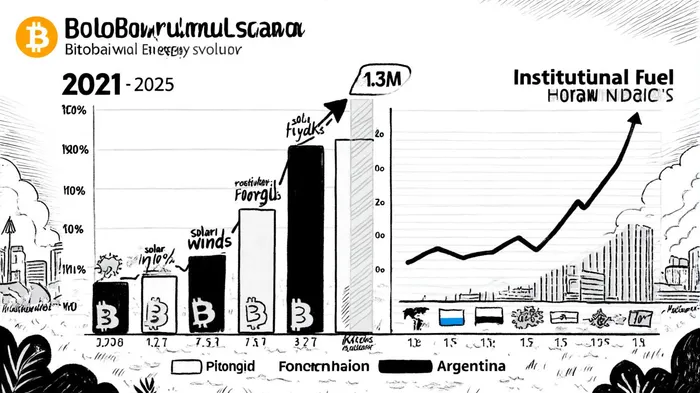
Energy Consumption: From Liability to Strategic Asset
Bitcoin's energy consumption remains a double-edged sword. As of early 2025, the network consumes 175–240 terawatt-hours (TWh) annually, equivalent to the electricity use of Poland or Argentina, according to the Bitcoin Mining Council. A single transaction requires up to 1,200 kWh, dwarfing traditional payment methods, according to an Analytics Insight analysis. However, the industry's pivot toward renewable energy has transformed this liability into a strategic advantage.
According to the Bitcoin Mining Council (BMC), the network's sustainable energy mix reached 63.1% in April 2025, up from 37% in 2021, per a Bitcoin Protocol report. A Cambridge study corroborates this, reporting 52.4% of mining now uses clean energy-including 23.4% hydro, 15.4% wind, and 3.2% solar. This shift is driven by economic incentives: renewable energy sources like hydroelectricity in Canada and solar in Texas offer cheaper, stable power for miners, reducing operational costs by 20–40% compared to fossil fuel-dependent regions, according to a SolarTech analysis.
Institutional ESG (Environmental, Social, and Governance) criteria now scrutinize not just carbon footprints but the verifiability of renewable energy use and jurisdictional oversight. For example, Bitcoin mining in Quebec, which consumed 5.1 TWh in 2025, leverages abundant hydro resources, aligning with net-zero pledges, according to CoinLaw data. This transparency has made Bitcoin a "green" alternative to gold, which requires 60 times more energy per dollar of value mined, as detailed in a Business Initiative analysis.
Economic Efficiency: Hash Rate Migration and Cost Arbitrage
Bitcoin's energy model is inherently competitive. The cost to mine one Bitcoin varies drastically by location, from $1,324 in Iran to $321,112 in Ireland, with electricity accounting for 60–80% of operational costs, according to a ScienceDirect study. This cost arbitrage has driven a geographic redistribution of hash power. The U.S. now leads with 37.8% of the network's hash rate, followed by Kazakhstan and Canada, per a Bitcoin Magazine analysis.
The migration of mining operations to low-cost, renewable regions has also improved efficiency. Modern ASIC miners achieve 46 joules per terahash (J/TH) in 2025-a 12% improvement over 2024, according to WorldMetrics data. Innovations like immersion cooling and dynamic mining software further optimize energy use, adjusting workloads based on real-time energy pricing, per the Bitcoin Mining Council. These advancements reduce Bitcoin's carbon intensity by 15–20% annually, making it increasingly attractive to ESG-focused portfolios (CoinLaw reports).
Institutional Adoption: A Structural Shift
Bitcoin's energy-backed model is now a catalyst for institutional adoption. By October 2025, global exchange-traded products (ETPs) and publicly traded companies have acquired 944,330 BTC, surpassing 2024's total, according to a Blockchain Magazine report. Businesses now hold 6.2% of the total Bitcoin supply (1.30M BTC), with 76% of corporate purchases made by treasury companies since January 2024 (a Business Initiative analysis).
The U.S. Strategic Bitcoin Reserve, established in March 2025, and the approval of spot Bitcoin ETFs by BlackRock and Fidelity have further legitimized the asset. These ETFs have amassed $50 billion in assets under management (AUM), directly boosting Bitcoin's price and institutional credibility (a Bitcoin Magazine analysis). MicroStrategy Inc., holding 640,031 BTC, exemplifies how corporations treat Bitcoin as a strategic hedge against inflation and a store of value, as reported by Analytics Insight.
Challenges and Counterarguments
Critics argue Bitcoin's environmental impact remains significant, with 98.10 million tonnes of CO2 and 2,772 gigaliters of water consumed annually (WorldMetrics data). Fossil fuels still account for 47.6% of the energy mix, and price volatility persists (Analytics Insight). However, the industry is addressing these issues through:
- Flared gas utilization: Converting wasted natural gas into energy for mining.
- Blockchain-based reporting: Enhancing transparency in energy sourcing.
- Geographic diversification: Reducing geopolitical risk by decentralizing hash power, per the Bitcoin Mining Council.
Conclusion: A Sustainable Store of Value
Bitcoin's energy-backed economic model is no longer a barrier to institutional adoption-it is a strategic enabler. By aligning with ESG criteria, leveraging cost arbitrage, and demonstrating economic efficiency, Bitcoin has positioned itself as a long-term asset for treasuries and portfolios. As the network's energy mix continues to green and institutional frameworks mature, Bitcoin's role as a hedge against inflation and a digital reserve asset will only strengthen.
For investors, the message is clear: Bitcoin's energy consumption is not a flaw but a feature-one that institutional capital is increasingly betting on.






Comentarios
Aún no hay comentarios