
Bitcoin's Emerging Role as a Digital Reserve Asset: Challenging Traditional Monetary Systems and Capturing Institutional Interest
The Institutional Inflection Point
Bitcoin's institutional adoption has reached a critical inflection point. The approval of spot BitcoinBTC-- ETFs in 2024 unlocked a flood of capital, with the iShares Bitcoin Trust ETF alone attracting $25 billion in inflows this year, according to a Deutsche Bank report. This liquidity has transformed Bitcoin from a volatile speculative asset into a tradable, institutional-grade instrument.
Yet, the narrative is shifting. A Coinfomania report shows EthereumETH-- outpaced it in Q3 2025 institutional inflows, capturing $9.6 billion compared to Bitcoin's $8.7 billion. The reason? Ethereum's staking rewards and yield-generating opportunities make it an income-producing asset, a feature Bitcoin lacks. This competition is healthy-it forces Bitcoin to prove its utility beyond scarcity.
Deutsche Bank analysts draw a compelling comparison: Bitcoin and gold now exhibit similar volatility patterns, positioning both as diversification tools for central bank reserves. Gold, which accounts for 24% of global official reserves-the highest share since the 1990s-has seen a structural resurgence in demand. If Bitcoin can replicate gold's role while offering digital advantages like programmability and divisibility, its case as a reserve asset grows stronger.
Corporate Treasuries Go Digital
Bitcoin's adoption by corporations has surged in 2025. According to Coinpaper coverage of Bitwise's Q3 Corporate Bitcoin Adoption report, 172 publicly traded companies now hold Bitcoin, collectively owning over one million BTCBTC-- valued at $117 billion. This represents a 38% increase in just three months, reflecting a maturing perspective on Bitcoin as a long-term asset.
Leading the charge is Michael Saylor's company, which maintains the largest corporate Bitcoin treasury at 640,250 BTC. Others, like MARA Holdings (53,250 BTC) and Tesla (11,509 BTC), are following suit, viewing Bitcoin as a hedge against currency volatility and macroeconomic uncertainty, as noted in an FXStreet analysis. Even the U.S. government is expanding its Bitcoin reserves, with potential holdings rising to 325,000 BTC ($36 billion) after seizing assets from a crypto fraud case.
However, recent trends show a cooling in corporate Bitcoin inflows. Weekly purchases dropped from $2.57 billion in early August to $33.74 million by October 2025. Analysts attribute this to profit-taking, tighter budgets, and a strategic pivot toward yield-bearing alternatives like Ethereum and SolanaSOL--. The rise of Bitcoin ETFs has also siphoned capital that might have otherwise flowed into corporate treasuries.
Central Banks and the Digital Reserve Frontier
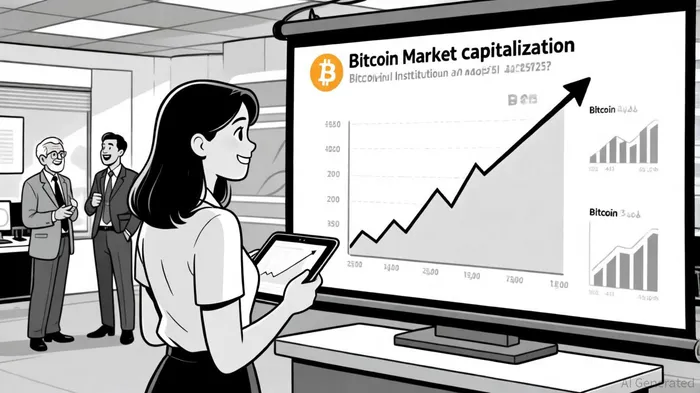
While corporations and institutions are embracing Bitcoin, central banks remain cautious. Deutsche BankDB-- predicts Bitcoin could join central bank balance sheets by 2030, but hurdles remain. Its market cap of $2.45 trillion pales next to the $30 trillion U.S. Treasury market, and its lack of sovereign backing raises questions about reliability.
Still, the broader ecosystem is evolving. Smaller nations like El Salvador have already added Bitcoin to their reserves, and corporate adoption is normalizing its role as a digital asset. JPMorgan's recent expansion into crypto trading and Binance's $400 million relief program for traders further institutionalize the space, as reported in a Coinotag article. These developments suggest Bitcoin is inching closer to fulfilling reserve asset criteria: scarcity, durability, divisibility, and, increasingly, legitimacy.
Challenges and the Road Ahead
Bitcoin's path to becoming a reserve asset is not without obstacles. Its volatility, though declining, still lags behind gold and Treasuries. Regulatory uncertainty and environmental concerns also persist. Yet, the asset's resilience and growing infrastructure-ETFs, custodians, and corporate treasuries-suggest it is not a passing fad.
The key question is whether Bitcoin can scale to meet the demands of a global reserve asset. If it can, it would challenge the dominance of fiat currencies and gold, reshaping monetary systems in the process. For now, the data tells a story of cautious optimism: Bitcoin is no longer a speculative bet but a serious contender in the race to redefine value in the 21st century.





Comentarios
Aún no hay comentarios