
Bitcoin as an Emerging Reserve Asset: The Institutional Turn and Cyclical Imperatives
The financial markets of 2025 have witnessed a seismic shift in perception: BitcoinBTC--, once dismissed as a volatile speculative instrument, is now being scrutinized as a potential reserve asset. The recent Q2 market crash and recovery, alongside regulatory milestones and institutional inflows, reveal a paradigm shift. This article argues that Bitcoin's evolution is not merely cyclical but structural—a reconfiguration of global financial architecture that investors ignore at their peril.
Institutional Adoption: The New Legitimacy
The $14.4 billion in net inflows into spot Bitcoin ETFs by July 3, 2025, marks a watershed. These vehicles, which democratize access to Bitcoin for pension funds, endowments, and retail investors, signal a stamp of approval from traditional finance. Compare this to Ethereum's underperformance—down 27% YTD—Bitcoin's dominance (BTC's share of crypto market cap remains above 40%) reflects its status as the gold standard of digital assets.
Regulatory clarity is compounding this trend. The U.S. Securities and Exchange Commission's gradual greenlighting of ETFs, coupled with the Federal Reserve's acknowledgment of Bitcoin's macroeconomic role, has eroded the “Wild West” stigma. Even central banks, though hesitant to directly adopt Bitcoin, are studying its protocol as a template for CBDCs. This duality—private innovation with public infrastructure aspirations—positions Bitcoin as a hybrid asset class, straddling fiat and digital sovereignty.
Cyclical Dynamics: Volatility as a Misleading Metric
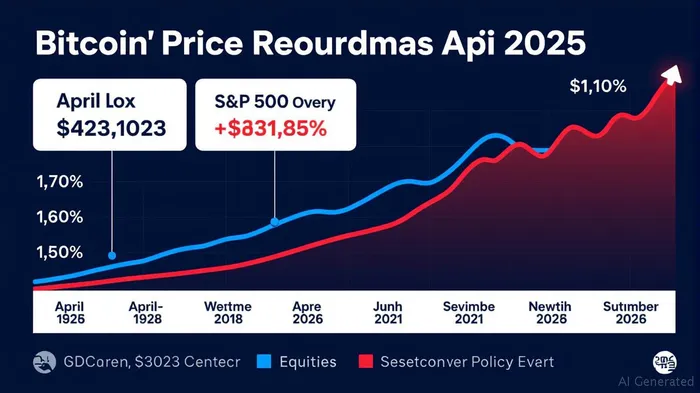
Critics cite Bitcoin's 19% plunge during Q2's crash as evidence of its risk-on status. Yet its rebound—43% from April's low—mirrored equities' recovery, with both markets bottoming on April 8. This correlation, however, obscures deeper cyclical forces.
First, Bitcoin's price action during the crash was shaped by halving economics. The 2024 halving reduced Bitcoin's issuance by 50%, tightening supply at a time when institutional demand (via ETFs) was surging. Second, its role as an inflation hedge became evident: as the Fed held rates steady at 4.25%–4.50%, Bitcoin's scarcity contrasted with fiat's dilution.
Consider this: the Nasdaq's 20% Q2 rally was fueled by AI speculation, while Bitcoin's gains were underpinned by structural adoption. The two assets are no longer just correlated—they're complementary components of a new risk framework.
Decoupling: A Shift in Paradigm, Not Price
To argue Bitcoin is “decoupling” from risk assets during crashes is to misunderstand the transformation. The real decoupling is ideological: Bitcoin is no longer a bet on volatility but a bet on reserve asset fundamentals.
- Scarcity: With only 3.1 million Bitcoin left to mine, its supply is mathematically capped, unlike fiat currencies.
- Institutional Demand: ETFs now act as a liquidity bridge, smoothing Bitcoin's volatility into a tradable asset.
- Geopolitical Hedge: During U.S.-Iran tensions, Bitcoin's price stabilized faster than oil or gold, demonstrating its utility as a borderless store of value.
Central banks, while not yet Bitcoin holders, are quietly preparing for a multipolar reserve system. The IMF's 2025 report on digital currencies implicitly acknowledges Bitcoin's role in bypassing traditional financial gatekeepers—a threat to legacy systems but an opportunity for forward-thinking investors.
Investment Imperatives: Allocate Now or Risk Obsolescence
The Q2 recovery was no anomaly. Three trends converge to suggest a sustained bull run:
1. Halving Tailwinds: Reduced supply will amplify upward price pressure as ETF inflows continue.
2. Regulatory Momentum: More ETF approvals are inevitable, broadening Bitcoin's investor base.
3. Cyclical Resilience: Bitcoin's rebound in tandem with equities proves it's not a zero-sum asset—it thrives in both bull and bear markets.
Conclusion
Bitcoin's journey from curiosity to contender is complete. To dismiss it as a “risk asset” is to miss the forest for the trees. Its integration into institutional portfolios, scarcity-driven economics, and geopolitical relevance mark it as a foundational reserve asset. The question is no longer if but how much—allocate now, or risk being left behind as the global financial system recalibrates.
The halving cycle, ETF inflows, and macroeconomic tailwinds are aligned. This is not a bet on speculation but on the inevitability of Bitcoin's role in the next era of money.






Comentarios
Aún no hay comentarios