
Bitcoin's Downside Risks: Structural Support Levels and the Psychology of Collapse
Structural Support Levels: The First Line of Defense
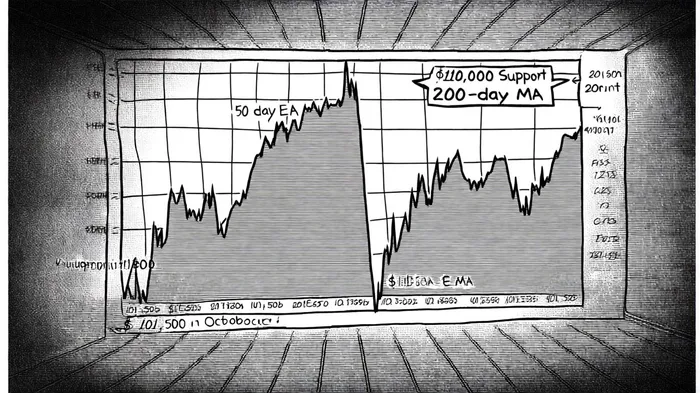
Bitcoin's price action is increasingly dictated by structural support levels, which act as both psychological and algorithmic barriers. The $110,000 level, for instance, has emerged as a pivotal threshold. A breakdown below this level could trigger a cascade of algorithmic selling, as seen in October 2025, when BitcoinBTC-- plummeted to $101,500, wiping out $7 billion in leveraged positions as liquidity evaporated, according to a Cryptoslate report. Technical analysts warn that the 50-day EMA at $114,000 and the 200-day MA at $104,000 form a bearish structure, with momentum indicators like MACD turning negative across multiple timeframes, per a CryptoNews analysis.
Historically, Bitcoin has shown mixed resilience at key levels. The $30,000 support in 2023 eventually gave way, while the $60,000 level in 2025 held firm, leading to a breakout, according to a BTCC analysis. However, the $100,000 mark-a psychological and technical linchpin-has become a battleground. Traders monitor this level closely, as a breach could reignite bearish momentum toward $90,000 or even $80,000, a Forbes analysis noted.
Cascading Market Psychology: Fear, Leverage, and Liquidity
Bitcoin's price corrections are not merely technical events-they are psychological phenomena. Investor sentiment, as measured by transaction-level data from exchanges like Coinbase, correlates strongly with price movements, particularly during volatility, according to a PMC study. When support levels break, panic selling intensifies, creating a feedback loop that accelerates declines.
The October 2025 crash exemplifies this dynamic. As Bitcoin fell below $110,000, leveraged long positions-many of which were overextended-triggered margin calls, exacerbating liquidity crunches, as Cryptoslate reported. This self-reinforcing cycle is compounded by macroeconomic factors, such as a stronger U.S. dollar and record options expiries, which add downward pressure, as BTCC noted.
Historical bear markets provide further context. The 2018 crash, driven by exchange breaches and regulatory uncertainty, saw Bitcoin lose 83% of its value. In 2022, the collapse of algorithmic stablecoins like TerraUSD and macroeconomic pressures pushed Bitcoin below $20,000, as Forbes reported. While investor behavior has matured over time, the 2022 crash revealed vulnerabilities in leveraged positions and algorithmic trading systems that remain relevant today, according to a PMC analysis.
Downside Scenarios and Institutional Implications
If Bitcoin fails to defend $110,000, the next critical support lies at $105,000. A break here could test the $100,000 psychological barrier, potentially triggering a deeper correction toward $90,000, according to CryptoNews. Institutional adoption, while a long-term bullish factor, introduces new risks. For example, the approval of Bitcoin ETFs in 2024 initially bolstered sentiment, but institutional redemptions during the October 2025 selloff exacerbated liquidity strains, as CryptoNews reported.
Macroeconomic conditions further complicate the outlook. The Federal Reserve's inflation-targeting policies and the DXY index (measuring the U.S. dollar's strength) remain critical variables. A dovish pivot could alleviate downward pressure, but rising interest rates or geopolitical tensions might reignite bearish momentum, as Forbes noted.
Conclusion: Navigating the Abyss
Bitcoin's downside risks are deeply intertwined with structural support levels and the psychology of market participants. While historical patterns suggest resilience at key thresholds, the interplay of leverage, liquidity, and macroeconomic forces creates a volatile environment. Investors must remain vigilant, monitoring not only price action but also sentiment indicators and institutional flows. As the market evolves, the line between technical analysis and behavioral economics grows thinner-underscoring the need for a holistic approach to risk management.






Comentarios
Aún no hay comentarios