
Why Bitcoin's Dominance is Waning and Emerging Chains Like Solana and Ethereum Are Surpassing It for ROI
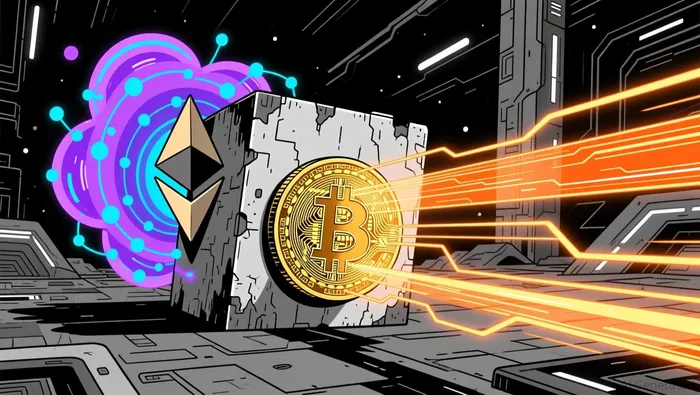
Bitcoin has long been the poster child of the cryptocurrency market, its dominance underpinned by first-mover advantage, macroeconomic appeal, and institutional adoption. However, as of 2025, the narrative is shifting. Emerging blockchains like EthereumETH-- and SolanaSOL-- are not only challenging Bitcoin's market leadership but also outperforming it in return on investment (ROI) metrics, driven by superior infrastructure, institutional innovation, and utility-driven adoption. This analysis explores how evolving blockchain ecosystems and institutional strategies are reshaping the crypto landscape, rendering Bitcoin's once-unassailable position increasingly vulnerable.
The Infrastructure Revolution: Ethereum and Solana's Structural Edge
Ethereum's 2025 upgrades-Pectra and Fusaka-have transformed it into a scalable, data-efficient platform capable of processing 5,600 transactions per second via rollups. These advancements have bolstered its role as the backbone of decentralized finance (DeFi), with total value locked reaching $99 billion and stablecoin settlements exceeding $18.8 trillion. By contrast, Bitcoin's infrastructure remains largely static, its utility confined to store-of-value speculation and macro-hedging.
Solana, meanwhile, has leveraged its high-throughput architecture to capture retail and institutional attention. With an average of 1,054 TPS and 98 million monthly active users in 2025, Solana has positioned itself as a high-speed settlement layer for real-time applications. Its partnerships with Visa, Stripe, and PayPal to enable stablecoin transactions underscore its appeal as a bridge between decentralized infrastructure and traditional finance. While Bitcoin's network usage remains limited to value transfer, Ethereum and Solana are building ecosystems that cater to diverse financial and technological needs.
Institutional Adoption: From Speculation to Strategic Infrastructure
Institutional adoption has accelerated the shift in ROI dynamics. Ethereum's RWA (real-world asset) tokenization initiatives, including corporate cash reserves and tokenized treasuries, have positioned it as a backend infrastructure for traditional finance. By 2025, Ethereum-based ETFs attracted $35 billion in holdings, while Solana ETFs captured $92 million in inflows, driven by staking yields and network growth.
Bitcoin's institutional narrative, however, has become increasingly macro-dependent. While spot BTC ETFs dominated inflows in 2025, accumulating $57.7 billion, the asset's price volatility- retracing from $126,000 to $90,000 by year-end-highlighted its sensitivity to interest rates and global trade dynamics. In contrast, Ethereum's price resilience, despite a mid-2025 dip to $1,500, was supported by its utility-driven demand and protocol upgrades. Solana's institutional ascent was even more pronounced: by 2025, it dethroned BitcoinBTC-- and Ethereum as a preferred asset for high-frequency trading and yield generation.
ROI: Beyond Price Volatility
While Bitcoin, Ethereum, and Solana showed comparable average daily returns from 2021–2024, their risk profiles diverged sharply. Solana's 30% price decline in 2025 contrasted with Ethereum's 6% drop, yet Solana's network usage and staking yields (8% annual returns for SOL stakers) offset its volatility. Ethereum's structural advantages-mature developer activity, TVL, and stablecoin supply- further insulated it from market shocks.
Institutional ROI strategies now prioritize yield and utility over pure price speculation. Ethereum ETFs offered higher total return potential than Bitcoin ETFs, including staking yields and network adoption growth. Solana's staking economy and AI integration also provided real yield, making it a compelling alternative to Bitcoin's inflation-hedging narrative.
Conclusion: The Future of ROI in a Diversified Crypto Market
Bitcoin's dominance is not collapsing-it remains the largest cryptocurrency by market cap. However, its role as the sole macro-safe asset is being contested by Ethereum and Solana, which offer superior infrastructure, institutional utility, and diversified ROI streams. As the SEC's approval of commodity-based ETFs expands access to digital assets, investors are increasingly allocating capital to blockchains that combine innovation with real-world applications.
For investors, the lesson is clear: ROI in 2025 is no longer a zero-sum game between Bitcoin and altcoins. It is a multi-layered strategy that rewards those who recognize the value of infrastructure, institutional adoption, and utility-driven growth. The future belongs to blockchains that can scale, adapt, and integrate with traditional finance-Ethereum and Solana are leading the charge.






Comentarios
Aún no hay comentarios