
Bitcoin Dominance Downturn and the Imminent Shift to a Selective Altcoin Season
Capital Rotation Dynamics: From Bitcoin to Altcoin Innovation
Bitcoin's dominance typically peaks between September and December, followed by a sharp decline as altcoins outperform, according to the Cryptofront News report. In early November 2025, Bitcoin's price volatility-fluctuating between $107,000 and $110,000-sparked $414 million in liquidations, signaling heightened leverage and risk-taking, as reported by Wral Markets. Despite this turbulence, Bitcoin's market capitalization remains robust at $2.202 trillion, a 54.39% annual increase, according to the Wral Markets report. However, the broader crypto ecosystem is witnessing a clear shift in capital.
Institutional investors are reallocating funds from Bitcoin to altcoin sectors, particularly those with real-world utility. For instance, JPMorgan increased its Bitcoin ETF stake by 64%, yet the broader market saw $2.2 billion in weekly inflows into Bitcoin, while EthereumETH-- attracted $429 million, driven by upgrades like the Pectra Upgrade, as noted in Coinotag. Meanwhile, the launch of the first staked crypto ETF in the U.S.-the REX-Osprey SOL + Staking ETF-has introduced new avenues for yield generation in altcoin markets, as reported by AltcoinBuzz.
Strategic Altcoin Positioning: DeFi, Layer-2, and NFTs in the Spotlight
The sectors poised to benefit from this capital rotation are those with strong technical foundations and real-world applications. DeFi protocols like AaveAAVE-- are transitioning from speculative phases to sustainable revenue models, as described in a TokenMetrics guide. Aave's cross-chain capabilities, variable interest rates, and Safety Module governance have positioned it as a cornerstone of decentralized finance, according to the TokenMetrics guide. In bullish market conditions, Aave's token price could surge to $2,175.85 if the total crypto market cap reaches $31 trillion, according to the TokenMetrics guide.
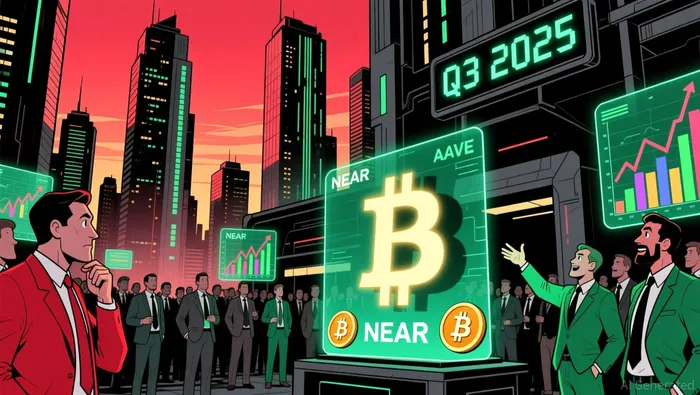
Layer-2 solutions are also gaining traction. NEAR ProtocolNEAR--, for example, closed Q3 2025 with a $3.3 billion market cap and a 24.3% quarter-over-quarter increase, as reported by NullTX. Its cross-chain infrastructure, NEAR Intents, processed $234.9 million in transaction volume, underscoring its role in multi-chain DeFi and AI-driven applications, according to the NullTX report. Similarly, Coinbase's expansion into decentralized exchanges (DEXs) with projects like AsterASTER-- ($ASTER) and Monad ($MON) highlights institutional recognition of scalable infrastructure, as noted in NullTX.
NFTs, though facing a post-2023 slump, are rebounding in niche markets. Institutional interest in NFTs tied to cross-border travel and logistics-exemplified by Aeromexico's $300 million IPO-suggests a growing alignment between traditional finance and crypto use cases, as reported by Blockchain News.
Geopolitical and Institutional Catalysts
The shift is further amplified by geopolitical developments. Kazakhstan's $1 billion crypto reserve fund, set to invest in ETFs and crypto-related companies, reflects a global trend toward regulated digital finance, according to a NullTX report. Pakistan's exploration of a rupee-backed stablecoin and CBDC also underscores the institutionalization of crypto markets, as noted in LiveBitcoinNews. These initiatives signal a broader acceptance of crypto as a tool for financial inclusion and macroeconomic stability.
Strategic Implications for Investors
For investors, the key lies in selective positioning. Altcoins with robust governance, cross-chain interoperability, and institutional backing-such as NEAR, Aave, and Aster-are likely to outperform in this environment. However, risks remain, including regulatory scrutiny and smart contract vulnerabilities, according to the TokenMetrics guide. Diversification across DeFi, Layer-2, and NFT sectors, coupled with a focus on projects with tangible use cases, will be critical.
As Bitcoin dominance continues its projected decline toward 45% by 2025, according to the Cryptofront News report, the crypto market is entering a phase where innovation and utility-not just speculation-will drive value creation. The question is no longer if an altseason is coming, but how investors will navigate it.






Comentarios
Aún no hay comentarios