
Bitcoin Dominance Deterioration: A Precursor to a More Selective Altcoin Season
The cryptocurrency market is undergoing a subtle but significant transformation. Bitcoin's dominance, once a near-absolute force, has shown signs of erosion in late 2025, with its market share dropping to 60% from a peak of 67% in October 2024. This shift, while modest, signals the emergence of a more selective altcoin season-one driven not by speculative frenzy but by institutional-grade innovation, regulatory clarity, and macroeconomic demand for yield.
Institutional Influence on BitcoinBTC-- Dominance
The rise of institutional Bitcoin ETFs has been a double-edged sword. On one hand, they've cemented Bitcoin's status as a mainstream asset. BlackRock's spot Bitcoin ETF (IBIT), for instance, has amassed nearly $100 billion in assets under management by late 2025, fueled by corporate treasuries and strategic allocations. This influx of capital has reduced Bitcoin's volatility-its average daily volatility dropped from 4.2% pre-ETF to 1.8% post-ETF- and introduced sophisticated strategies like basis trading, where arbitrageurs exploit price discrepancies between spot and futures markets.
However, this institutionalization has also redirected capital flows. While Bitcoin remains the dominant asset (accounting for 70-80% of crypto treasuries), institutions are now allocating smaller portions to altcoins with clear utility and scalability. For example, LayerLAYER-- 2 solutions like Base have surpassed Arbitrum in total value locked, capturing 43.5% of the market with $4.94 billion in TVL. This diversification reflects a shift from "buy and hold" speculation to strategic positioning in ecosystems that address real-world use cases.
The altcoin market in 2025 is no longer a monolith. Instead, it's a mosaic of projects solving specific pain points in finance, technology, and infrastructure. Institutional investors are gravitating toward altcoins that offer yield generation, cross-chain interoperability, and real-world asset tokenization.
Ethereum (ETH) remains the bedrock of decentralized finance (DeFi) and tokenized assets. Its recent upgrades, including EIP-7002 and Dencun, have enhanced staking efficiency and scalability, making it a cornerstone for institutional portfolios. Platforms like Lido and Rocket PoolRPL-- now enable liquid staking derivatives, allowing institutions to earn yield while maintaining liquidity.
Solana (SOL) is another standout, leveraging its sub-second block times and low fees to attract high-frequency DeFi applications and institutional settlements. Partnerships with Visa and Shopify, coupled with its inclusion in U.S. strategic reserve proposals, underscore its growing institutional appeal.
Chainlink (LINK) is emerging as the data backbone of institutional DeFi, providing secure, verified data feeds for smart contracts. Its Cross-Chain Interoperability Protocol (CCIP) has enabled asset managers to test tokenized asset pricing and cross-chain solutions, bridging traditional finance and crypto.
Layer 2 solutions like Polygon (MATIC) and Arbitrum (ARB) are also gaining traction. 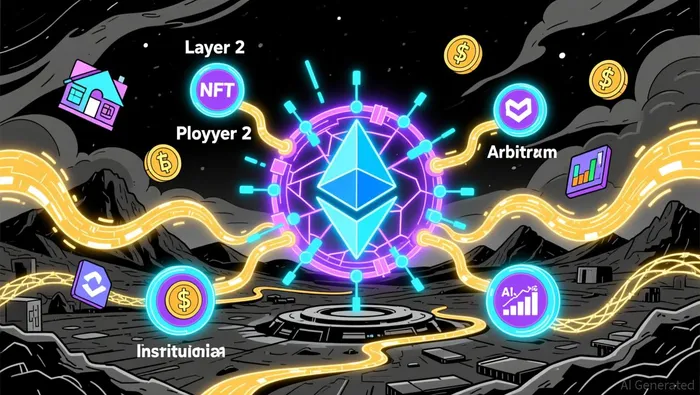 Polygon's EVM compatibility and low fees have attracted enterprise adoption, with brands like Starbucks and Nike building NFT and rewards programs on the chain. ArbitrumARB--, meanwhile, offers Ethereum-based scalability without compromising security, making it a preferred choice for institutional DeFi applications.
In the AI and DeFi space, Linea and DoubleZero are addressing scalability bottlenecks. Linea's zkEVM solution enables secure, scalable EthereumETH-- execution, while DoubleZero's modular data layer optimizes Layer 2 performance according to traders. Virtuals Protocol (VIRTUAL) is pioneering decentralized compute and data marketplaces for AI agents, enabling on-chain coordination of AI model inference.
Tokenized real-world assets (RWAs) are also attracting institutional interest. Ondo Finance (ONDO) tokenizes U.S. Treasuries and short-term credit instruments, offering on-chain yield generation with regulatory compliance. Pendle (PENDLE) creates on-chain fixed-income markets by enabling the trading of tokenized future yields according to market analysis.
Market Dynamics and Future Outlook
The deterioration of Bitcoin's dominance is not a collapse but a recalibration. Institutions are no longer viewing altcoins as speculative side bets but as complementary assets in a diversified portfolio. This shift is driven by three factors:
1. Regulatory Clarity: The SEC's approval of multiple Bitcoin ETFs in 2024 has created a framework for institutional participation in altcoins, provided they meet compliance standards.
2. Technological Maturity: Projects like Ethereum, SolanaSOL--, and Layer 2 solutions have demonstrated scalability and utility, reducing the risk premium associated with altcoins.
3. Yield Demand: In a macroeconomic environment where traditional assets offer low returns, altcoins with yield-generating capabilities (e.g., staking, tokenized RWAs) are filling the gap.
However, challenges remain. The altcoin market is still concentrated among a few major players, with most capital flowing to projects like Ethereum and Solana rather than smaller, niche tokens. Additionally, the rise of institutional capital has introduced centralization risks, as large players dominate liquidity and governance.
Conclusion
Bitcoin's dominance is not waning-it's evolving. The market is transitioning from a "Bitcoin-only" narrative to a more nuanced landscape where institutional-grade altcoins play a strategic role. For investors, this means moving beyond simple Bitcoin exposure and evaluating altcoins based on their utility, technological innovation, and alignment with macroeconomic trends. The selective altcoin season of 2025 is not a return to the speculative mania of 2021 but a maturation of the crypto ecosystem, driven by institutional demand for yield, scalability, and real-world application.





Comentarios
Aún no hay comentarios