
Bitcoin's Diverging Holder Behavior and Market Bottom Signals
Retail Investors: From Frenzy to Desperation
Retail participation in Bitcoin has plummeted. According to on-chain data from CryptoQuant, daily BTC inflows to exchanges like Binance have dropped from 552 BTC in early 2023 to just 92 BTC today, as Coinotag reported. This collapse reflects a broader trend: smaller investors are increasingly opting for regulated vehicles like spot Bitcoin ETFs, which offer compliance and ease of access over the volatility of direct trading, as Coinotag reported.
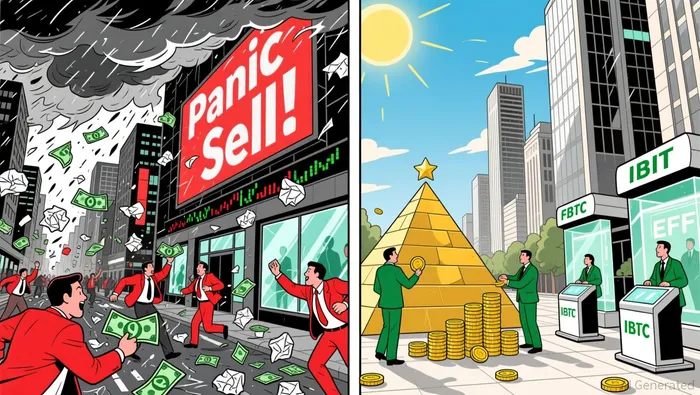
The retail segment's share of low-dollar trades ($0–$1,000) has shrunk to 0.48% of total volume in October 2025, down from 1.8% in 2021, as Coinotag reported. Daily retail turnover now sits at $108 million, a fraction of previous peaks. Bitwise's Matt Hougan notes that this "max desperation" among retail investors-marked by leverage blowouts and widespread pessimism-often precedes market bottoms, as CNBC reported. When retail selling pressure exhausts, capitulation gives way to stabilization.
Institutional Confidence: A New Bullish Foundation
While retail sentiment crumbles, institutions are building a fortress. JPMorgan Chase, for instance, increased its holdings in BlackRock's iShares Bitcoin Trust (IBIT) by 64% in Q3 2025, acquiring 5.2 million shares valued at $312 million, as Bitcoinist reported. This move aligns with broader institutional optimism: Bitcoin's realized capitalization surged $8 billion in the past week, driven by long-term holders accumulating at lower prices, as Coinotag reported.
Institutional dominance is also evident in on-chain metrics. The Short-Term Holder (STH) Realized Price, a critical support level, currently sits at $113,000, as Bitcoin Magazine reported. Holding above this level suggests recent buyers are breakeven or profitable, fostering confidence. Meanwhile, MVRV (Market Value to Realized Value) ratios indicate Bitcoin is in an accumulation-friendly range, historically correlated with buy zones, as Bitcoin Magazine reported. Analysts project price targets of $160,000–$200,000 if Bitcoin sustains above $113,000, as Bitcoin Magazine reported.
The Market Bottom Signal: Divergence as a Catalyst
The interplay between retail and institutional behavior creates a unique predictive framework. When retail investors hit "rock bottom"-as seen in October 2025's $20 billion liquidation event-capitulation often triggers a rebound, as Coinotag reported. Institutions, meanwhile, use these moments to accumulate, leveraging ETFs and corporate treasuries to smooth volatility, as Coinotag reported.
Galaxy Digital's revised 2025 price target of $120,000 reflects short-term bearish pressures but underscores a long-term bullish thesis: Bitcoin's structural bull market remains intact, as Coinotag reported. The key lies in divergence. Retail pessimism and institutional optimism rarely align, and their misalignment often marks turning points.
Conclusion: A Maturing Market, A New Cycle
Bitcoin's 2025 landscape is defined by maturity. Retail speculation has waned, replaced by institutional prudence. This shift reduces volatility but also creates clearer signals for market bottoms. As retail investors retreat and institutions step in, the next bull phase may hinge on whether the STH realized price holds and if MVRV metrics confirm accumulation, as Bitcoin Magazine reported.
For now, the data suggests a market at a crossroads. Retailers are exhausted; institutions are resolute. In this divergence lies the blueprint for Bitcoin's next move.





Comentarios
Aún no hay comentarios